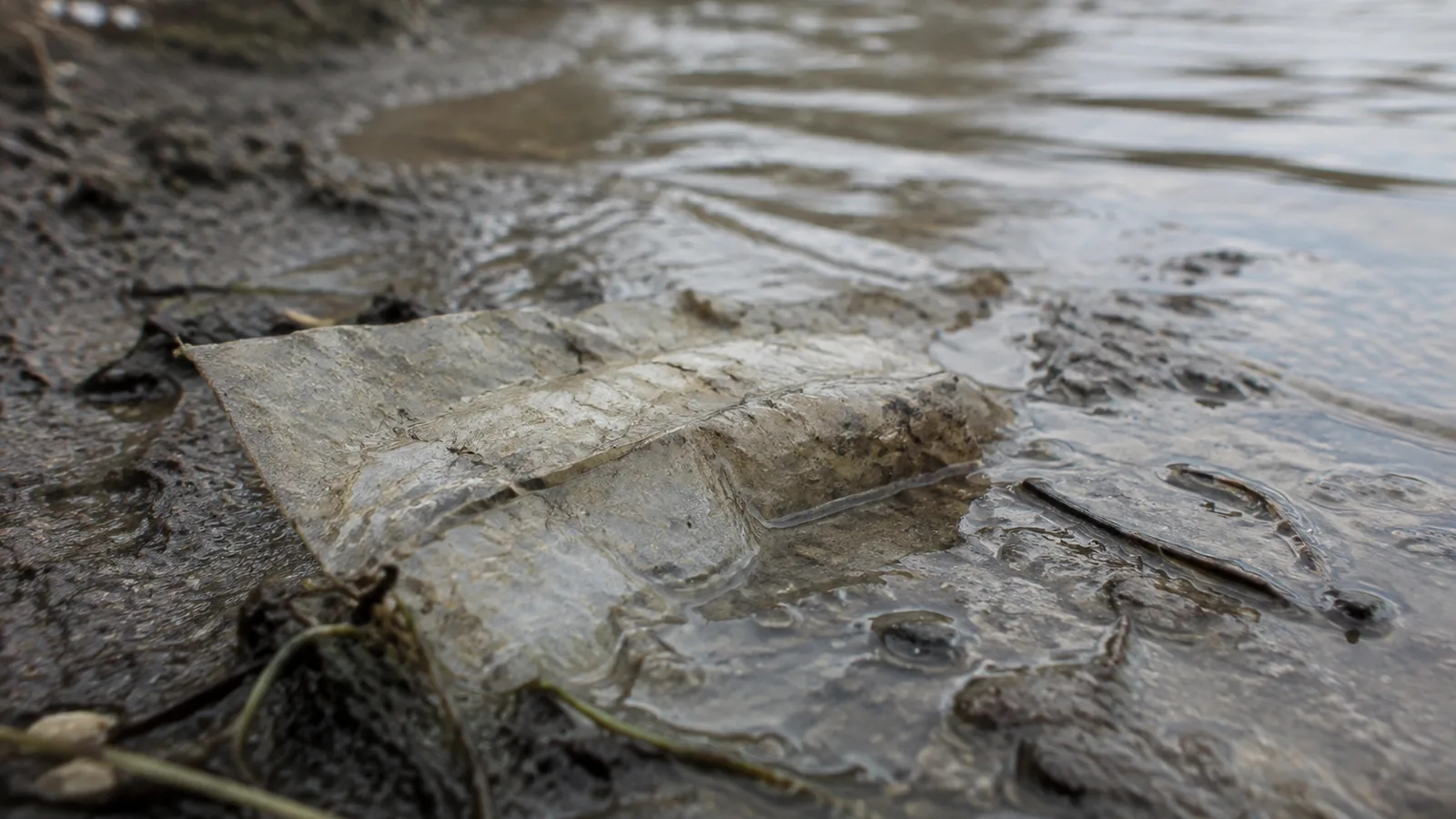
I used to file microplastics under “gross but basically inert.” A fleck of degraded packaging in a glass of water: unpleasant, chemically annoying, but dead. Litter. Then one detail rearranged the whole picture for me. The plastic is not dead at all. It is a raft, and the passengers are learning to survive our antibiotics.
The raft changes crews. The dangerous cargo stays aboard.
That is the finding at the center of a study out of Nanjing University, covered this week by News-Medical. The framing is blunt. Microplastics do not just carry their own chemical baggage, they carry biology. And biology is how a resistance gene in one bug becomes a resistance gene in a completely different bug.
Here is what happens on the surface of a plastic fragment after it has sat in water for a while, and I had no idea any of this was going on until I started reading. A film forms. Bacteria settle, secrete a sticky matrix of extracellular polymers, and build a crowded, gooey neighborhood scientists call the plastisphere. It is not a metaphor. It is a physical community with its own real estate, denser and better defended than the open water around it. And the density is the whole problem.
Because bacteria trade genes. Not just down to their offspring but sideways, to their neighbors, in a process called horizontal gene transfer. The most powerful route is conjugation: one cell extends a bridge to another and hands over a plasmid, a little loop of DNA that can carry the instructions for beating a whole class of drugs. Conjugation needs contact. It needs cells jammed against each other long enough to build that bridge, and a biofilm on a plastic raft is exactly that, a room where everyone is pressed together for weeks.
But why would a plastic surface enrich for resistance specifically, and not just for life in general? The crowding is only half of it. The plastisphere is where selective pressures stack. Plastics adsorb antibiotics, heavy metals, and biocides onto their surfaces, and those compounds sit there at low, sub-lethal doses, the exact concentrations that reward a resistant cell without killing off the rest of the population. The review describes that same setup: strong microbial selection at relatively low contaminant concentrations, worst on aged, oxygen-scarred fragments held in the water for a long stretch. Our aging trash is not getting safer as it breaks down. It is turning into a better classroom.
The genes turning up are not obscure. Plastisphere surveys keep pulling the clinically serious classes: sulfonamide genes like sul1 and sul2, tetracycline genes like tetA and tetC, blaTEM for beta-lactams, qnrS for fluoroquinolones, alongside multidrug efflux pumps. And the bacteria colonizing these rafts include names any ICU nurse would recognize. Pseudomonas aeruginosa, Acinetobacter, Aeromonas, the same opportunists behind hard-to-treat human infections.
The most concrete piece of the story is a freshwater study that watched this unfold in real time. As microplastics drifted from Taihu Lake into the Liangxi River in China, researchers tracked the biofilm and the surrounding water for five weeks and logged 102 new antibiotic-resistance gene subtypes appearing in that window. The genes did not stay put on the plastic. They diffused outward into the water, and resistance to carbapenems, the drugs we hold in reserve for our worst infections, along with tetracycline resistance, proliferated across different water bodies. The timing is what got me. The microbial community on the plastic kept shifting, but the resistance genes held steadier than the bugs carrying them. The raft changes crews. The dangerous cargo stays aboard.
There is a second delivery system running alongside the first, the one the review calls the “Trojan horse” effect. Microplastics adsorb pollutants and heavy metals, and when an animal eats a particle, its gut breaks it down and releases that chemical load right where it can be absorbed. Size decides the route. Larger microplastics dump their cargo through the digestive tract, while nanoplastics smaller than about 1 micrometer can slip across biological membranes outright and reach internal organs. The two effects feed each other. The chemicals pressure the microbes, and the microbial film reworks the plastic surface so it grabs even more chemicals next time.
Not every study finds plastic supercharging resistance everywhere, and I would rather say that plainly than oversell it. One ACS analysis of mainstream anaerobic treatment found microplastics may not proliferate resistance under those specific conditions, and a separate ACS review spelled out how genuinely hard it is to isolate plastic’s own contribution from everything else fouling our water. That is a limit on how sure we can be about the size of the effect, not a debunking of the mechanism. The biology is well documented. What varies is how much it matters in any given place. And the places where it matters most, warm and contaminated water thick with biofilm and exposure past about 30 days, describe an enormous share of the world’s rivers.
What bothers me is the mismatch between how loudly we treat antibiotic resistance as a crisis and how casually we treat its delivery infrastructure. We warn about a post-antibiotic era in one breath and wave through an ever-growing fleet of plastic gene-swapping rafts in the next. A lot of the sharpest work here is coming from Chinese research groups mapping their own waterways, so the mechanism is not fringe. It is documented, and it points straight at a pollution problem the plastics industry has spent decades reframing as a tidy recycling story. It was never tidy. Every fragment left in the water is a mobile, weeks-long incubator, and recycling slogans do not change the biofilm math.
I am not going to pretend a home filter fixes a planetary problem. But this did change something for me. I have stopped treating the plastic in my water as something I can wait out, as if it will quietly crumble into harmlessness. It does the opposite. It crumbles into a better habitat. So I filter what I drink now, and more than that, I would stop waiting for a guideline to catch up and start treating microplastics as an antimicrobial-resistance problem, which means pulling plastic out of the water at the source instead of skimming the aesthetics off the top, because that is the frame the receipts actually support.
Sources
- New Contaminants – Microplastics as vectors for the spread of antibiotic resistance genes across aquatic ecosystems: microbial adaptation and temporal dynamics (2026)
- News-Medical – Microplastics transport toxins and antibiotic resistance across ecosystems (Sept 2026)
- The plastisphere paradox: microplastics as engines of antimicrobial resistance and hosts for polymer degraders (PMC)
- Water Emerging Contaminants & Nanoplastics – How microplastics and nanoplastics shape antibiotic resistance? (2022 review)
- ACS ES&T Engineering – Microplastics May Not Proliferate Antibiotic Resistance during Mainstream Anaerobic Treatment
- Environmental Science & Technology – Determining the Contribution of Micro/Nanoplastics to Antimicrobial Resistance: Challenges and Perspectives