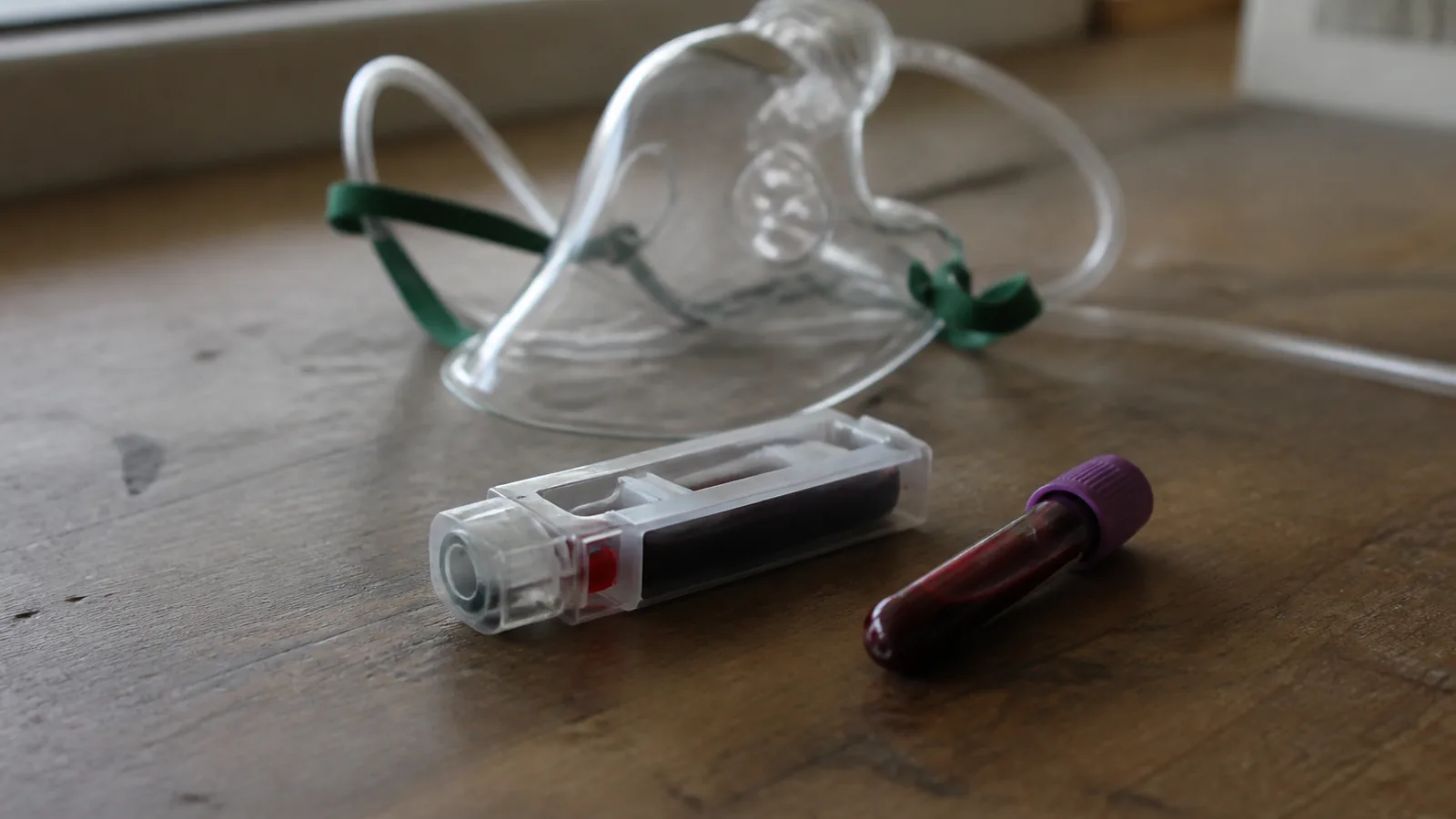
I did not expect to spend a morning defending carbon dioxide. But there it was, in a dozen places at once: the rising atmosphere is now changing what is in your blood, and within fifty years the air could turn “potentially toxic.” My stomach did the thing stomachs do. Then the biologist in me asked the question I ask before I let a scary headline move in and unpack its bags. How much CO2, exactly, and next to what?
Two Australian researchers, Alexander Larcombe and Phil Bierwirth, went into the U.S. NHANES survey, the enormous rolling health dataset epidemiologists have mined for decades, and pulled blood chemistry on roughly 7,000 people every two years from 1999 to 2020. Across that stretch, average serum bicarbonate rose from 23.8 to 25.3 milliequivalents per liter, about 7 percent. Calcium slipped around 2 percent. Phosphorus fell about 7. And over the same years, atmospheric CO2 went from about 369 to 420 parts per million. Four lines on a graph, all moving. The authors say the sky is driving the blood.
The physiology they reach for is genuine, and I want to give it its due, because it is the kind of thing that makes me love this job. Your blood guards its pH obsessively. When acid loads up, your kidneys hold onto bicarbonate to buffer it, and when that is not enough your skeleton gets drafted: bone surrenders calcium and phosphorus to neutralize the acid sitting in your tissues. So a pattern where bicarbonate climbs while calcium and phosphorus drop reads, on its face, like an acid-buffering story. It hangs together. That is exactly why it ran everywhere.
And then I did the arithmetic, and the whole thing came apart in my hands.
Wait, why would 51 more parts per million of outdoor air move your blood at all, when your own body is a CO2 furnace? Convert that atmospheric rise into the pressure that actually pushes gas across your lungs and the CO2 in the air you breathe went from about 0.28 to 0.32 millimeters of mercury. A nudge of four hundredths of a millimeter. Meanwhile the CO2 dissolved in your arterial blood sits near 40 millimeters of mercury, set almost entirely by your metabolism and your breathing rate, not by the sky. Every cell in you dumps CO2 into your bloodstream every second you are alive. Against that furnace, the atmospheric increase is a rounding error, roughly a thousand times too small to register through the pathway the study proposes. Hold your breath for ten seconds and your blood CO2 climbs by a couple of millimeters of mercury, dozens of times the entire shift two centuries of emissions added to the air you inhale.
So what did move those NHANES numbers? Almost anything could, and that is the problem. Serum bicarbonate is one of the twitchiest values on a standard metabolic panel. It shifts with kidney function, with diet, with vomiting, with diuretics, with chronic lung disease, even with how long the blood tube sat before the lab ran it. Now think about what else changed across America between 1999 and 2020: the population aged, chronic kidney disease grew more common, obesity and metabolic syndrome went from widespread to nearly the norm, and tens of millions more people started taking blood-pressure and reflux drugs that quietly reshape electrolytes. Any one of those could nudge a population’s bicarbonate as much as the sky supposedly did. Two decades of two lines rising together is the oldest trap in the book. I could line up bicarbonate against the gallons of oat milk America drank over the same years and get a graph just as pretty. It would mean exactly as much.
To their credit, the authors say plainly that this does not prove causation and that the changes so far are small and still inside the body’s tolerable range. Bierwirth’s own line is that our bodies “are not adapting.” But that honesty lives deep in the coverage, while the paper’s title and the press around it carry “potentially toxic atmosphere within 50 years.” That projection is a straight line drawn off a short, confounded trend and run half a century into the future until it hits a scary threshold. Institutions love that move. A modest, messy correlation goes in one end and a public-health siren comes out the other, and somewhere in the middle “we cannot rule out” gets quietly deleted. I have watched this same machine run on saturated fat, on salt, on a dozen other things. The extrapolation is not evidence. It is a mood.
None of which makes the underlying question worthless. If chronically higher CO2 really does force bone to buffer acid, that is worth chasing, and there is a clean way to ask it: track the same people over time instead of comparing strangers a decade apart, adjust for kidney function and diet, and compare people who spend their days in stuffy, high-CO2 rooms against people who do not. Because here is the irony the alarm sails right past. The air in a closed office runs well past 1,000 parts per million, and a shut bedroom by morning can climb toward 2,000, several times the outdoor rise everyone is panicking about. If ambient CO2 were rewriting our blood, the exposure that matters is the one you are sitting in right now, not the one on the emissions chart.
So no, I am not going to lie awake over 51 parts per million of sky. What I will do is crack the window in my office when the afternoon goes thick and my head starts to fog, because that stale indoor air is a fixable exposure I can actually feel. The atmosphere outside is a serious problem for a hundred reasons. My bicarbonate is not one of them.
Sources
- Larcombe & Bierwirth, “Carbon dioxide overload, detected in human blood, suggests a potentially toxic atmosphere within 50 years,” Air Quality, Atmosphere & Health (2026)
- ScienceAlert – the NHANES bicarbonate, calcium, and phosphorus figures
- Phys.org – researcher quotes and the acid-base mechanism
- Satish et al., “Is CO2 an Indoor Pollutant? Direct Effects of Low-to-Moderate CO2 Concentrations on Human Decision-Making Performance,” Environmental Health Perspectives – realistic indoor CO2 levels