For years I’ve been the person at the dinner party telling anyone within earshot that losing the fat around their middle is one of the kindest things they can do for their metabolism. I still believe it. But I now have to attach a footnote, because that fat doesn’t leave quietly: in people who lose a lot of weight fast, a residue of DDT, a pesticide the United States banned in 1972, more than doubles in the blood.
Rapid weight loss leads to an increase of circulating POPs
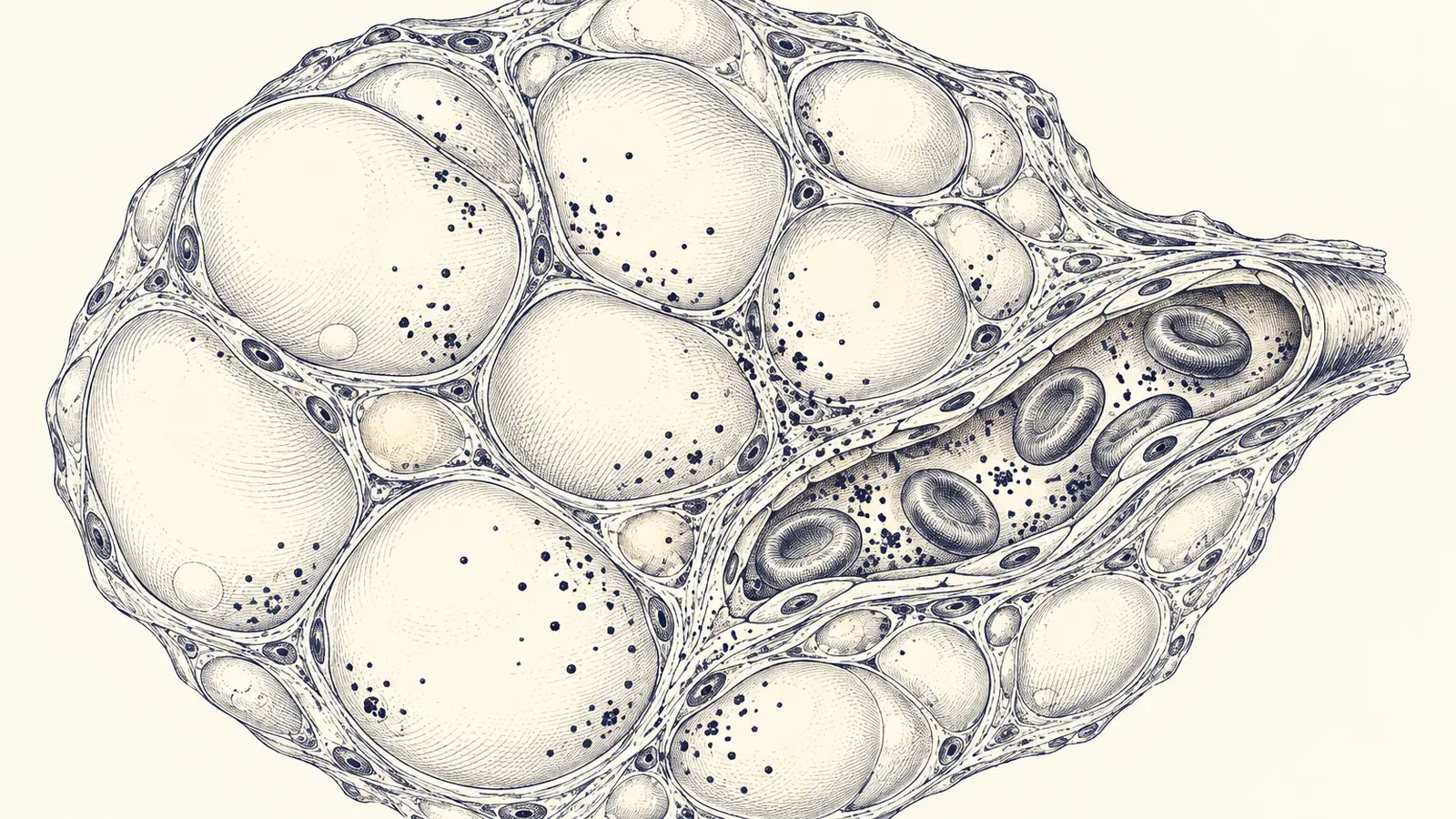
The fat you’re trying to burn isn’t just a fuel tank. It’s an archive, and for half a century it has been filing away some of the most stubborn industrial chemicals ever made. Start breaking it down and it hands them back.
The U.S. banned DDT in 1972 and stopped making PCBs in 1979, before a lot of us were born. DDT was the mosquito killer; PCBs were insulating fluids in electrical equipment, including transformers and fluorescent-light ballasts. Both were built to resist breaking down, which is why the people who study them call them persistent organic pollutants, or POPs, and “persistent” undersells it. DDE, the compound DDT degrades into, lingers in the human body for years. The French E3N cohort is still finding these old chemicals in women’s blood decades later, and has been testing them against markers of oxidative stress and, in a paper out in September, systemic inflammation.
Which brought me to the question I couldn’t shake. Why would doing something healthy push a banned pesticide’s residue up in your blood? That runs backwards from every detox story I’ve ever been sold.
The answer is almost embarrassingly physical. These compounds are lipophilic, fat-loving: they won’t dissolve in water, so they never sit comfortably in blood, but they slip right into lipid. So your body tucks them into the one tissue that is basically a lipid warehouse, and there they settle and go quiet. Then you diet, or get sick, or have surgery, and your fat cells start breaking down their stored triglycerides and shipping fatty acids into the bloodstream for fuel. Whatever was dissolved in that fat rides out with it. Wait, so the fat was shielding the blood the whole time? Pretty much. The warehouse opens, and the inventory goes back on the road.
You can watch this happen at two volumes. The quiet one comes from the Study of Women’s Health Across the Nation, an American cohort of midlife women with a median age of 49 at the start, whose blood was drawn at four visits stretching from 1999 to 2011. When a woman’s waist grew, one of the most fat-soluble PCBs in her blood moved the other way: each 1-inch increase in the change in waistline tracked with a 4.9 percent drop in the change in serum PCB 194, as if the expanding depot were pulling the chemical out of circulation and holding onto it. Run that film backward and a shrinking depot should push it out. I’ll be straight about how faint this is, though. Only 65 women had enough samples for the PCB analysis, only one of the 34 PCBs measured reached significance, DDE showed no link to waistline at all, and the authors themselves allow that the single hit could be chance. On its own, it’s a whisper.
The loud version comes from the operating room. On Gran Canaria, in Spain’s Canary Islands, researchers followed 59 adults with severe obesity through bariatric surgery. Over roughly a year and a half they lost an average of 45 kilograms, nearly a hundred pounds, and the median DDE level in their blood climbed from 210 to 476 nanograms per gram of fat. Three heavy PCBs rose by roughly 78 to 125 percent at the median. “Rapid weight loss leads to an increase of circulating POPs,” the authors wrote, with none of the throat-clearing you’d expect.
Chemicals that had been out of sight came into view, too. Before surgery, PCB-153 and PCB-180 were each detectable in just 10.7 percent of patients; afterward, PCB-153 turned up in 61.5 percent and PCB-180 in 73.1 percent. DDE, already present in 69.6 percent of patients, showed up in 96.2 percent. Less fat, fewer places to stash them: that’s the simplest reading of a jump that big.
So does it matter whether these molecules are filed away or circulating? Twenty years ago, Duk Hee Lee and colleagues looked at 2,016 American adults in the NHANES 1999-2002 survey and found that people at the top of the blood scale for six POPs had adjusted odds of diabetes 38.3 times higher than people at the bottom, with the link strongest in obese participants. That was a snapshot, one blood draw per person, so it can’t say which came first. Still, it ties a knot I can’t untie: the intervention we push hardest to prevent diabetes, losing weight, can raise the blood level of chemicals that track with diabetes. Whether that bump does lasting harm, nobody has shown, in either direction.
Notice who’s missing from this conversation. Chemical makers sold these compounds by the ton for a generation before regulators shut them down in the 1970s, and half a century later the residue is still riding around in us, parked in the one tissue public health tells everyone to get rid of. The official advice fits on a bumper sticker, lose the weight, delivered as if fat were inert ballast. It isn’t. It’s a reservoir of a toxic legacy nobody cleaned up, and the bill landed in our own bodies. I also keep thinking about the millions of people now losing weight quickly on injectable drugs. None of the studies here looked at them, and I’d love to know who’s planning to.
Where I land isn’t where a scary headline wants me to. I’d still lose excess fat; nothing in these papers argues for keeping it. But the dramatic numbers came from dramatic loss, nearly a hundred pounds in about 18 months, while the slow waistline drift in the SWAN women moved blood levels by a few percent. That contrast doesn’t prove slow is safe, and nobody has run the trial that would. It’s still the one knob I control, so I’d take the weight off at a steady pace rather than a crash, and if I were scheduled for bariatric surgery I would ask my surgeon to measure my DDE and PCB levels before and after.