Two days before an FDA advisory panel was set to vote on Replimune’s melanoma therapy, the agency’s own reviewers wrote the kind of sentence a drug company does not usually survive. The overall survival data from the single-arm IGNYTE trial, they said, were “not interpretable.” The response numbers were “not of sufficient magnitude to overcome concerns.” With no comparison group, the reviewers added, there was no way to know whether the company’s engineered virus was doing anything at all.
None of this was new. The FDA had already turned the application down twice on the same ground. The first complete response letter, in July 2025, ruled the trial neither adequate nor well-controlled and faulted a patient population too mixed to read. The second, in April 2026, came back to the same objection: a single-arm study cannot tell you what one of its two drugs did on its own.
- 2025first rejection
- 2026second rejection, then approval
- 2030randomized survival data due
On July 30, the Cellular, Tissue, and Gene Therapies Advisory Committee looked at that same file and split 10 to 3. 10 of the 13 voting members called the IGNYTE results “evaluable and clinically meaningful.” 3 did not. Nine days after the reviewers’ memo, on August 6, the FDA approved the drug.
| Measure | Value |
|---|---|
| Count | 10 of 13 members |
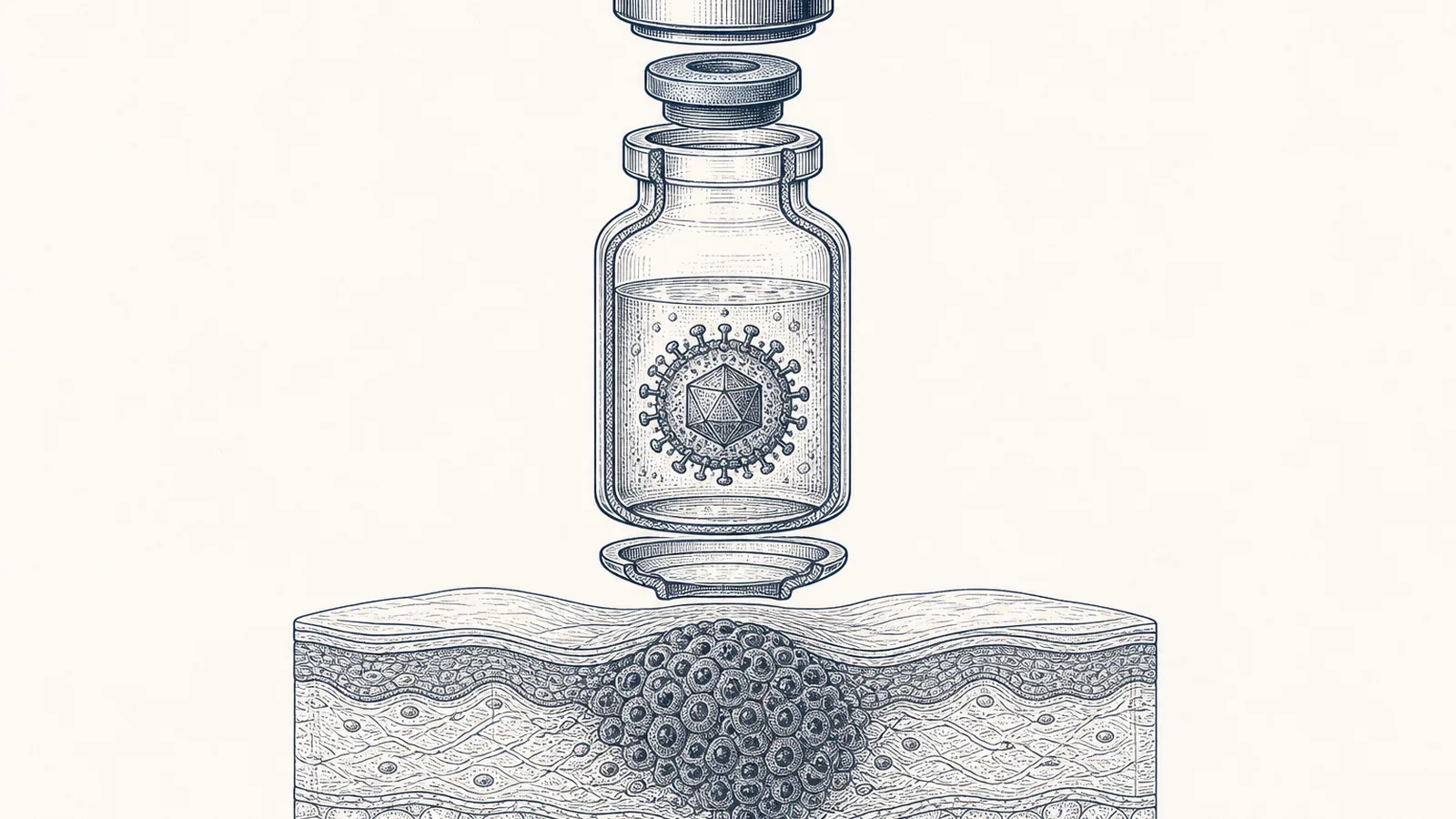
The product is Tudriqev, generic name vusolimogene oderparepvec, known through its development as RP1. It is a herpes simplex virus rebuilt in the lab, armed with a fusion protein and an immune-signaling gene, and injected straight into tumors. The FDA cleared it for adults whose advanced melanoma has kept growing through PD-1 immunotherapy, given alongside one of those same drugs, Bristol Myers Squibb’s Opdivo. The clearance is accelerated approval, the conditional kind the agency grants on an early signal while it waits for proof.
The objection the reviewers kept raising was not paperwork. IGNYTE enrolled 140 patients and gave every one of them the identical regimen. There was no control arm. About a third responded, 33.6 percent, and the responses tended to last, a median past two years, with median overall survival of 32.9 months and 47.8 percent of patients still alive at three years. Those are good numbers for people who have run out of options. But every patient also received nivolumab, a drug that shrinks tumors on its own, so nothing in the trial could separate what the virus did from what its partner did. That was the whole of the government’s case, made plainly and made twice.
| Measure | Value |
|---|---|
| of 140 treated patients | 33.6% |
The data did not change. The agency did. What moved was the venue: the same file that two review teams had rejected went to a 13-member panel, convened after a nine-month stretch in which the FDA had held almost no advisory meetings at all. The evidence in front of the panel was the evidence in front of the reviewers. The answer that came back was different.
Accelerated approval is a promissory note. It rests on a stand-in for survival, here the response rate, and it carries a bill that comes due later: a confirmatory trial that has to show the drug actually keeps people alive longer. That trial is already enrolling. IGNYTE-3 randomizes anti-PD-1-failed melanoma patients to the RP1 combination or the treatment their doctor would otherwise pick, and its survival results are not expected until 2030. A randomized trial in exactly these patients was not, it turns out, impossible to run. One is running. Its answer will land four years after the drug reaches the shelf.
There is a serious argument on the other side, and it belongs on the record. Patients who have exhausted PD-1 therapy have little in front of them, and the responses IGNYTE recorded were durable, which counts for a great deal when the alternatives are thin. For a company whose application and share price had both collapsed across two rejections, the approval is a rescue.
But the uncertainty the FDA spent more than a year refusing to accept did not dissolve on August 6. It moved. Off the reviewers’ desk, onto the patients who will take the drug and the payers who will pay for it, where it will sit until the confirmatory data arrives. The sentence the reviewers typed in July is, as a matter of arithmetic, still true. The single-arm trial is no more interpretable now than it was that week. What changed is also in the record, 10 votes to 3, and it will not be settled until 2030. The three who voted no did not get to write a letter.
Sources
- FDA – Accelerated approval of Tudriqev (vusolimogene oderparepvec-wtpg) for treatment-resistant advanced melanoma (Aug 6, 2026)
- CancerNetwork – FDA approves RP1/nivolumab for anti–PD-1-progressed melanoma: IGNYTE design, 33.6% response, 32.9-month median OS, 47.8% alive at three years
- BioSpace – FDA calls Replimune’s melanoma data package “not interpretable,” two prior complete response letters, nine-month gap in advisory meetings
- Replimune – CTGTAC advisory committee votes 10-3 that IGNYTE results are evaluable and clinically meaningful (July 30, 2026)
- Replimune – First patient dosed in the randomized phase 3 confirmatory IGNYTE-3 trial