I had PCBs filed under “solved.” Banned before I was born, the kind of chemical that shows up in a documentary about smokestacks and river foam, not in a blood draw from a school-age kid. So the phrase that always gets attached to them, “legacy contaminant,” sounded about right to me. It is one of the most soothing phrases in all of environmental regulation, and it does a lot of quiet work: it implies a chapter that closed, a mess someone else already mopped. A new paper in the journal Environmental Health spent its whole length taking that comfort apart, because a chemical the U.S. stopped making in 1979 is now tied to a cellular aging signal in living children.
The study did something more interesting than counting a poison. It went looking for the route. Researchers measured dioxin-like PCBs, the DL-PCB subset, in children, they measured how those kids performed on cognition, and then they asked the question most exposure studies skip: what biological errand are these molecules running between the bloodstream and the brain? Their answer, tested as a formal mediation analysis, is that the chemicals track with shorter telomeres, and the shortened telomeres appear to be part of how the cognitive hit happens.
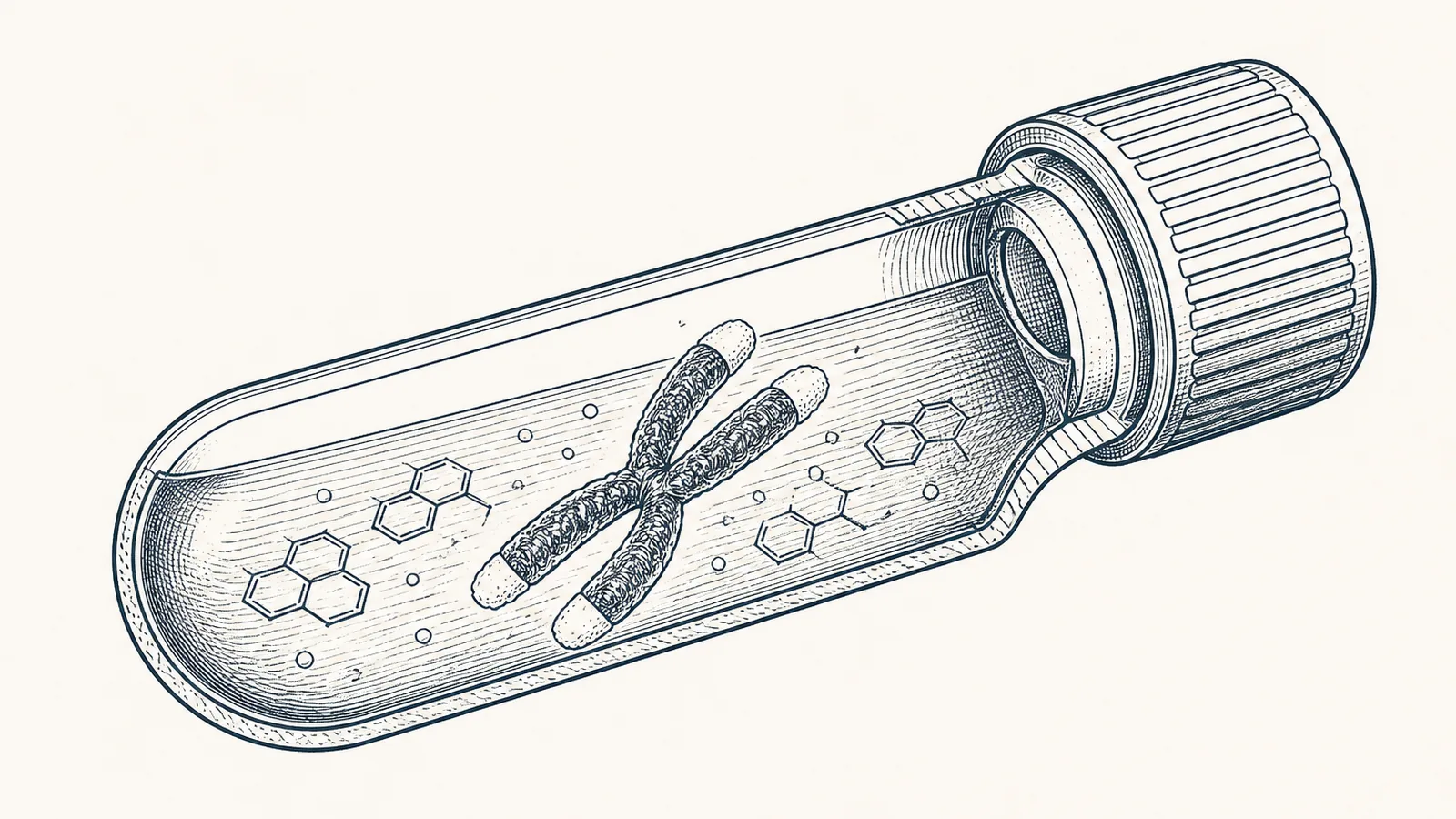
Here is where I had to slow down, because telomeres are not where I expected an old industrial coolant to leave prints. They are the caps on the ends of your chromosomes, the little plastic tips on a shoelace that keep the whole strand from unraveling every time a cell divides. They shorten with age, and they shorten faster under two specific pressures: oxidative stress and chronic inflammation. Which is exactly what dioxin-like PCBs are built to do. They settle into fat, they switch on the body’s aryl-hydrocarbon receptor (being “dioxin-like” is precisely what that means), and they keep the inflammatory machinery idling. Early-life environmental exposures and telomere loss have a long, documented relationship, and the mechanism this paper proposes is almost brutally physical: the chemical sits in the tissue, the tissue stays low-grade inflamed, the telomeres get gnawed down early, and a cell that should still be young starts acting old. In a developing brain, that timing is everything.
But what do the tips of a chromosome have to do with whether a kid can hold a string of numbers in their head? More than I would have guessed. Shorter telomeres are one of the cleanest signs we have that a body is running ahead of its own clock, and shorter telomeres and lower measured intelligence have already been shown to travel together in the general population. What this new work adds is a middleman. The telomere shortening is not just sitting next to the exposure and the cognitive scores, it appears to be one of the threads connecting them. I sat with that for a minute. The damage isn’t only “chemical, meet brain.” It’s “chemical ages the cell, and the aged cell shortchanges the brain.”
And the reason I don’t think this is a lone statistical mirage is that DL-PCBs keep turning up in the child-health literature wearing different disguises. The same class has been tied to higher blood pressure in primary-school children and to disrupted fetal thyroid function during pregnancy. In US adults, a NHANES analysis found that as combined dioxin and DL-PCB body burden rose, the odds of general obesity climbed by roughly 75 percent per quartile (OR 1.75, 95% CI 1.38 to 2.22). Blood pressure, thyroid, metabolism, and now the aging clock inside a child’s cells. These molecules park in fat and never stop talking to the body.
The cognitive worry itself is not new. Prenatal PCB exposure was linked to lower IQ in 9-year-olds years ago, back when many of today’s parents were the ones being tested: for each 1 ng/g rise in PCBs measured in placental tissue, the children’s Full Scale IQ dropped 3 points and Verbal IQ dropped 4, even after the researchers accounted for mercury, DDT, and lead. The telomere signal isn’t new in adults either. Dietary intake of these compounds has been associated with shorter telomeres in adults. What this paper does is push the same clock backward, into childhood, where the accounting is far less forgiving.
So here is the uncomfortable part of “legacy.” PCBs stopped being made in the U.S. in 1979, and they are still here: they do not readily break down, they cycle between air, water, and soil, and they bioaccumulate up the food chain into the fish people eat. The chemicals did not get the memo that we moved on. And yes, this newest study is observational. It can show that exposure, telomere length, and cognition travel together in a plausible order, not that one PCB molecule reached into one child’s chromosome and clipped it. Mediation is a statistical argument, not a biopsy. The honest open question is whether the early telomere shortening causes the cognitive gap or is a shared fingerprint of the same inflammation, and only longer follow-up in these kids will pull those apart. But “we can’t prove the last inch” is a very different sentence from “there’s nothing here.”
Here’s what I’ll actually do with it. I already check my state’s fish-consumption advisories before I buy from a local river or lake, and I used to treat that as a mild personal quirk. Not anymore. For a growing kid, diet is one exposure route a family can actually control, and I am not going to wait for a fresh federal guideline to tell me that a chemical we banned nearly fifty years ago is still worth keeping off my kid’s plate. On that one, the receipts are already in.
Sources
- Environmental Health – Mediating role of telomere shortening in DL-PCB associated cognitive decline in children (2026)
- US EPA – Learn about Polychlorinated Biphenyls (PCBs)
- PMC – Prenatal PCB exposure and IQ in 9-year-old children
- PMC – Intelligence and leukocyte telomere length: a longitudinal population-based study
- J. Clinical Endocrinology & Metabolism – Mixed dioxin/DL-PCB exposure and obesity in US adults, NHANES (2024)
- Ecotoxicology and Environmental Safety – Serum DL-PCBs and blood pressure in primary school children (2025)
- Ecotoxicology and Environmental Safety – DL-PCB exposure in pregnancy and fetal thyroid function (2025)
- PubMed – Dietary PCB and dioxin exposure and telomere length (2022)
- PMC – Early environment and telomeres: a long-term toxic relationship