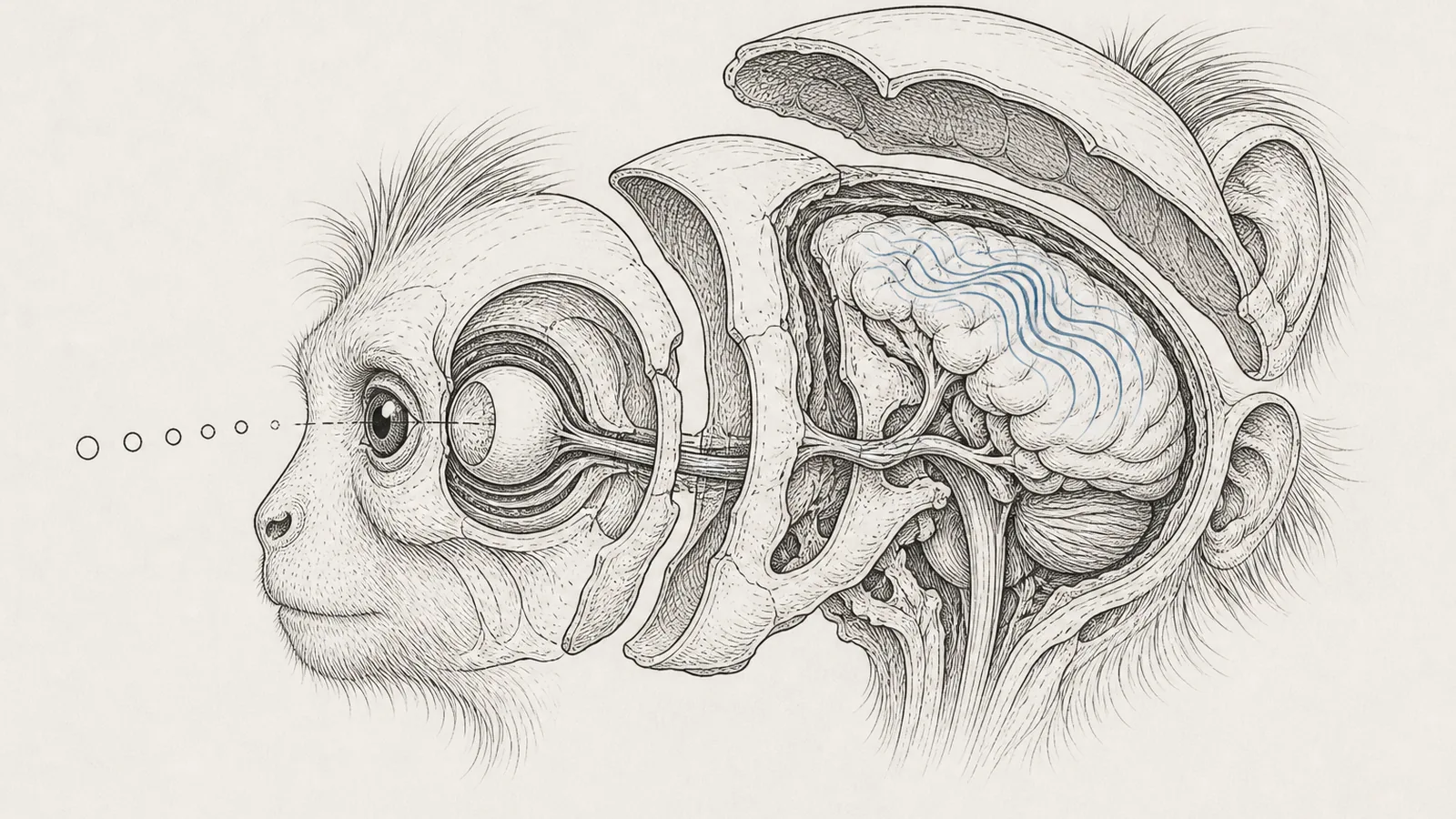
For most of my life I treated seeing as something that happened to me. Light comes in, the eyes catch it, the brain plays it back like a screen. So when a Salk lab announced that the faint electrical waves rolling across your cortex are not background static but the machinery that builds what you see, I did not lean in. I got suspicious. That is an enormous claim, and I wanted a good look at the thing holding it up.
What is holding it up is a review. On July 21, 2026, a group with Salk neuroscientist John Reynolds as senior author published a paper in Neuron arguing that neural traveling waves, those slow ripples that roll across the sheet of cortex, work as a generative computational engine for perception. The Salk announcement says the waves let the visual cortex “predict, reconstruct, and perceive the world.” By the time it reached ScienceDaily, the waves were turning “sensory chaos into what you see.” The paper, though, is a review. It gathers years of prior work and proposes a framework; nobody in it watched your brain construct your reality. Announcing a review like a fresh discovery is the oldest move in the institutional-science press shop, and it is worth naming before the music carries us off.
So trace the claim back to the experiments, and it lands mostly on one 2020 study in Nature. Reynolds and his colleagues Zachary Davis and Lyle Muller recorded from the visual cortex of awake marmosets, small monkeys, while the animals tried to spot a faint target. This is where I stopped rolling my eyes. The waves were already there before the target appeared, rolling across the cortical surface on their own, and whether the monkey saw the faint dot depended on whether one of those waves happened to be washing over the right patch of cortex at the right instant.
- 2020Marmoset study: wave timing predicts detection
- 2024Follow-up: wiring shapes waves into feature-selective motifs
- 2026Neuron review recasts waves as a perception engine
Wait, why would a ripple that started before the stimulus decide whether you notice the stimulus? That is the question I could not put down. The reading the team proposes is almost unbearably neat, and I want to flag it as their interpretation, not settled fact. Picture the wave as your brain’s internal weather, a swell of readiness moving through the tissue. When it crests over the neurons about to receive a signal, those cells are already leaning forward, primed, sitting closer to the edge of firing, so the faint dot lands on prepared ground and gets through. When the trough is passing, the same dot lands on cells that are dialed down and dies quietly, never becoming a thing you saw. The light from the world holds steady; your internal weather does not, and it is casting a vote on what you perceive before you know there is anything to perceive.
That finding is solid, and it did not stay alone. A 2024 follow-up in Cell Reports showed the horizontal wiring between cortical columns can shape these same waves into feature-selective patterns, which is how a rolling blob of activity starts to carry content instead of just timing. The synapses hold what the brain has learned about the world, then pour that structure back out as organized waves. The broader idea, that the brain runs on prediction and is forever guessing the most likely cause of the light hitting your retina, is one of the most useful frames in modern neuroscience, and traveling waves are a lovely candidate for the hardware that does the guessing.
But look at the distance the press release quietly jumped. From “wave timing predicts whether a marmoset detects a faint dot” to “waves generate your internal model of reality” is a leap across species, across complexity, and across the gap between correlation and cause. The 2020 result is correlational. The waves predicted detection, which is not the same as proving the waves do the perceiving. Stretch it from a monkey squinting at a low-contrast blur to you picking your mother’s face out of a crowd, and you have left the evidence behind. You are selling a theory because it is beautiful, and I get the pull, because it is beautiful.
Then there is the line that made me put my coffee down. Reynolds compares the brain’s process to how large language models learn “statistical structure” and use it to generate output. It is a slick analogy, and it will travel far precisely because everyone has a chatbot on the brain this year. But an analogy is a teaching tool, not a result. Your visual cortex is not a transformer, and the comparison flatters the machine at least as much as it explains the mind. When a neuroscience framework reaches for the most fashionable technology of the year to describe itself, my hand drifts toward my wallet.
None of this is bankrolled by anyone selling you a pill, and that matters. The review and the work under it were backed by the NIH, Research to Prevent Blindness, and Canada’s NSERC, basic-science money, not pharma money. So the conflict here is not commercial. It is the quieter incentive every lab lives under: to make a careful review sound like a revolution, because revolutions get covered and careful reviews do not.
So where does that leave a curious reader? Honestly, thrilled. The idea that your perception rides on internal waves that were already rolling before the world showed up is one of those facts that quietly rearranges how you think about your own eyes, and I will be carrying it around for a long time. What I will not do is let a review paper talk me into believing the case is closed, or let a tidy comparison to a chatbot stand in for the experiment nobody has run yet. The next time a headline tells me perception has been solved, reduced to a wave rolling across the cortex, I will go read the methods on the marmosets before I believe the story about you.
Sources
- Neuron – Muller, Busch, Davis & Reynolds, “Neural traveling waves in cortex: Network mechanisms and potential roles in neural computation” (review, July 21, 2026)
- Nature – Davis, Muller, Martinez-Trujillo, Sejnowski & Reynolds, “Spontaneous travelling cortical waves gate perception in behaving primates” (2020)
- Cell Reports – Davis, Busch, Steward, Muller & Reynolds, “Horizontal cortical connections shape intrinsic traveling waves into feature-selective motifs that regulate perceptual sensitivity” (2024)
- Salk Institute – “Why do we have traveling brain waves?” (news release, July 21, 2026)
- ScienceDaily – “Mysterious waves sweeping across your brain may help turn sensory chaos into what you see” (2026)