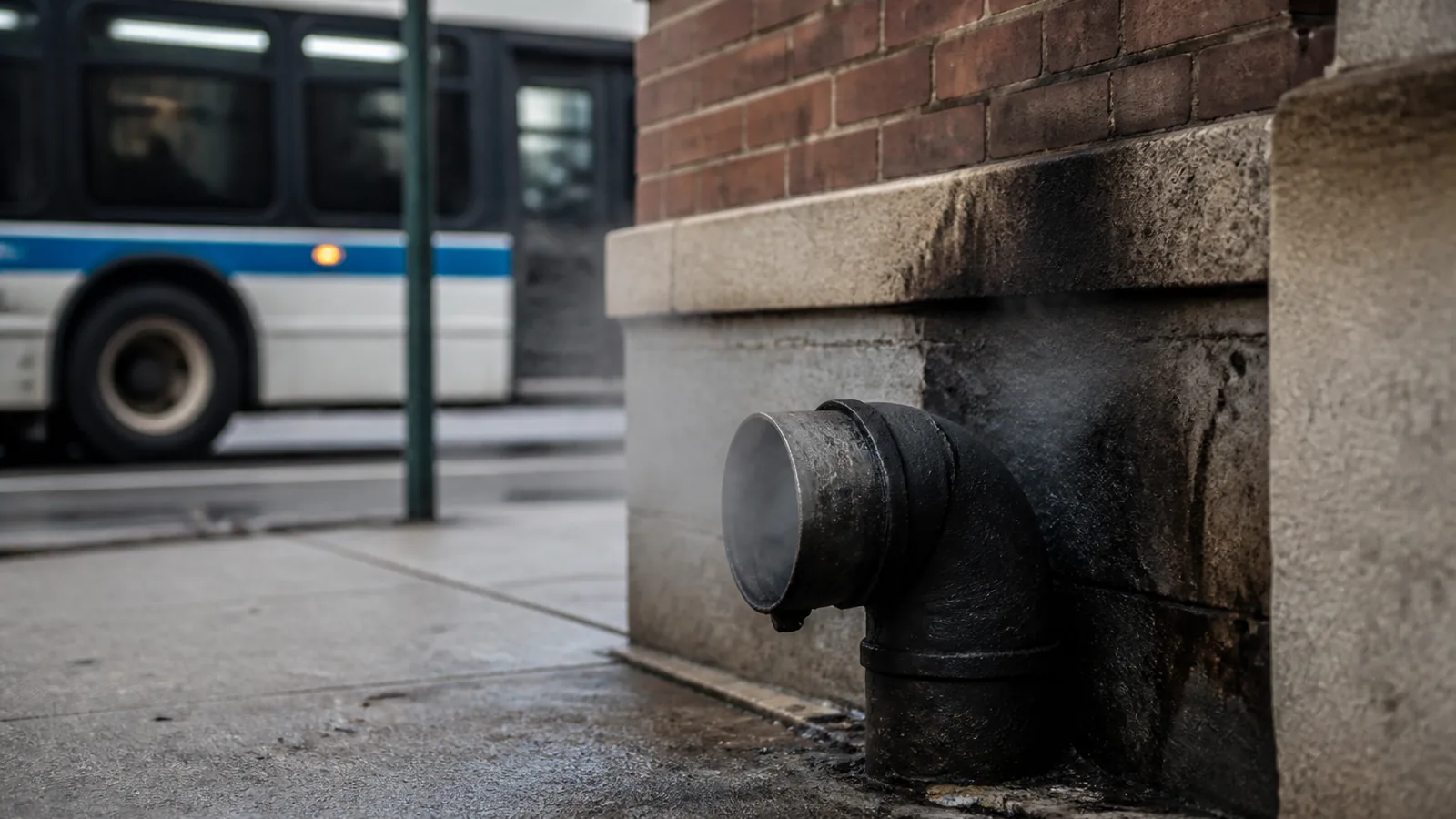
I used to file air pollution under lungs. Asthma, wheezing, the rescue inhaler zipped into a kid’s backpack. So the thing that stopped me in this study was not the headline number at all. It was the quieter fact sitting under it: the soot coming off a city bus does not politely stay in a mother’s lungs. It gets into her blood and reaches a fetus whose brain is, at that moment, still wiring itself together.
And it does that to some mothers far more than others. The children in this study were not from tree-lined blocks. They were mostly Black and Dominican kids in low-income Northern Manhattan and the South Bronx, born to women living beside bus depots and buildings still burning the cheapest grade of heating oil. For decades the city let that air sit in those neighborhoods. What follows is the story of what it cost the kids who breathed it, and how late the cleanup came.
Researchers at Columbia’s Center for Children’s Environmental Health, led by Frederica Perera, followed more than a thousand mother-child pairs, enrolling them one cohort at a time from 1998 through 2020. The children were tested at ages 1, 2, and 3 on the Bayley scales, which produce a Mental Development Index, a rough early read on how a toddler’s cognition is coming along.
Over those same two decades the air in those neighborhoods got dramatically cleaner, and not by accident. At the mothers’ own addresses, fine particulate matter (PM2.5) fell about 32 percent and nitrogen dioxide about 30 percent between 1998 and 2016, while the polycyclic aromatic hydrocarbons (PAHs) captured on the personal air monitors the pregnant women wore dropped roughly 60 percent by 2020. And the toddlers’ scores climbed. Compare the earliest cohort to the latest and the age-3 MDI came in about 26 percent higher.
| Measure | Value |
|---|---|
| PAHs | 60 |
| PM2.5 | 32 |
| NO2 | 30 |
26 percent is a huge jump, and here is where I have to slow my own enthusiasm down. That number is not from a trial. Nobody randomized babies to clean or dirty air. It is a before-and-after stretched across twenty years, and twenty years changes almost everything, not just the air. Population test performance drifts over decades on its own. The families enrolled in 1998 are not demographically identical to the ones enrolled in 2019. Prenatal care changed, nutrition changed, the Bayley itself got re-normed. The team adjusted for maternal education, the child’s sex, gestational age, and whether a smoker lived in the home, and for a claim this size that is a thin set of controls. So no, I don’t buy that cleaner air alone bought a quarter of a toddler’s cognition. The scores did rise; what is soft is how much of that rise the air can honestly claim.
But this same cohort has spent twenty years building the harder version of the evidence, the kind you cannot wave off as an accident of the calendar. Within a single group of children breathing the same era’s air, the ones with higher prenatal PAH exposure scored lower on that same Bayley index and carried nearly three times the odds of developmental delay, an odds ratio of 2.89. Follow the cohort out to age 9 and high prenatal PAH combined with material hardship tracked with significantly more ADHD symptoms. Same-era kids, sorted by how much exhaust reached them before birth: that comparison is much harder to explain away than a shift across two decades.
That sent me looking for the mechanism, because why would a combustion byproduct care about a fetal brain at all? PAHs are what you get when fossil fuel burns incompletely, off a diesel engine or an oil boiler. They are fat-loving molecules, so they cross the placenta easily, and Perera’s group has measured PAH-DNA adducts, the chemical scars left when these molecules bind directly to DNA, in umbilical cord blood, which is about as direct as proof of fetal exposure gets. In that same cord blood, higher adduct levels tracked with lower BDNF, brain-derived neurotrophic factor, the growth signal that tells young neurons to survive and connect, and lower BDNF tracked with lower toddler scores. So the exhaust is not a vague environmental stressor. It is a specific molecule reaching into the cord blood and leaning on the machinery of a brain under construction. That is what got under my skin.
Which brings me to how this is being sold, and where I would push back. The study is packaged as proof that clean air and climate policies benefit developing brains, and Perera’s own quote leans on policies to reduce fossil fuel emissions. The air did clean up on the back of unglamorous local policy: the Clean Fuel Bus Program, Clean Air Taxi rules, and above all the Clean Heat program that finally forced the dirtiest heating oil out of New York’s boilers. Good. Overdue. But watch what gets folded into the climate banner. The story this cohort has been telling since the mid-2000s is not really a climate story. It is that poor, mostly minority kids in Harlem and the Bronx breathed bus-depot and boiler exhaust into their developing brains for decades, the harm was documented in these children in real time, and the fix arrived late. That is an accountability story about who gets clean air first, and it does not need a carbon-policy bow to matter.
One thing in the study’s favor: the money is not industry money. The work ran on foundation grants, the John and Wendy Neu Foundation and the New York Community Trust, plus an NIH grant. No drug company on the funding line, no fuel company, nobody with a product to move. In a field where I spend a lot of time squinting at who paid for the answer, a funding page with no corporate logo on it is worth saying out loud.
So where does that leave me. I don’t believe cleaner air handed these toddlers a 26 percent boost, and I would read anyone selling that exact number as too eager by half. But the claim underneath it, that combustion soot reaches the fetus and leaves a mark on a brain still being built, is not soft at all, and it is the one I would act on. If I were pregnant next to a bus depot or a building still coughing out heating-oil smoke, I would not wait for a randomized trial that will never ethically exist. I would run an indoor air filter, put what distance I could between my window and the exhaust, back every boring local clean-air rule going, and I would not let anyone dress up twenty years of the city poisoning its poorest mothers’ air as a climate win when it was a debt paid two decades too late.
Sources
- Environmental Health – Perera et al., declining prenatal air pollution and child cognition in NYC (2026)
- Columbia Mailman School of Public Health – press release on the CCCEH clean-air and cognition study (2026)
- Environmental Health Perspectives – Perera et al., prenatal PAH exposure and neurodevelopment in the first 3 years, developmental-delay odds ratio 2.89 (2006)
- Environmental Research – prenatal PAH/aromatics, cord-blood BDNF, and child development (2015)
- Environmental Research – prenatal PAH exposure, material hardship, and child ADHD behavior at age 9, CCCEH cohort (2018)
- Frontiers in Public Health – major NYC air pollution and climate policies and air-quality trends, 1998–2021 (2024)
- MedicalXpress – coverage detailing the study’s adjustment variables and author framing (2026)