For most of my adult life I believed something about my own brain that turned out to be wrong: that the one you finish your twenties with is the one you keep. No new parts, no new cells, just slow subtraction from there. I believed it the way you believe things you have never had a reason to check. So when a Columbia team mapped nearly 500,000 cells from postmortem brains and found that in the depressed ones the machinery for making new neurons had gone quiet, it landed as a double surprise. We may keep minting neurons deep into old age. And depression may be where the line goes dead.
The study itself is a feat of scale. On August 21, researchers at Columbia University Irving Medical Center published the most detailed map yet of the cell types in the human hippocampus, in Nature Medicine, and used it to look at what depression does at the level of single cells. The donors were unmedicated, some with major depressive disorder and some without, their tissue collected soon after death. In the depressed brains, the assembly line that pumps out new neurons in the hippocampus had slowed to a crawl. That is the finding Nature’s news desk summed up as a brain that struggles to make new neurons once depression takes hold.
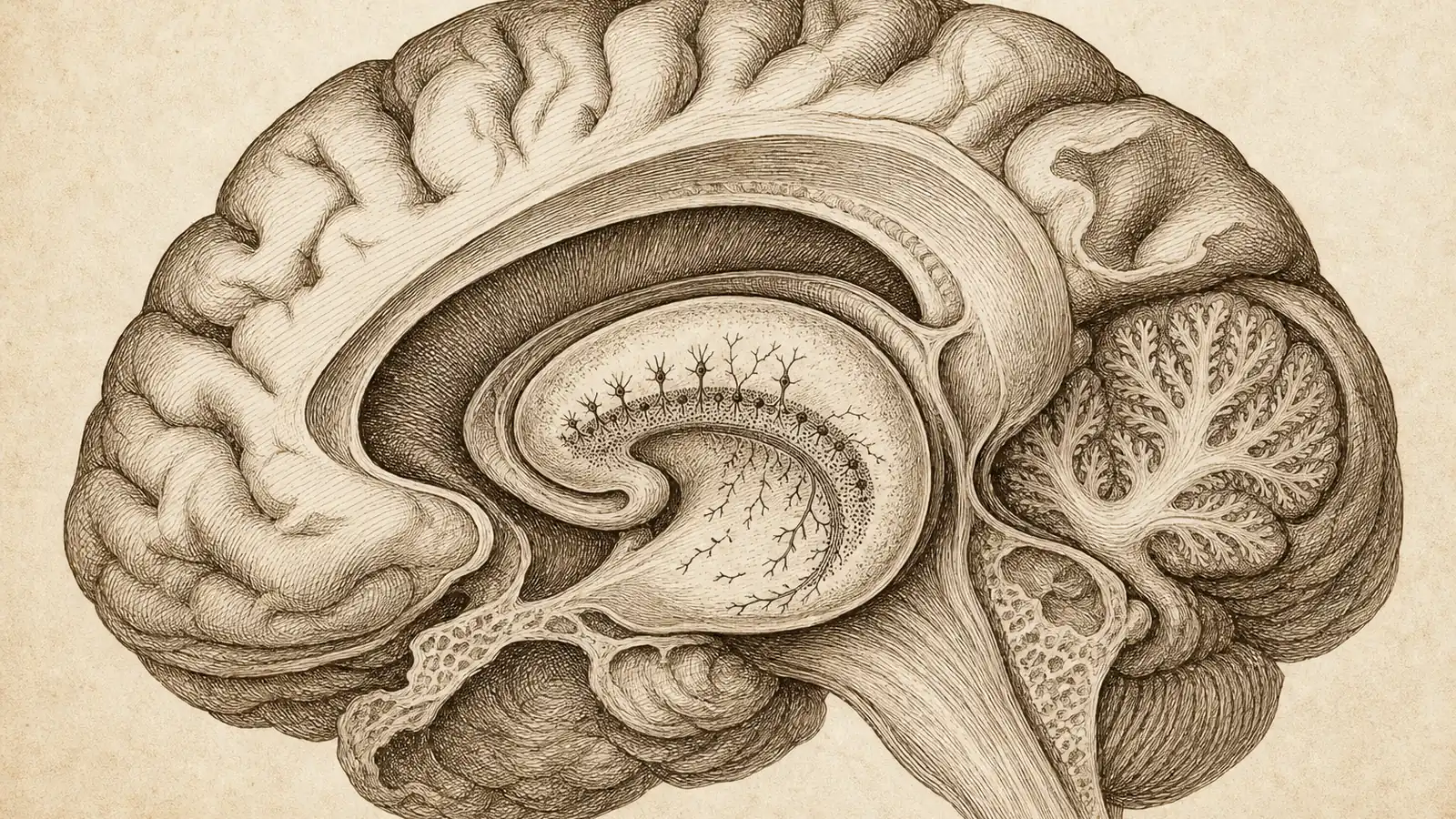
The hippocampus runs every new experience through a filter neuroscientists call pattern separation, the trick that lets your brain file today’s bad meeting as its own thing instead of gluing it onto every bad meeting you have ever sat through. Researchers have proposed that the cells doing much of that filtering are the youngest ones, newborn neurons in a thin curl of tissue called the dentate gyrus, still plastic enough to tag an incoming memory as new. Wait, why would a brand-new cell be the thing that keeps a fresh wound from reopening every old one? The rough idea is that a young neuron, hungry for connections, grabs the new experience and gives it its own address in the circuit. Slow the supply of those cells, the thinking goes, and new pain has fewer places to land except on top of the old. Read that way, depression looks less like plain low mood and more like a memory system losing its grip on the difference between this week and every other bad week.
The trouble did not stop at the newborn cells. Across the trisynaptic circuit, the hippocampus’s main memory loop, the depressed tissue showed inflammation, cellular stress, and the genes for a cell’s energy supply and internal cargo transport misfiring together. Maura Dupont, the Columbia psychiatry professor who led the work, read the spread of it as a sign that depression “is not just one disease” but several conditions wearing one name, each with its own molecular program gone wrong. That part excites me. A field that has treated depression as one blurry thing for decades suddenly has a cell-level parts list to argue over.
Before anyone reaches for a neurogenesis pill, look hard at what this map is standing on. The whole finding leans on a premise neuroscience has been openly at war over for years: whether adult humans make meaningful numbers of new neurons at all. In 2018 two teams examined the same slip of human tissue and reached flatly opposite conclusions, one finding it essentially undetectable in adults, the other counting thousands of young neurons in people into their seventies. That fight never resolved. This study, as I read it, plants its flag firmly on the yes-we-do side, and its entire story about depression depends on that flag holding.
Then there is what postmortem tissue can and cannot say. It is a photograph, not a film. It can show you that the depressed hippocampus looks different, but it cannot tell you whether the stalled neuron-making helped drive the depression or simply trailed behind it, whether the illness did the stalling or the long shutdown of dying did. The donors here were unmedicated, so at least the usual suspicion, that the antidepressants caused the change, does not apply. But this is one study on a small pool of donated brains, and I would trust anyone who told you it settles the direction a little less for saying so.
To its credit, this is not a pharma pipeline dressed up as discovery. The work was funded by the NIH and the Bill Herrlinger Research Foundation, not a drugmaker with a molecule to move. But watch the language the press materials reach for anyway: reclassifying depression by its molecular features “similar to what has been done in cancer,” and a hope that “turning neurogenesis back on may be a way to treat depression.” That is the sentence that launches a drug program and a decade of grant renewals, and right now it is balanced on a single postmortem study.
So I am not waiting for a switch that flips my neurons back on. What this map hands me is a mechanism worth chasing, the idea that a brain has to keep building new cells to keep its worst days from bleeding into one long gray one, and I would rather hold it as exactly that than as a pill around the corner. I would not buy the treatment the press release is already selling. I would watch for the second team, working in living brains, to see whether the stall shows up when the tissue can still talk back.
Sources
- Columbia University Irving Medical Center – Depression Stalls Formation of New Brain Cells (Dupont et al., Nature Medicine, Aug 21, 2026)
- Nature – The brain struggles to make new neurons in people with depression
- News-Medical – Neurogenesis stalls in the brains of adults with major depressive disorder
- ScienceDaily – Depression may shut down the brain’s ability to make new neurons
- Biological Psychiatry – Pattern Separation: A Potential Marker of Impaired Hippocampal Adult Neurogenesis in Major Depressive Disorder
- Science Translational Medicine – Adult neurogenesis in humans: dogma overturned, again and again? (the Sorrells vs. Boldrini debate)