When a press release opens with the words “first-ever FDA-approved treatment,” my honest first reaction is relief for the patients, and my second is to go looking for the number the company chose not to put in the headline. Warm autoimmune hemolytic anemia has gone decades without a single drug approved specifically to treat it, so I came in ready to be moved. Then I found the number, and it complicated the word “landmark” more than J&J would like.
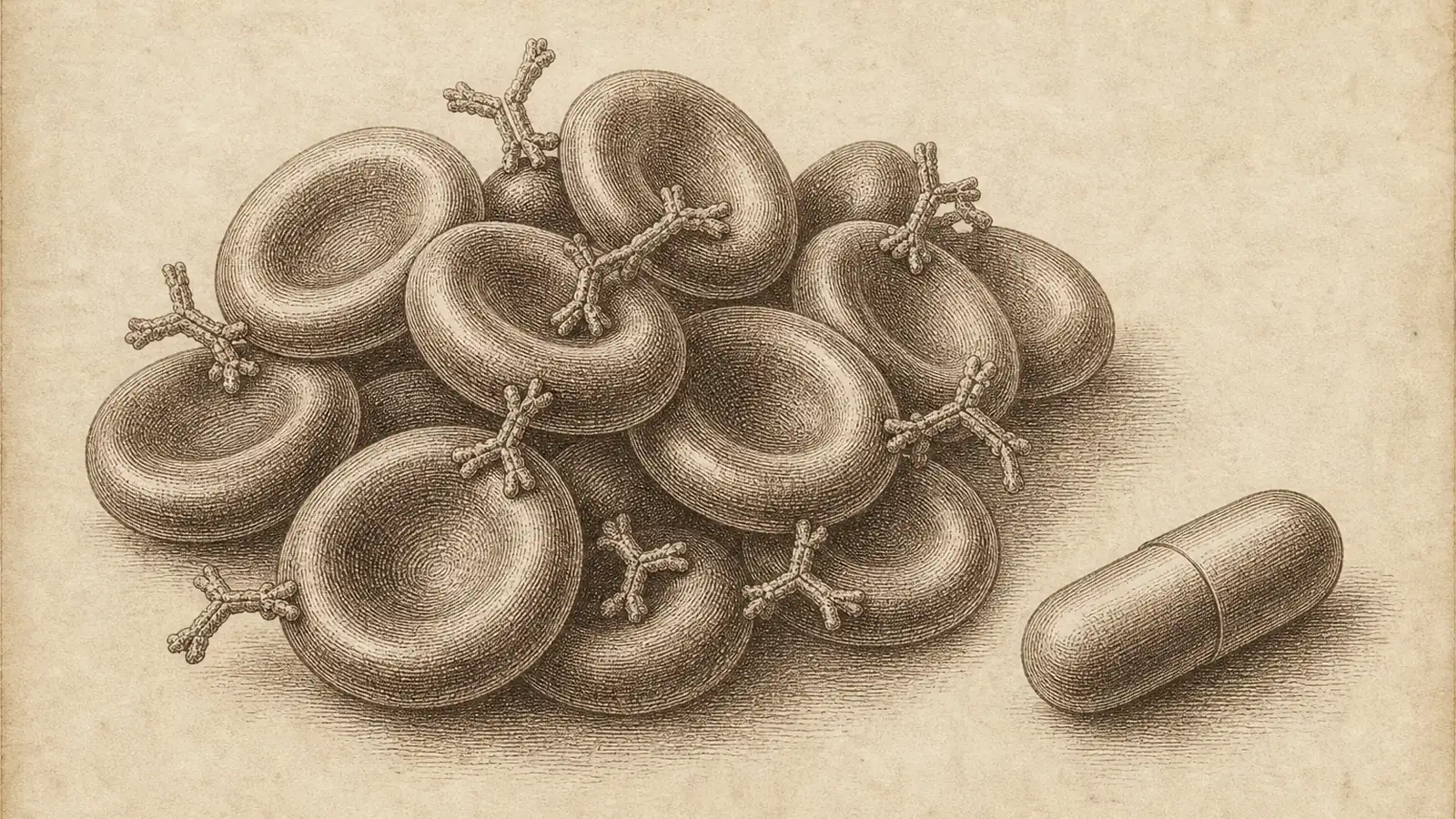
Here is the disease, because you should feel it before we argue about the drug. In warm autoimmune hemolytic anemia, wAIHA for short, your immune system builds an antibody against your own red blood cells. A warm IgG antibody sits on the surface of a red cell and tags it as trash. Your spleen, which is very good at taking out the trash, obliges: it pulls the flagged cells out of circulation and breaks them down faster than your marrow can pour new ones in. You end up jaundiced, wiped out, short of breath after a single flight of stairs, sometimes passing dark urine as the wreckage of your own blood clears through your kidneys. It is rare, on the order of one to three cases per 100,000 people a year, and for the sickest patients it is dangerous.
So the unmet need is enormous, and I want to state the drug’s case at full strength before I complicate it. On August 24, 2026, the FDA approved nipocalimab, branded Imaavy, from Johnson & Johnson, as the first treatment ever cleared for wAIHA in adults and kids 12 and up who are on or have been on steroids. J&J called it a landmark advancement, and in the narrow sense that nobody had ever gotten a drug approved for this exact disease, they are right.
| Measure | Value |
|---|---|
| treated arm | 24% |
Then there is the mechanism, which I found lovely. Your antibodies are not supposed to last long. Left alone, IgG gets swept into cells and degraded within a day or two. The reason it survives for weeks is a protein called FcRn, the neonatal Fc receptor, which works like a recycling truck: as IgG gets pulled into a cell for destruction, FcRn grabs it inside the acidic sorting compartment, turns around, and drops it back into the bloodstream before the cell can chew it up. That one rescue step is what gives IgG its long half-life. Nipocalimab jams the truck. It is an FcRn blocker that occupies the receptor so it cannot grab passing IgG, and the un-rescued antibodies get degraded fast.
Wait, why would that help someone whose problem is one specific rogue antibody? Because FcRn does not read labels. It recycles all your IgG indiscriminately, so blocking it strips out the pathogenic warm autoantibody along with the rest. Lower the circulating IgG, lower the number of red cells getting tagged for the spleen, and the hemolysis eases. What I like about it is that it sidesteps the antibody-making machinery entirely. It does not deplete your B cells the way rituximab does; it leaves the factory standing and just clears the product already in circulation. That is a conceptual shift from how this has been treated for seventy years, and it is why the same drug class is being chased across a whole shelf of antibody-driven diseases.
Then I looked at what the trial actually showed. The approval rests on ENERGY, a phase 2/3 randomized, double-blind, placebo-controlled study in 115 patients. The endpoint was a durable hemoglobin response: getting hemoglobin to at least 10 g/dL with a rise of at least 2 points from baseline, and holding it there for at least 28 days without rescue treatment. J&J’s headline number is that roughly three times as many patients on the approved dose cleared that bar as on placebo. That is accurate. It is also a way of saying that about 24 percent of treated patients, a little under one in four, got a durable response, while fewer than one in twelve did on placebo. Three times a small number is still a small number.
I am not sneering at one in four. For someone who has cycled through steroids and relapsed, a one-in-four shot at a rescue-free hemoglobin is not nothing, and the drug does move fast: a mean 1 g/dL rise as early as week one, and a median time to first response of 4.1 weeks versus 12.1 weeks on placebo. Fatigue improved modestly too. But the steroid-sparing was gentler than the marketing implies, only a slim edge over placebo on lowering the steroid dose by the 24-week mark. Better than a sugar pill, but not a ticket off steroids.
And here is the comparison the “first-ever” framing quietly skips. Nipocalimab was tested against placebo, not against the drugs doctors already reach for. First-line steroids still work well at first for most wAIHA patients; the problem is relapse. When steroids fail, the workhorse second-line drug is rituximab, which lands an overall response rate around 70 to 80 percent, though roughly half those patients eventually relapse. There is no head-to-head telling us how nipocalimab stacks up against that. We only know it beats a sugar pill.
Meanwhile the field is crowded with candidates chasing the same small market from every angle. Sovleplenib, a spleen tyrosine kinase inhibitor, posted a 67 percent overall hemoglobin response in an early trial, though on a looser endpoint than ENERGY used. BTK inhibitors and complement blockers are lined up behind it. Being first to the FDA is a regulatory win and a commercial one. It is not the same as being the best drug for the job, and J&J has every incentive to blur that line.
So what would I do with this? The biology deserves the enthusiasm. An FcRn blocker that works by starving autoantibodies of their recycling route, without gutting the rest of your immune system, is a smart tool, and for refractory patients out of options it is a welcome one. What I would not do is let a superlative do my thinking. If someone I loved had wAIHA, I would not read “landmark first-ever” and hear “the drug most likely to fix this.” I would ask the hematologist one blunt question: given that steroids and rituximab already have a track record here, where does a one-in-four drug fit in the sequence, and would we reach for it before or after the options we have decades of data on? I would trust the answer to that far more than the word “landmark.”
Sources
- MedPage Today – First Drug OK’d for Warm Autoimmune Hemolytic Anemia (Aug 2026)
- Johnson & Johnson – ENERGY phase 2/3 durable-response and rapid-onset readout
- Johnson & Johnson – FDA approval press release (calls it a “landmark advancement”)
- Clinical Trial Vanguard – ENERGY specifics: time to response, early hemoglobin rise
- Blood – How I Treat Warm Autoimmune Hemolytic Anemia (2021): standard care, rituximab response and relapse
- Frontiers in Immunology – Pathogenetic networks and emerging therapies in AIHA, including FcRn inhibitors (2025)
- The Lancet Haematology – Sovleplenib phase 2 in wAIHA (2025)