Kevin Tharp had a nagging suspicion about the way cancer biologists grow their cells. Tumors are stiffer than the tissue around them, and they sit in a fluid nothing like the sugar-rich broth that fills a laboratory dish. So when his team set out to study how cancer cells feed themselves, they did the thing most labs skip: they built a culture that behaved like a human body, matched its nutrients and its firmness, and only then turned up the glucose. The standard dish, it turned out, had been keeping a secret.
Changes in mitochondrial function lead to the synthesis of cell surface sugar-derived molecules that make it difficult for the immune system to recognize and kill cancer cells.
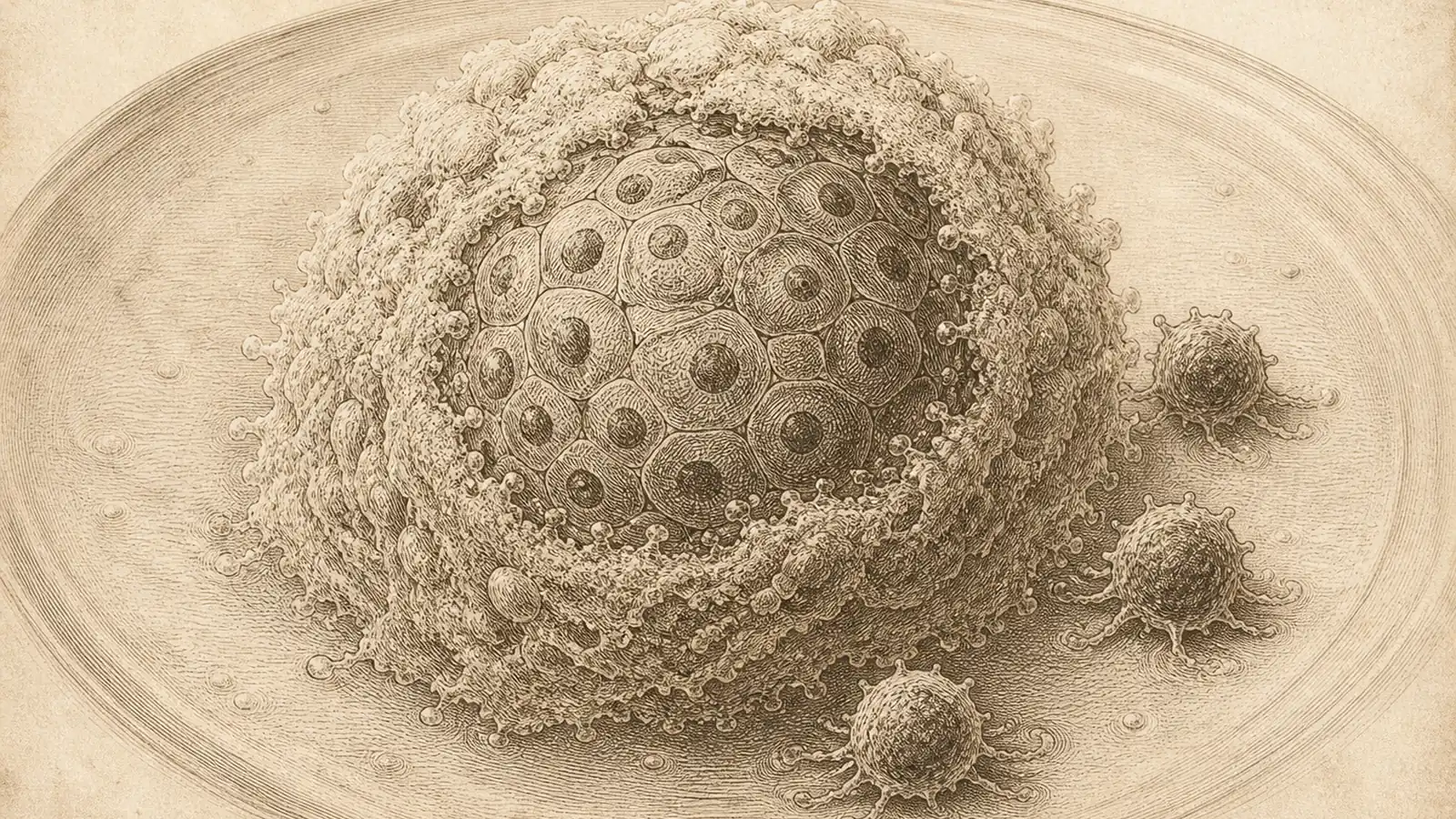
What they found, published August 7 in Science Advances, is the kind of result that only shows up when someone stops taking the usual shortcut. Under body-like conditions, excess sugar prompted the cancer cells to thicken the glycocalyx, the fuzzy coat of sugar-derived molecules every cell wears, into something denser. That coat is camouflage. The immune cells whose job is to find a tumor and kill it could no longer pick it out.
The thickening needed a partner. It required a stress protein called heat shock factor 1, or HSF1, best known for helping cells survive heat and other insults. Strip HSF1 out and the hyperglycemia advantage vanished; leave it in and high blood sugar rerouted the cell’s metabolism, starting in the mitochondria, toward building more of the sugar shield. Tharp put it plainly: “Changes in mitochondrial function lead to the synthesis of cell surface sugar-derived molecules that make it difficult for the immune system to recognize and kill cancer cells.”
In the standard laboratory medium that has fed cancer cells for generations, the effect was nowhere to be found. Turn the glucose up in a fluid built to resemble the body, and it was unmistakable. The physiological dish showed the mechanism. The ordinary one hid it.
That reaches well past the bench, because the correlation it points at is already sitting in the clinic. People with high blood sugar develop cancer more often and tend to fare worse after treatment, a pattern the researchers note has substantial evidence behind it and almost no mechanism to explain it. Tharp’s work offers a candidate: the hyperglycemia common in metabolic syndrome and type 2 diabetes may be handing tumors their cloak. With both conditions now everywhere, he argues, high blood sugar is becoming a bigger cancer risk factor than the field has treated it as. Which is another way of saying the number on a patient’s routine glucose panel may belong in the cancer conversation, not off to the side of it.
The distance from here to a treatment is the distance between a mechanism and a medicine. None of this has been tested in an animal, let alone a person; the work lives entirely in cultured cells. The tidy promise, that a drug against HSF1 could thin the coat and let the immune system back in, is a hypothesis with a target attached, not a therapy. Immunotherapy keeps a long graveyard of mechanisms that dazzled in a dish and did nothing in a body.
The work was paid for by the National Institutes of Health and the National Cancer Institute, along with the National Foundation for Cancer Research, the Ovarian Cancer Research Alliance, and a Canadian glycomics chair, with collaborators across eleven institutions, including Calico Life Sciences, Alphabet’s secretive longevity venture.
The quieter finding is the one aimed inward, at the field itself. For decades, cancer researchers have watched their cells thrive in a medium sweeter and softer than anything the human body serves up, and drawn conclusions from it. Tharp changed the recipe to match the patient, and a mechanism that had been hiding in plain sight stepped forward. The question that leaves behind is not what high blood sugar does to a tumor, but how much else the standard dish has been quietly leaving out.
Sources
- Science Advances – Tharp KM, Park S, Timblin GA, et al., “The microenvironment dictates glyco-immune surveillance via HSF1-mediated metabolism” (2026)
- Sanford Burnham Prebys – “Stripping away what conceals cancer cells from our immune system” (2026)
- Technology Networks – “High Blood Sugar Thickens Cancer Cells’ Sugary Shield” (2026)
- ScienceDaily – “High blood sugar may help cancer cells hide from the immune system” (2026)