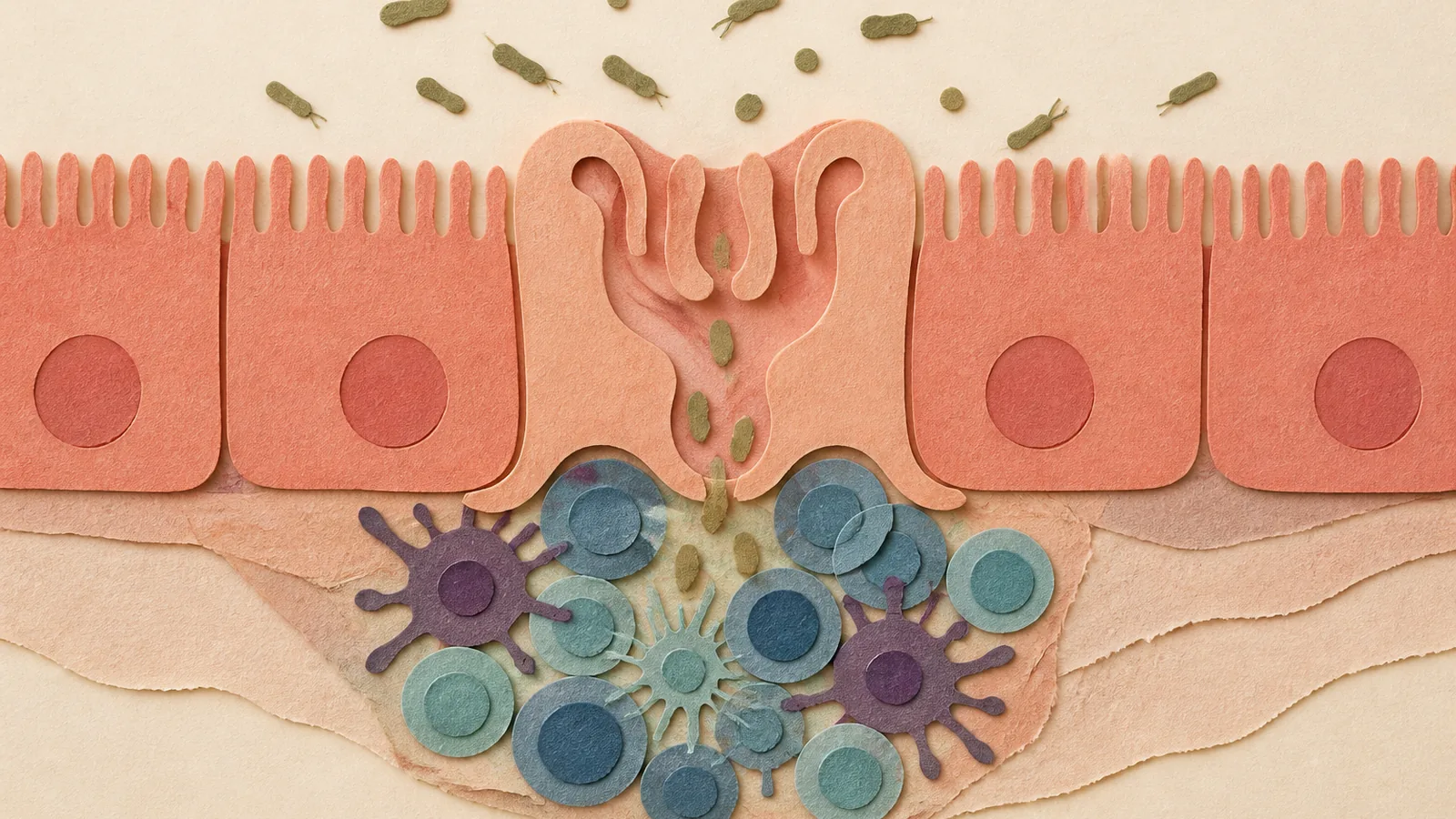
For years I filed microfold cells under mail slot: a hole in the gut wall that lets the immune system peek at whatever you just ate, then does nothing else worth mentioning. I had them completely wrong, and how I was wrong is the fun part.
The cell we assumed was the dumbest thing in the epithelium is positioning immune cells, tuning a cytokine that sits between leaky gut and cancer, and, in us, maybe holding a match near celiac disease.
On August 18, a team led by Gabrielle Belz’s lab at the University of Queensland’s Frazer Institute reported in Nature Immunology that these cells hold down a second job nobody had pinned on them: inside the mouse gut, they organize the immune defense they were only ever supposed to sample. The famous first job is well documented. Microfold cells, or M cells, sit in the flat patch of epithelium over a Peyer’s patch, and they ferry antigens from the gut lumen across to the immune cells waiting underneath, kicking off antibody responses. That is the textbook line, and it is also why M cells carry a bad reputation, because pathogens like Salmonella and Yersinia learned to ride that same conveyor belt straight through your barrier. The cell got typed as a doorway, handy to you and handy to the bug that wants in.
Here is what the Queensland group found instead. In the mouse gut, M cells build a small piece of real estate, a spatial niche, that grabs a specific defender and holds it in place. The defender is a group 3 innate lymphoid cell, an ILC3, and the reason you want it parked right there is what it pours out: interleukin-22. IL-22 is the cytokine that tells the epithelium to reinforce its barrier, pumping out antimicrobial peptides and mucins that keep bacteria at arm’s length. Knock out the M cells and the ILC3s lose their address, stop proliferating in the dome, and quiet down. So the M cell is not just the slot in the door. It positions the guard and keeps feeding it.
But why would the gut build a defensive niche and then wire a dampener into the very signal that builds it? Because that is what the same paper describes. The molecule that tells an ordinary gut cell to grow up into an M cell is RANKL, and the group flags RANKL as a brake on the ILC3’s effector output. IL-22 is one of those molecules you cannot leave running wide open. Too little and the barrier springs leaks; too much and, in the wrong context, it can push epithelial cells toward tumors. So the M cell holds the dial. It sustains the defense with one hand and caps it with the other. That is a far more interesting cell than a mail slot.
What makes this land harder is that M cells are having a moment, and the two big findings point in opposite directions. Nine months ago a separate team, using human intestinal organoids, reported in Nature that human M cells look startlingly like dendritic cells, carry MHC-II, and actively present gluten to T cells. They express transglutaminase 2, the enzyme that deamidates gliadin into exactly the shape that fits the HLA-DQ2.5 groove behind celiac disease. Read the two papers side by side and the same humble cell is a border-defense architect in one and, in the other, a suspect in teaching the immune system to attack a slice of bread. Same cell type, and the thing we called passive is making decisions on both counts.
I want to be straight about what this is and is not, because the gap changes what you should do with it. The defense-organizing story is mouse work, built on genetic tricks you can only run in animals: deleting the transcription factor that makes M cells, manipulating RANKL. The gluten story is human, but it is organoids in a dish, not people. Neither is a clinical result, and there is no product waiting at the end. If anyone tries to sell you a supplement to “activate your M cells” or “boost your ILC3s,” they are selling you a mouse abstract with a price tag, and you should keep your wallet shut.
The shape of it is what I keep turning over. We spent decades treating the gut barrier as plumbing, a wall with a few sampling ports, and every year the wall turns out to be more like a switchboard. The cell we assumed was the dumbest thing in the epithelium is positioning immune cells, tuning a cytokine that sits between leaky gut and cancer, and, in us, maybe holding a match near celiac disease.
I am not changing one thing in my kitchen over a mouse study, and I would be suspicious of anyone who tells you to. What I am doing is quietly retiring the idea that any cell in the gut is just infrastructure. The next time a paper calls some gut cell “passive,” I am going to assume we just haven’t caught it doing its real job yet.
Sources
- Nature Immunology – Cao, You, Belz et al., “Antigen-sampling gut cells moonlight as organizers of immune defense” (2026)
- Nature – “Human gut M cells resemble dendritic cells and present gluten antigen” (2025)
- Mucosal Immunology – “Microfold (M) cells: important immunosurveillance posts in the intestinal epithelium”
- Immunology & Cell Biology – Yu, Chen, Belz, “Intestinal ILC-epithelial cell circuits shaping barrier immunity” (2026)
- University of Queensland Frazer Institute – Professor Gabrielle Belz