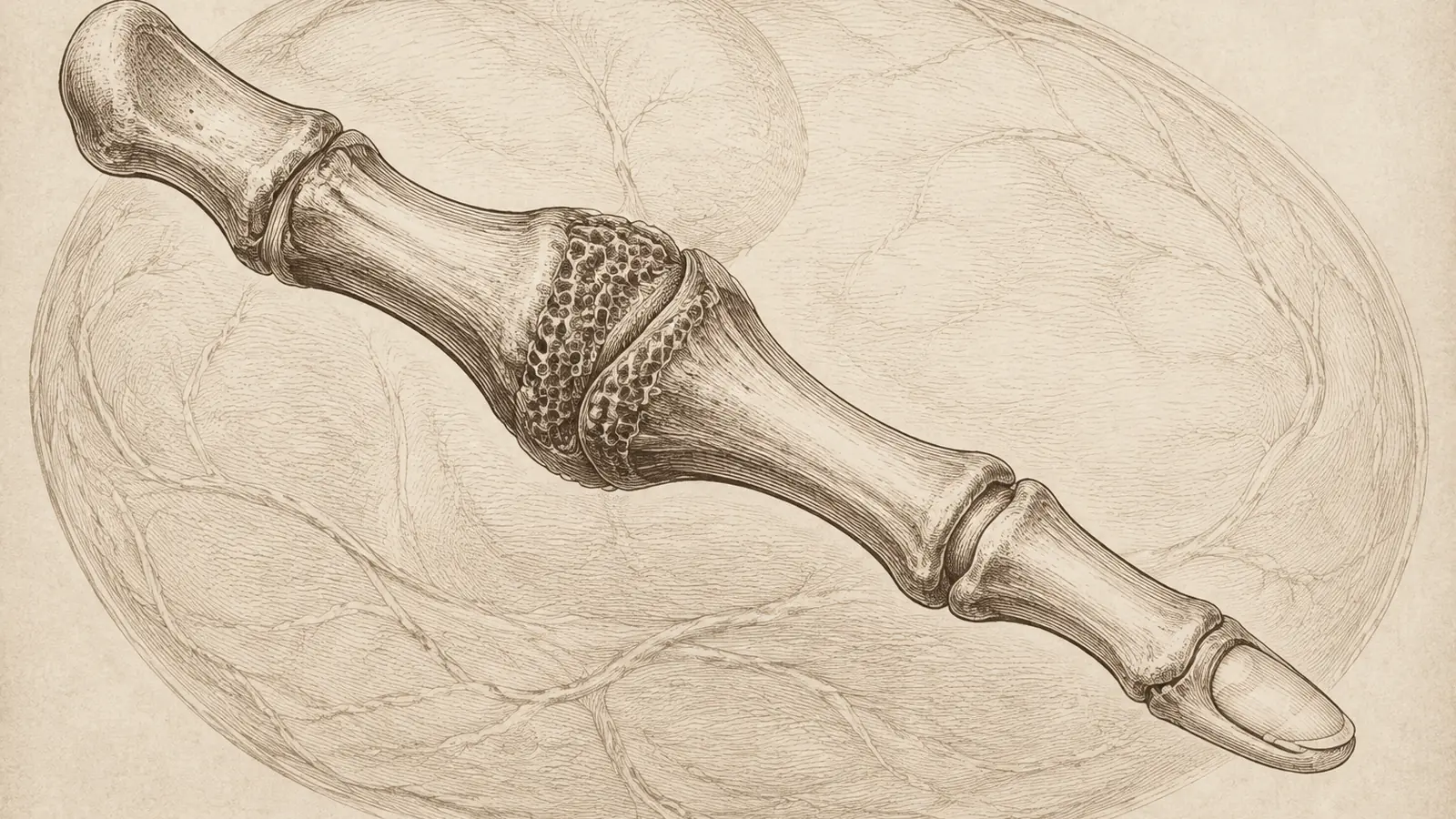
Here is a question I never thought to ask, even after years of writing about autoimmune disease: why does rheumatoid arthritis go after the middle knuckle of your finger and leave the joint one segment down, right by the nail, almost completely alone? For years I assumed the answer lived in the immune system, the way you assume anything you can’t explain is just the body being confused. It might not live in the immune system at all. It might be built into the joint itself, and built there before you were born.
The joint is not an innocent bystander. It may be a co-author.
That is the claim out of the Kennedy Institute of Rheumatology at Oxford, published in Nature Immunology, and it reorganized how I think about this disease. The researchers did something almost embarrassingly direct. Instead of studying inflamed adult joints and working backward, they went and looked at developing human finger joints and compared two neighbors: the proximal interphalangeal joint, the middle knuckle that rheumatoid arthritis loves to destroy, and the distal interphalangeal joint near the fingertip, which the disease usually walks right past.
Those two joints sit about a centimeter apart on the same finger. You would expect them to be built from the same blueprint. They are not.
The middle knuckle, the vulnerable one, showed up with a larger volume of synovial tissue, the soft lining that cushions a joint, and that lining was organized differently. When the team looked at which cells were sitting inside, the fingertip joint and the middle knuckle turned out to be stocked with different populations of fibroblasts. Fibroblasts are the connective-tissue cells everyone ignores, the structural crew you think of as inert scaffolding. Here they are anything but. The vulnerable joint was enriched for a specific kind, PI16-positive fibroblasts, clustered exactly where you would want to start a fire: around the blood vessels and at the anchor points where tendons and ligaments tie into the joint.
And these differences showed up in fetal tissue. That stopped me. Not laid down by decades of wear, not triggered by some adult infection or a rough immune year. Seeded in the womb, when the developing joint is mostly cartilage-forming cells and fibroblasts and barely any immune cells at all.
So why would that matter? A cell being present is not the same as a cell being dangerous. Plenty of us are walking around with PI16+ fibroblasts in our knuckles and no arthritis to show for it. What turns this population into a liability instead of just a resident?
The answer is in how these cells behave when something goes wrong, and this is where the biology gets genuinely strange. When the researchers hit the fibroblasts with inflammatory signals, the PI16+ cells shared the ordinary pro-inflammatory response with their PI16-negative neighbors. Same alarm, roughly. But layered on top, the PI16+ cells lit up a separate set of pathways the other fibroblasts didn’t, programs tied to tissue organization and immune regulation. In plain terms, these are cells that don’t just yell “inflammation.” They also start rearranging the neighborhood and calling in the immune system. The joint that gets destroyed, in other words, comes pre-stocked with the fibroblasts most primed to remodel it into a place an inflammatory attack could settle and stay.
That reframing is what makes this more than an interesting cell-atlas paper. No one was treated and nothing was prevented, so hold the excitement at developmental biology, not cure. But look at how we treat rheumatoid arthritis right now. The whole expensive arsenal, the biologics and the JAK inhibitors, works by turning down the immune system, often the entire immune system, for years, at real cost and real infection risk, all of it built on the premise that the problem is an immune system attacking innocent joints. This study complicates that premise. As Christopher Buckley, the Kennedy Professor of Translational Rheumatology who led the work, put it, the answer “lies not only in the immune system but also in the tissues themselves.” The joint is not an innocent bystander. It may be a co-author.
And there is no test yet that reads your fetal fibroblasts and tells you your knuckles are marked, so anyone who tells you this predicts your arthritis is selling something. What it does instead is move the origin of the disease. We have known for a while that rheumatoid arthritis runs on a long quiet runway, a preclinical phase where the autoantibodies are circulating years before a single joint swells. The field even has a name for it, “rheumatoid arthritis before rheumatoid arthritis.” This work pushes that runway back further than anyone was looking, past the antibodies, past adulthood, all the way to how the joint was assembled. The vulnerability isn’t the last thing to appear. It may be one of the first.
Would I do anything differently tomorrow because of one paper on fetal fingers? Honestly, no, and I’d distrust anyone who says you should. But I’ve changed what I’m watching for. When the next wave of rheumatoid arthritis drugs shows up, I’m no longer going to ask only how hard it hits the immune system. I’m going to ask whether it touches the fibroblasts, the tissue itself, because that’s where this study says the disease was quietly waiting the whole time. That’s the question I’d bring to my own rheumatologist, and it’s the one I’ll be asking of every RA headline from here on.
Sources
- Nature Immunology – “Arthritis susceptibility begins before birth” (2026)
- ScienceDaily – “Some joints may be primed for rheumatoid arthritis before birth” (2026)
- SciTechDaily – Kennedy Institute PI16+ fibroblast and synchrotron imaging details, with Buckley quote (2026)
- MedicalXpress – “Arthritis origins may begin before birth,” researcher quotes and methods (2026)
- Joint Bone Spine – “Rheumatoid arthritis before rheumatoid arthritis: What can we learn from clinical trials?” (2025)