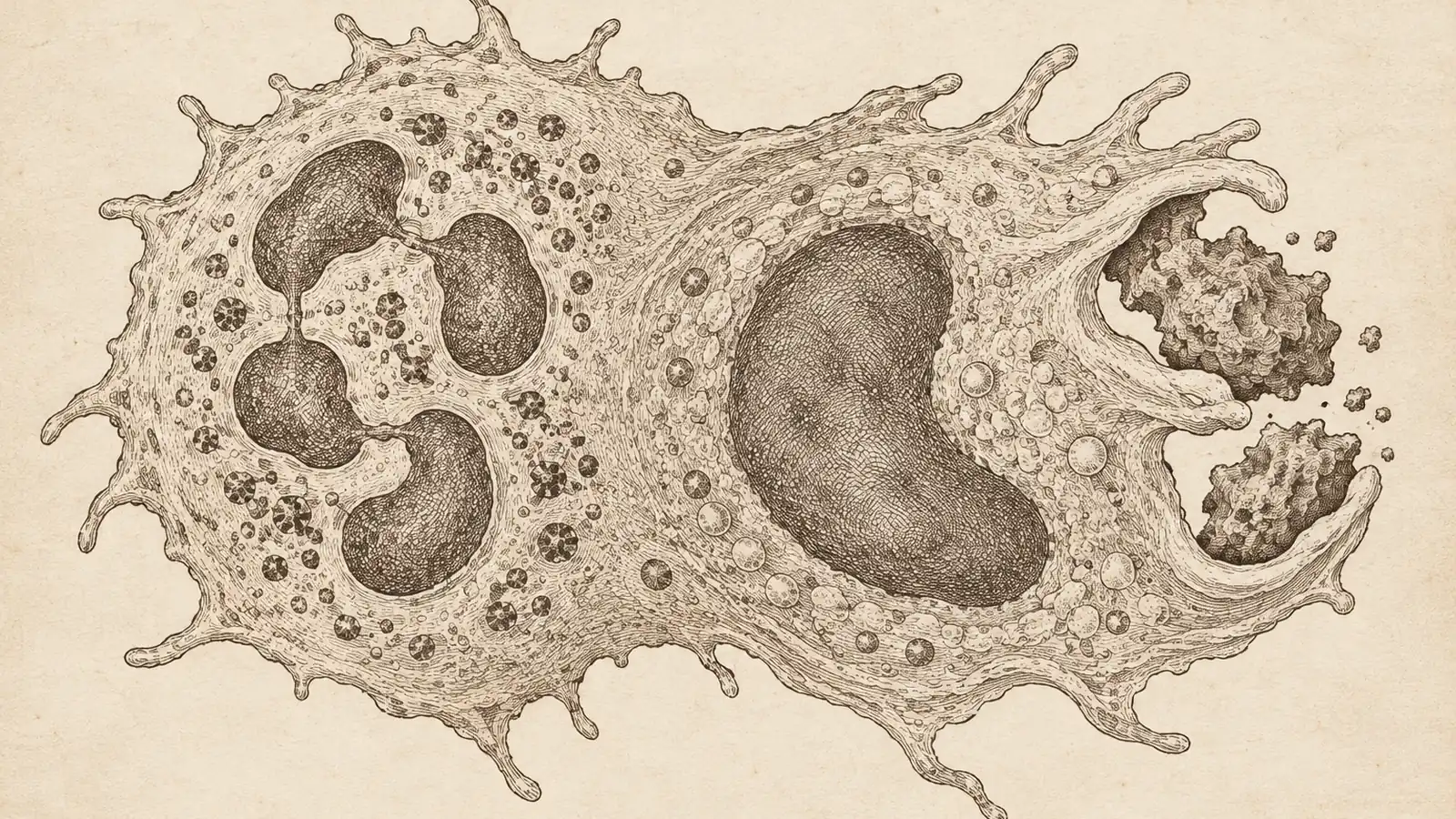
When a paper promises to clear a tumor in a single dose, my reflex is to close the tab. I have read too many mouse cures that never survived first contact with an actual person, and “one shot and it’s gone” is the exact register of a claim built to disappoint. What kept me reading was not the cure line. It was the cell, so strange I read the methods twice: a neutrophil and a macrophage, fused into one.
A group at Huazhong University of Science and Technology in Wuhan, led by Zhiping Zhang, did exactly that, reporting the result in Nature Immunology in 2026. They call it a syncytial CAR-macrophage, or S-CAR-M, and an accompanying commentary in the same journal is titled around the hybrid bringing “double trouble” to tumors. Both halves of that phrase earn their keep, and so does my skepticism.
Start with the problem the fusion is chasing. CAR-T therapy rewired what we can do with blood cancers by arming a patient’s own T cells with a targeting receptor, and there it has been close to miraculous. Drop those same cells into a solid tumor and they mostly stall. So the field turned to the macrophage, the immune system’s designated eater, because macrophages naturally infiltrate solid tumors and can phagocytose what they find. But the macrophage version has underwhelmed in people. According to a 2026 review of where the field stands, the first-in-human CAR-macrophage work was strikingly safe, with no dangerous cytokine storms, yet the cells persisted for a median of just 1 to 2 weeks and the tumor shrinkage stayed thin. Two failures keep repeating: the cells struggle to get into the tumor in useful numbers, and once inside, the tumor re-educates them or simply drops the target antigen the CAR was built to grab.
Here the fusion starts to make an odd kind of sense. Neutrophils are the body’s first responders, swarming a splinter or an infection within minutes because they are exquisitely tuned to follow chemical trails. Macrophages are the slow, deliberate cleanup crew. Bolt the neutrophil’s homing machinery onto the macrophage and, the study reports, the hybrids pour into tumors far more heavily than plain CAR-macrophages, riding the neutrophil’s chemokine-following instinct like a GPS the macrophage never had.
What made me sit up was not the homing. It was what the neutrophil half does after it arrives. Neutrophils fight dirty. They fling out sticky webs called neutrophil extracellular traps and dump reactive oxygen species, a raw chemical assault. In the hybrid, that assault does something I did not expect: it forces the tumor cells to flip a molecule called phosphatidylserine to the outside of their membrane. Phosphatidylserine normally sits tucked on the inner face of a healthy cell, and when it shows up on the surface it is the universal “eat me” flag that dying cells wave to get cleared. So the neutrophil weapons are effectively painting the tumor with “eat me” signals. Wait, why would that matter more than just killing the cells outright? Because it opens a second door. The macrophage can now eat the tumor through the CAR’s antigen-specific grip and through the phosphatidylserine flag, which it reads with a receptor called MerTK. That second door does not care what antigen the tumor is showing.
And antigen is exactly where the tumor usually wins. Its favorite escape trick is to shed the target so the CAR has nothing to hold, and a hybrid that also eats via the “eat me” flag can swallow the antigen-low cells that would otherwise slip away. There is a bonus. Once a macrophage eats tumor debris, it presents the pieces to the rest of the immune system and teaches it new targets, a process called antigen spreading. The study reports the hybrids set that off, and in their mouse experiments a single dose slowed tumor growth, limited spread, and protected against the tumor coming back, across both syngeneic models with an intact immune system and xenografts of human tumor cells in immune-compromised mice.
So do I buy it? I trust the mechanism. I do not trust the recurrence claim, not yet.
The mechanism holds together in a way most “breakthrough” cancer papers cannot manage: every striking result traces back to one specific thing the neutrophil brought to the party, the dirty-fighting weapons that both drive homing and flip the “eat me” switch. That is unusual. But it is mice, and mouse tumors are notoriously easy to cure. The history behind this exact modality is full of animal data that looked this clean and then did very little in patients. CAR-macrophages were supposed to be the solid-tumor answer years ago, and the current reviews of where they actually stand are still writing about promise, not cures.
There is also a worry hiding inside the mechanism I just praised. Neutrophil extracellular traps are not a precision instrument. In ordinary human biology they also drive collateral tissue damage and dangerous clotting, which is the whole reason the body keeps neutrophils on such a short leash. A therapy whose cleverness depends on unleashing NETs and reactive oxygen inside a patient has to prove it is not also unleashing them where you do not want them. Add the plain fact that a fused, multi-nucleus cell is its own manufacturing and safety question mark, and there is a lot of distance between a mouse in Wuhan and an oncology ward.
I would not stake anything on the recurrence claim today. What I will do is watch for the first human safety readout and read it for one thing before all else: what those borrowed neutrophil weapons do to a body that is not a mouse. If the NETs stay in bounds, this is one of the more elegant ideas I have seen in cell therapy in a while. If they don’t, it becomes a lesson in why borrowing a first responder’s arsenal is easier than controlling it. Either way, it surprised me, which is not a seat most one-dose cure stories get to sit in.
Sources
- Nature Immunology – Tian et al., “Neutrophil-integrated syncytial CAR macrophage for cancer immunotherapy” (2026)
- Nature Immunology – News & Views: neutrophil-hybrid CAR-macrophages “bring double trouble to tumors” (2026)
- CAR-macrophages: a new chapter in cancer immunotherapy – review of clinical status and first-in-human CAR-M safety/persistence (2026)
- npj Precision Oncology – “CAR-macrophages in solid tumors: promise, progress, and prospects” (2025)
- Frontiers in Immunology – “Advancing CAR-based immunotherapies in solid tumors: CAR-macrophages and neutrophils” (2023)