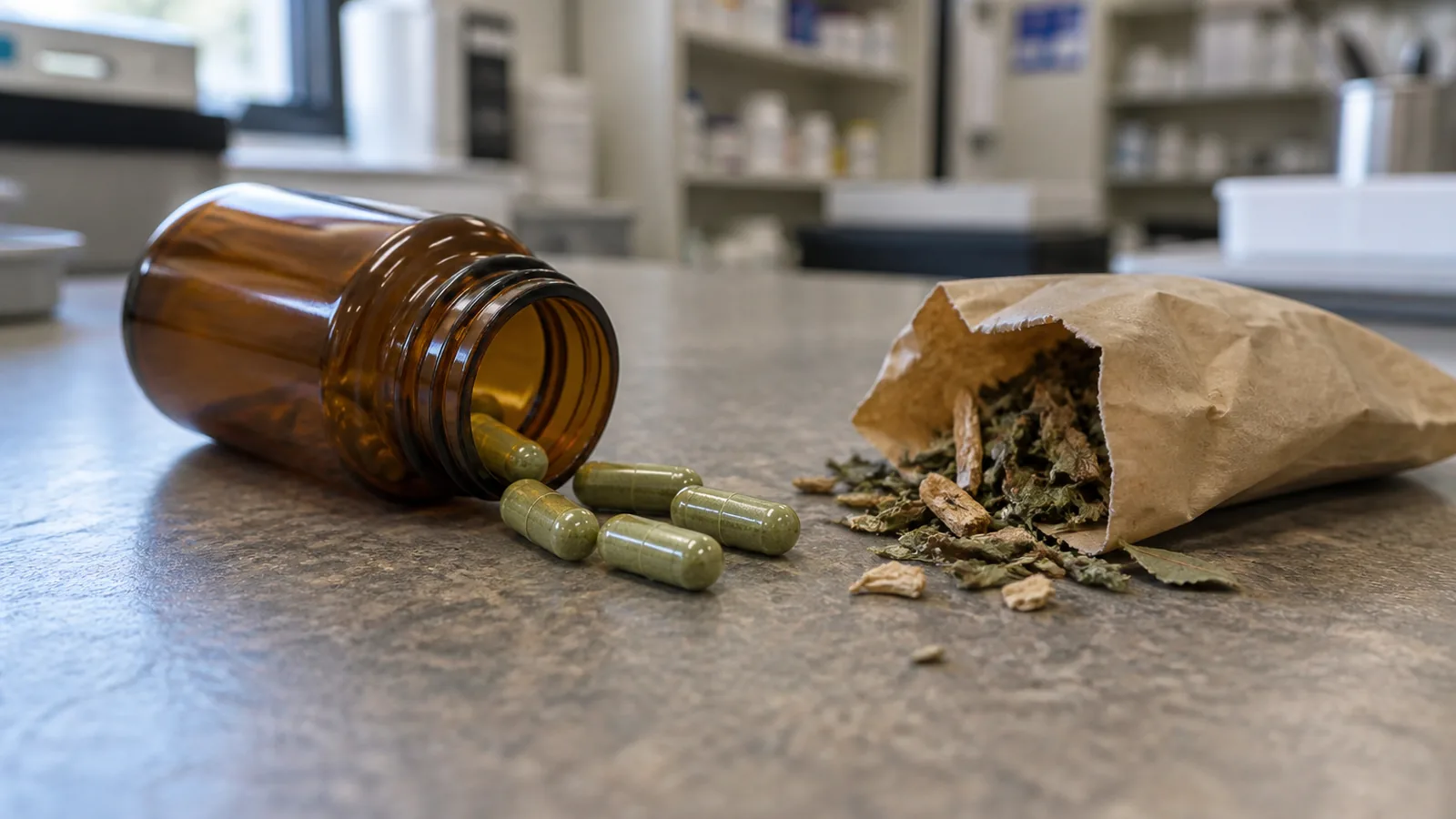
The FDA wrote the rulebook for turning a plant into a prescription in 2004, and refreshed it in 2016. In the 22 years since that first guidance, the agency has approved 4 botanical drugs. On September 3 it asked the public to help it work out why that number is so small.
Four. Start there, because the number tells you almost everything about the announcement. The FDA’s own primer lists them: sinecatechins, a green-tea-leaf ointment for genital warts; crofelemer, made from the crimson sap of the South American dragon’s blood tree, for diarrhea in HIV patients; birch-bark triterpenes for the open wounds of a rare blistering disease; and a pineapple-stem enzyme that eats away burn eschar. A tea, a tree sap, a bark, and a pineapple. Two decades of a formal pathway, and that is the entire graduating class.
To see why the wait ran so long, you have to see what makes a botanical hard, because the difficulty is real and it is also convenient. A typical small-molecule drug is one compound. You can weigh it, purify it, prove that batch A is chemically identical to batch B, and build a clean dose-response curve. A botanical is a crowd. Green tea extract carries dozens of catechins that shift with the soil, the harvest, and the season, and the active ingredient is often a mixture no one has fully resolved. The FDA’s framework answers this with a “totality of the evidence” standard: control the raw plant material, lock down the manufacturing, and lean on clinical data to show the whole complicated mixture behaves the same way batch after batch. That is a genuinely tough scientific bar. For a small developer without a pharma balance sheet behind the manufacturing controls and the trials, it is also a wall.
So when the agency now says it wants more plant medicines through, the honest first reaction is that it built the maze and is asking the public for a map out.
The records show what happened. On September 3 the FDA issued a request for information, docket FDA-2026-N-9550, published in the Federal Register the next day. It is not a rule, not a new guidance, not an approval. It is a questionnaire. The agency wants to know where the roadblocks sit, what trial designs might work for complex mixtures, whether “real-world evidence” could stand in for parts of a classic trial, and how the existing guidance should change. Comments run 60 days, closing November 3. A joint workshop with the European Medicines Agency is set for September 25.
Read the verbs, because this is where the announcement’s confidence outruns what it has delivered. An RFI supports exactly one claim: the agency intends to gather input. It approves nothing, loosens nothing, and commits to no change. It becomes reform only if it produces revised guidance or a real shift in what the drug center expects from a botanical application, and nothing in the press release binds the agency to write a single new line. The last time the FDA touched this framework, in 2016, it landed on the same “totality of the evidence” language it is now asking the public to help it rethink. Whether this round ends any differently depends entirely on what comes after November 3.
Now look at who is carrying the message. The quote at the top of the release belongs to Kyle Diamantas, the acting commissioner, who frames the effort as the Trump administration’s commitment to “modernizing regulatory frameworks to ensure promising, natural health options are evaluated through rigorous science.” Diamantas runs the FDA as a lawyer. His agency bio lists a law degree, a run leading the Human Foods Program, and a senior-counselor post since February 2026, and it lists no drug-review training or prior experience in the drug center. He moved into the top job in May, after Marty Makary resigned, with Trump saying only that Makary “was having some difficulty.” The man promising that plant medicine will be judged by “rigorous science” has never, on the public record, evaluated a drug application.
The second quote repays a close read. It comes from Marta Sokolowska, whose title is Deputy Center Director for Substance Use and Behavioral Health inside the drug center. Her line is the one worth keeping: “many people use botanicals for self-treatment,” so more real science “could create new opportunities for patients.” She is right, and that is the populist case for taking plant medicine seriously. Plenty of Americans already dose themselves with botanicals outside the approved prescription-drug pathway. But notice which office is fronting this. When the substance-use-and-behavioral-health directorate is the one championing a botanical push, the plant most on the agency’s mind is probably not chamomile. Trade coverage read the RFI as a signal to cannabis- and CBD-derived medicine developers that the FDA wants them working through the drug center. That points to a narrower reading than a broad opening for herbal medicine: an attempt to route the plants Washington finds politically pressing into a pathway it can control.
None of that makes the impulse wrong. This is the rare case where the MAHA-era instinct and the evidence pull the same way. A pathway that has cleared 4 drugs in 22 years is not a pathway that is working, the public demand is real, and asking how to fix it beats pretending the maze is not there. The skepticism here is not about the goal. It is about the distance between an agency that says it wants natural medicine and an agency that has approved 4 such drugs in more than two decades, leaning on the same “totality of the evidence” language it is invoking again now. A comment period does not close that distance. New guidance would start to.
Watch two dates. September 25, when the FDA sits down with European regulators, will show whether it is hunting for real regulatory ideas or diplomatic cover. November 3, when the docket closes, starts the only clock that matters: what the agency writes once the comments stop. If the next document is revised guidance that genuinely lowers the wall for complex mixtures, the drought may finally break. If it is a summary of what everyone said, followed by quiet, the number to remember is still 4.
Sources
- FDA – Seeks Public Input to Advance Development of Botanical Drug Products (Sept. 3, 2026)
- Federal Register – Advancing Development of Botanical Drug Products; Request for Information (docket FDA-2026-N-9550)
- FDA – What is a Botanical Drug? (definition, guidance history, four approvals)
- FDA – Kyle Diamantas, Acting Commissioner (biography)
- STAT – FDA Commissioner Marty Makary resigns, replaced by Kyle Diamantas (May 12, 2026)
- The Marijuana Herald – FDA Opens Public Docket on Botanical Drug Development, With Implications for Cannabis-Derived Medicines