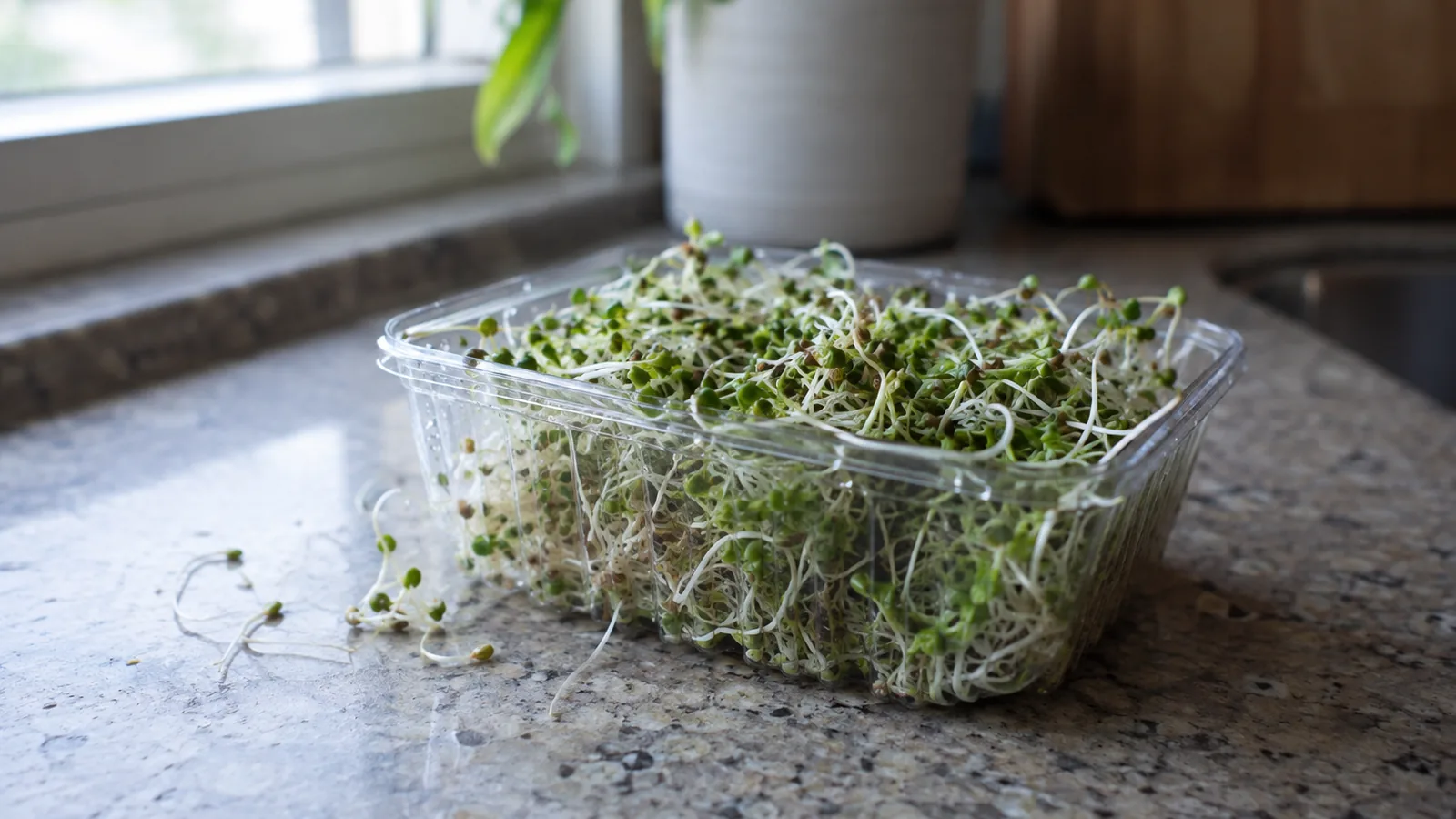
In the spring of 2011, three children turned up at a single Hamburg hospital with failing kidneys, and within weeks the German public-health system was staring at the largest outbreak of hemolytic uremic syndrome ever recorded. Before it burned out, 3,950 people were sickened and 53 died, roughly 800 of them with HUS, a condition that shreds the small blood vessels of the kidney. Investigators chased tomatoes, then cucumbers, then lettuce. The culprit, when it finally surfaced, was not a factory or a chemical: it was a batch of organic fenugreek seeds imported from Egypt and grown into sprouts in warm water.
Hamburg was not a freak event. It was the map for Idaho. On September 9, the FDA confirmed that broccoli sprouts grown by Evergreen Fresh Sprouts, LLC of Moyie Springs, Idaho had infected 22 people across Idaho, Montana, Utah, and Washington with Salmonella Bovismorbificans. Two were hospitalized. Illnesses began between July 7 and late August, and of the 19 patients investigators managed to interview, all 19 reported eating sprouts and 17 named broccoli sprouts specifically. The company recalled its product on September 4, after Montana officials cultured Salmonella straight out of a sample.
Twenty-two cases is not Hamburg. But the timing says more than the count does: while the FDA was tracing these broccoli sprouts, it was simultaneously working a second, unrelated sprout outbreak, this one alfalfa carrying both E. coli and Salmonella, that has sickened 55 people across 15 states. Two sprout outbreaks running at once, two different pathogens, is not bad luck; it is the pattern reasserting itself.
Broccoli sprouts are not junk food that happens to be dangerous. They are the darling of the wellness shelf, and not without reason. Young broccoli sprouts pack glucoraphanin, the precursor to sulforaphane, a compound with a phytochemical and antioxidant profile serious enough to have driven a decade of preclinical cancer research and a small industry of detox and longevity claims. People buy them for the cancer-prevention hope and the promise of concentrated plant chemistry, and they eat them raw, by the fistful, because the wellness canon insists heat destroys the delicate enzymes and you have to take them living to get the benefit. That raw imperative is the whole identity of the food. It is also the exact mechanism that keeps sending people to the hospital.
To see why, start with what a sprout is. A seed needs warmth, moisture, and time to germinate, which are the same three things a bacterium needs to divide. When a pathogen is present on or inside a seed, germination does not dilute it, it amplifies it; researchers have documented a handful of cells multiplying by three to five orders of magnitude per gram over the days a sprout takes to grow. The contamination usually rides in on the seed itself, so a rinse at the sink does little, and when it sits inside the seed tissue rather than on the surface, washing does nothing at all. Because the entire selling point is that you eat the result raw, there is no cooking step, no kill step, nothing standing between the bacterium and your gut. A sprout is a bacterial incubator you swallow uncooked.
Regulators have known this for a long time. The CDC’s outbreak system logged at least 53 sprout-associated outbreaks between 2000 and 2020, causing roughly 1,498 documented illnesses, 179 hospitalizations, and 5 deaths, and because most salmonellosis is never diagnosed or reported, those figures undercount the true toll by a wide margin. The FDA first warned high-risk consumers off raw sprouts in 1999, issued grower guidance, wrote a dedicated sprout rule into the Food Safety Modernization Act, and even ran a major sampling study to catch contaminated lots before they shipped. A quarter century of advisories, and the two outbreaks running this month push the tally higher still. When an agency has known about a hazard since the Clinton administration and its recurring output is a recall notice and a reminder to sanitize your countertops, that is not a solved problem; it is a hazard being managed with a leaflet.
So what should a reader who actually wants the sulforaphane do? Here the wellness dogma and the food science split, and they split in the wellness reader’s favor. The claim that heat wrecks the compound is mostly wrong. In a 2022 study, briefly blanching broccoli sprouts near 61 degrees Celsius for about five minutes tripled their sulforaphane content, a 3.3-fold jump over raw. The mechanism is tidy: mild heat knocks out a heat-sensitive protein called ESP that otherwise shunts the pathway into an inactive byproduct, while sparing the tougher enzyme myrosinase that actually forges sulforaphane. A short blanch gives you more of the compound and may cut the pathogen load, but it is not a sterilization step. Thorough cooking is the actual kill step, and it still leaves you a cruciferous vegetable with real value.
Sulforaphane is promising, not magic. The human cancer-prevention case is still mostly preclinical and mechanistic, nowhere near the randomized trials that would let anyone promise an outcome. And for the people most likely to end up hospitalized, children under five, adults over 65, and anyone immunocompromised, the safe move is simple: no raw sprouts, of any kind, ever. That is the one place the FDA’s long-standing advice is exactly right.
The test now is not whether another recall posts; that much is a foregone conclusion. It is whether the FDA traces this Salmonella strain back to the seed lot and names the supplier, treating contaminated seed as the upstream failure it has been for a quarter century instead of the cost everyone downstream keeps eating. The seed is where these outbreaks are born, and it is where the accountability has never landed. Watch whether it lands this time.
Sources
- FDA – Outbreak Investigation of Salmonella: Sprouts (September 2026)
- The New York Times – Salmonella Outbreak Linked to Broccoli Sprouts From Idaho (2026)
- The Epoch Times – New Salmonella Outbreak Linked to Broccoli Sprouts: FDA (2026)
- CDC MMWR – E. coli O104:H4 Infections Associated with Sprout Consumption, Europe and North America, 2011
- Clinical Infectious Diseases – Infections Associated with Eating Seed Sprouts: An International Concern
- Colorado State University Food Source Information – Sprouts (CDC NORS outbreak tally, 2000–2020)
- FDA – FDA Concludes Major Sampling Study of Sprouts
- Foods (2022) – Maximization of Sulforaphane Content in Broccoli Sprouts by Blanching
- Applied Sciences (2025) – Broccoli Sprouts as Functional Food: Phytochemical Profile and Antioxidant Activity
- FDA – Outbreak Investigation of STEC & Salmonella: Sprouts (August 2026, concurrent alfalfa outbreak)