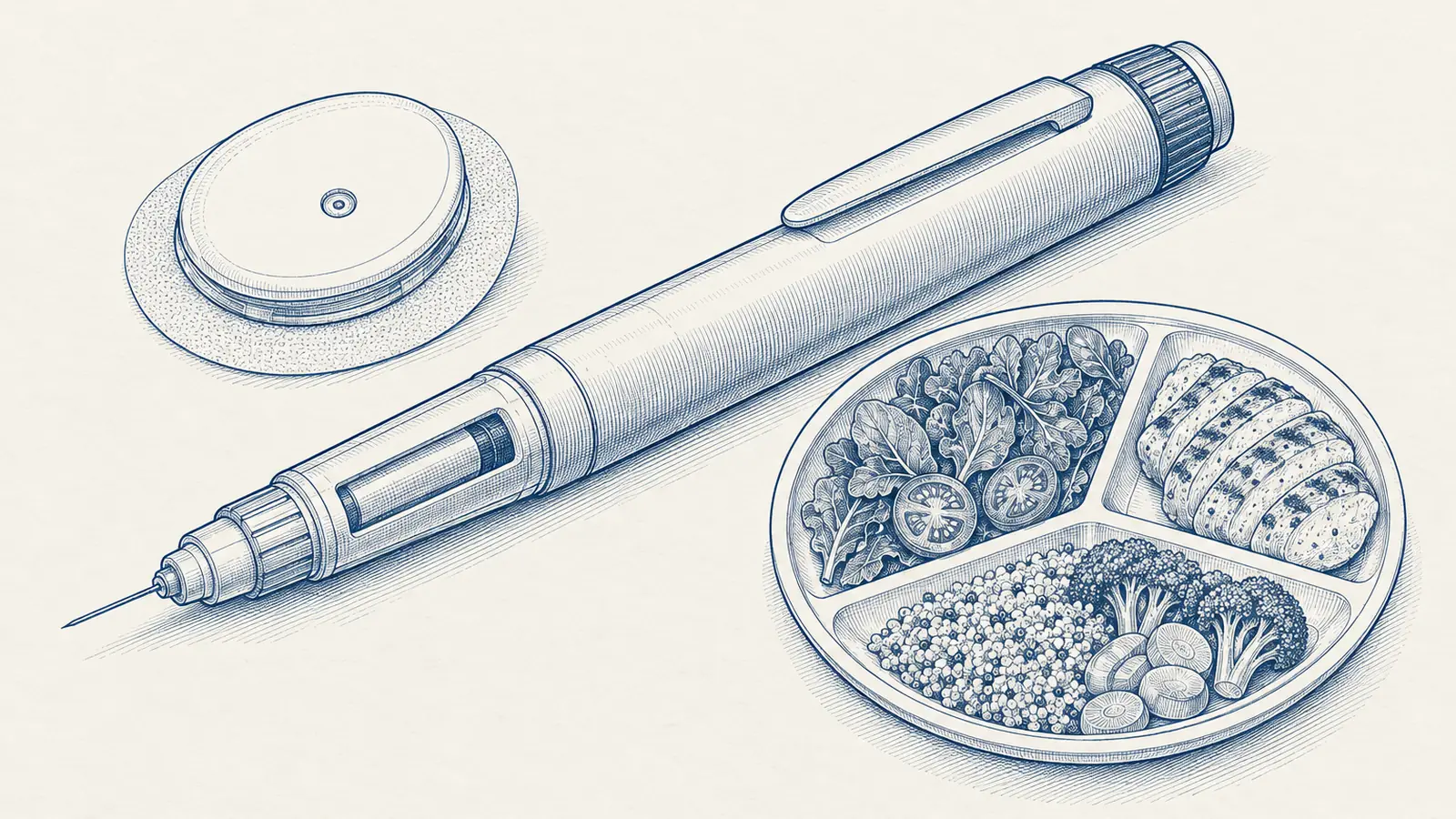
For years I filed intermittent fasting and Type 1 diabetes into the same mental folder as “things that do not mix.” So when I read that a University of Illinois Chicago team had asked 32 obese adults with Type 1 to eat only between noon and 8 p.m. for 6 months, my first reaction was not curiosity. It was alarm. Who signs off on that, and does everyone come out the other side? They did. The thing I assumed would hurt these patients simply did not.
Here is why I assumed danger. If your pancreas has quit and you are dosing insulin by hand, several hours without food is exactly how you end up shaky, sweating, and reaching for juice at three in the morning. Insulin does not care that your stomach is empty. It keeps pulling sugar out of your blood until there is dangerously little left, and at the far end of that sits diabetic ketoacidosis, the emergency that is the scariest failure mode in Type 1. Every bit of standard advice I had ever absorbed warned people off the long unplanned fast. In this trial, published in Diabetes Care, the fasting group showed no increase in severe hypoglycemia, severe hyperglycemia, or diabetic ketoacidosis. That fear is precisely why nobody had run the study before.
The design was three groups. One ate only in the 8-hour window with no calorie counting, one cut daily calories by 25 percent, and one changed nothing. It was small and short on purpose, the first trial of its kind in Type 1 patients. A first look, not a verdict.
Then there is the glucose number, modest but genuine. Average blood sugar, measured as HbA1c, fell 0.46 points in the fasting group relative to the calorie-cutters, and the confidence interval stayed entirely on the helpful side of zero (95% CI 0.12 to 0.80). Half a point of A1c is worth having. It is roughly what you might chase with a medication adjustment. It is not the kind of swing that rewrites a treatment plan on its own, and the coverage got excited a good deal faster than that number warrants.
Then the results did something I had to reread. Body weight barely moved. The fasting group lost about 2 percent, the calorie group less, and the gap between them was not statistically significant. So the usual explanation, that fasting works by melting off fat and improving insulin sensitivity along the way, does not carry the load here. If they were barely losing weight, why did their blood sugar improve at all?
My best guess is almost boringly mechanical, and I find it more convincing than a hand-wave about metabolism. Squeeze eating into 8 hours and you create fewer eating events, which means fewer mealtime insulin doses, and every one of those doses is a chance for the carb-count-to-insulin math to go wrong. Fewer meals, fewer overnight boluses working while you sleep, fewer big spikes to chase, fewer of the swings that quietly inflate an A1c. You are not out-clevering the disease. You are handing your insulin regimen fewer chances to miss. The paper did not measure that directly, so treat it as a hypothesis, not a conclusion, but for a condition where the daily arithmetic never stops, narrowing the window narrows the room for error.
Now the harder read, because this publication does not extend benefit of the doubt just because a finding flatters the eat-real-food instinct I share. Varady is described across the coverage as a leading fasting expert, which is true and undersells the problem. She is the author of two consumer fasting books, The Every Other Day Diet and The Fastest Diet, and the same university page lists her funders. Alongside the NIH and the American Heart Association sits the International Life Sciences Institute, a group founded in 1978 by a Coca-Cola executive and run for decades as a food-industry lobby arm. None of that makes the data wrong. The safety findings stand on their own and are the most useful thing here. But when the researcher who sells fasting books calls her own 32-person, six-month pilot “extremely promising,” that adjective is doing marketing the study cannot yet back, and the press coverage that crossed my feed led with the promise, not the fine print. The honest word is the quieter one Varady also used: this is a first step.
For a person actually living with Type 1, the takeaway is narrower and more valuable than “fasting fixes diabetes,” which is nowhere near what this shows. What it shows is that a carefully structured eating window, in obese adults, under study conditions, did not trigger the catastrophic lows everyone feared, and nudged average blood sugar in the right direction. That is permission to have a conversation, not a protocol to copy off a headline. The insulin still has to be managed, and trying this without an endocrinologist watching your continuous glucose monitor is how a promising idea turns into an ambulance call.
Would I be interested if I had Type 1 and carried extra weight? Yes, and I would bring this exact paper to my doctor rather than a wellness reel about it. But I would not touch my own eating window on the strength of 32 people and a book author’s enthusiasm, and I would want to see a trial several times this size, run longer, before I called it anything more than a door that just opened.
Sources
- Diabetes Care – Varady et al., “Efficacy and Safety of Time-Restricted Eating in Adults With Type 1 Diabetes: A Randomized Controlled Trial” (2026)
- ScienceDaily – “Eating only 8 hours a day may help control Type 1 diabetes” (2026)
- Medical Xpress – “Intermittent fasting may help type 1 diabetics control their blood sugar levels”
- University of Illinois Chicago – Krista Varady faculty profile (books and funding history)
- U.S. Right to Know – “International Life Sciences Institute (ILSI) is a food industry lobby group”