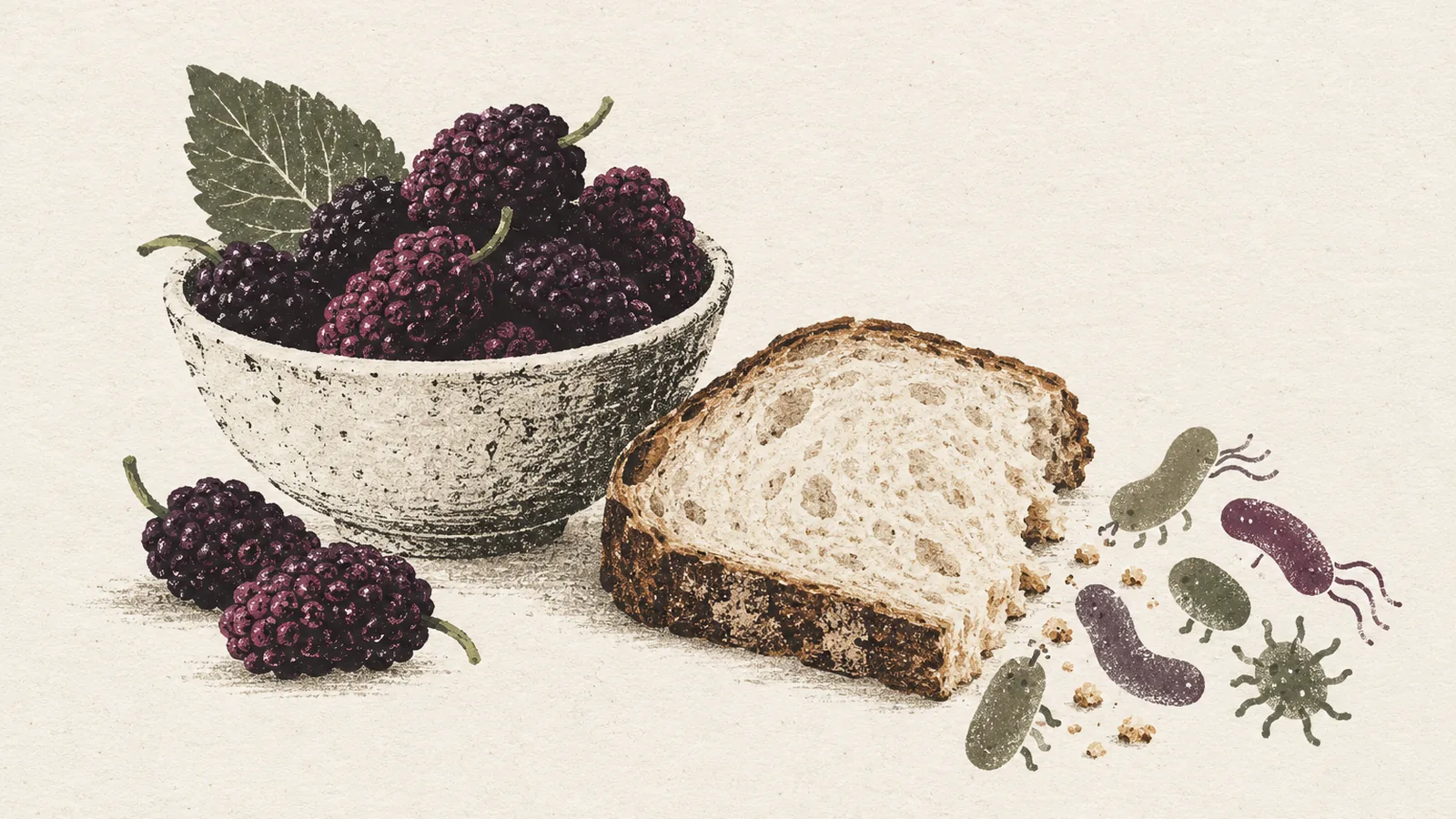
I had mulberry filed in the same mental drawer as cinnamon capsules and apple-cider-vinegar shots: a “blood sugar” plant that probably does a little something and mostly rides on vibes. I almost scrolled past a review of it last month. Then I read how it actually works, and it stopped me cold. Mulberry doesn’t so much lower your blood sugar as reroute the carbohydrate that would have become blood sugar, handing it off to the trillions of bacteria living in your colon. I have not stopped thinking about it since.
The review came from Anna Prescha’s group at Wroclaw Medical University, published in the journal Biomolecules under a title that quietly gives away the plot: “Mulberry, Gut Microbiota and Gut Functionality: Effects Shaped by Raw Material and Processing Methods.” The press version, picked up by ScienceDaily, ran the usual gentle “may reshape gut bacteria.” What the authors actually did was pull together the whole preclinical and test-tube literature on Morus alba and Morus nigra and ask a sharper question than the headline: under what conditions does this plant do anything at all, and by what route.
The route is where the biology gets strange. The active compound in mulberry leaves is 1-deoxynojirimycin, DNJ for short, an alpha-glucosidase inhibitor. In plain terms, it jams the enzyme in your small intestine that chops dietary carbohydrate into absorbable sugar, so some of that carbohydrate escapes being broken down and absorbed up top where it would spike your blood. It slides on down to the colon instead, where the bacteria sit waiting to be fed. So the plant isn’t really lowering your blood sugar so much as rerouting it, sending the carbohydrate your gut skipped straight to the microbes downstream. Wait, why would that help anything? Because your gut bugs ferment that leftover carbohydrate into short-chain fatty acids, the acetate, propionate, and butyrate that feed the cells lining your gut, and the review ties mulberry’s intestinal benefits to exactly that fermentation step. The sugar that didn’t spike your blood became bacteria food.
It gets weirder, and this is the part I had to reread twice. In mice, a 2020 study in mSystems traced the cholesterol-lowering side of mulberry DNJ and found it wasn’t really the DNJ’s doing at all. The benefit tracked indole-3-propionic acid, a molecule the gut bacteria build out of the DNJ, and when the researchers fed the mice that bacterial metabolite on its own, their lipids dropped anyway. So the compound isn’t working around your bacteria. It’s working through them. That reframes the whole thing for me: mulberry is less a drug you take than a message you pass to the ecosystem living in your gut.
Which bugs bloom when you pass it? Across the animal and in-vitro studies, the review reports fairly consistent enrichment of the metabolic greatest-hits list: Bifidobacterium, Lactobacillus and its relatives, and Akkermansia, the mucus-loving species that turns up every time someone finds a leaner, metabolically healthier gut. The inflammation-driving, lipopolysaccharide-producing taxa drop, and the Firmicutes-to-Bacteroidetes ratio that goes haywire in obesity edges back toward normal. In obese mice fed mulberry leaf polysaccharide, insulin resistance and fat deposition both eased alongside those microbial shifts, and in diabetic mice a mulberry-derived galacto-oligosaccharide improved glucose handling through the same gut route.
But the review’s sharpest point is the thing the supplement aisle erases completely: the effect depends entirely on which mulberry, which part, and how it was handled. Leaves carry the DNJ. Dark Morus nigra fruit carries the anthocyanins. Dry it past 70°C and you degrade the anthocyanins and chlorogenic acid you were paying for. Extract with water and you pull the polysaccharides; extract with acetone and you pull the phenolics instead. Ferment it and you can triple the GABA content while quietly destroying the vitamin C. The capsule on the shelf labeled “mulberry extract” tells you none of this, and after reading the review I honestly don’t know what most of them contain. Two products with the identical name can do opposite amounts of nothing.
There’s a lovely whole-food wrinkle buried in here too. The single most effective preparation the authors flagged wasn’t a purified compound at all. It was a mulberry leaf fraction combining polyphenols and fiber, which beat either fraction given alone for weight loss and microbial diversity in mice. The matrix matters: the polyphenols and the fiber did more bundled together than either managed solo, which is about as close as the data comes to saying the plant already knows how to package itself.
So where does that leave the bottle on the shelf? The marketing fuses two separate things together and hopes you won’t pull them apart. Every microbiome result I just walked you through is mice and petri dishes. The Wroclaw review says so plainly: no human study has yet tested whether eating mulberry reshapes a living person’s gut. Now set that against the one effect that has been tested in people, the post-meal glucose blunting, which shows up in a randomized human trial and a 2024 DNJ meta-analysis covering 12 trials and 615 participants. The glucose effect rests on 12 human trials and 615 participants. The microbiome makeover rests on 0. What’s proven in humans is modest: mulberry takes the edge off the sugar spike after a meal. What’s being sold, the gut reset, lives only in rodents.
The supplement industry lives in that gap. Take the modest-but-tested human glucose data, staple it to the splashy mouse-microbiome headline, blur the two into one capsule, and charge you accordingly for a “gut reset.” The honest version is less sexy and more interesting: mulberry is, in the Wroclaw group’s own words, a promising food and research target rather than a proven treatment.
So what will I actually do with this? I’ll eat the real thing. The dark fruit when I can get it, the leaf brewed as tea, treated as a food that nudges my post-meal glucose and probably feeds my gut something good, not as medicine. What I won’t do is buy the standardized “gut-reset” mulberry capsule on the strength of a mouse colon and a chemistry I can’t read off the label. When the first real human microbiome trial lands, I’ll change my mind in whichever direction it points. Until then, I’m treating mulberry like dinner, not a prescription.
Sources
- Biomolecules – Miszczak et al., “Mulberry, Gut Microbiota and Gut Functionality: Effects Shaped by Raw Material and Processing Methods” (2026)
- PMC open-access full text of the same review
- ScienceDaily – “Mulberry may reshape gut bacteria and influence metabolism” (2026)
- Randomized human trial – bioequivalence of mulberry fruit extract and DNJ for postprandial blood glucose (2025)
- NFS Journal – “Effects of 1-Deoxynojirimycin on glycemic control: a systematic review and meta-analysis” (2024)
- mSystems – gut-bacteria-produced indole-3-propionic acid confers the lipid-lowering effect of mulberry DNJ in mice (2020)
- Mulberry leaf polysaccharide ameliorates insulin resistance and adipose deposition in high-fat-diet obese mice
- Journal of Functional Foods – mulberry galacto-oligosaccharide, glucose metabolism and gut microbiota in type 2 diabetic mice (2021)
- Wroclaw Medical University – “Mulberry and gut microbiota: what does research show?”