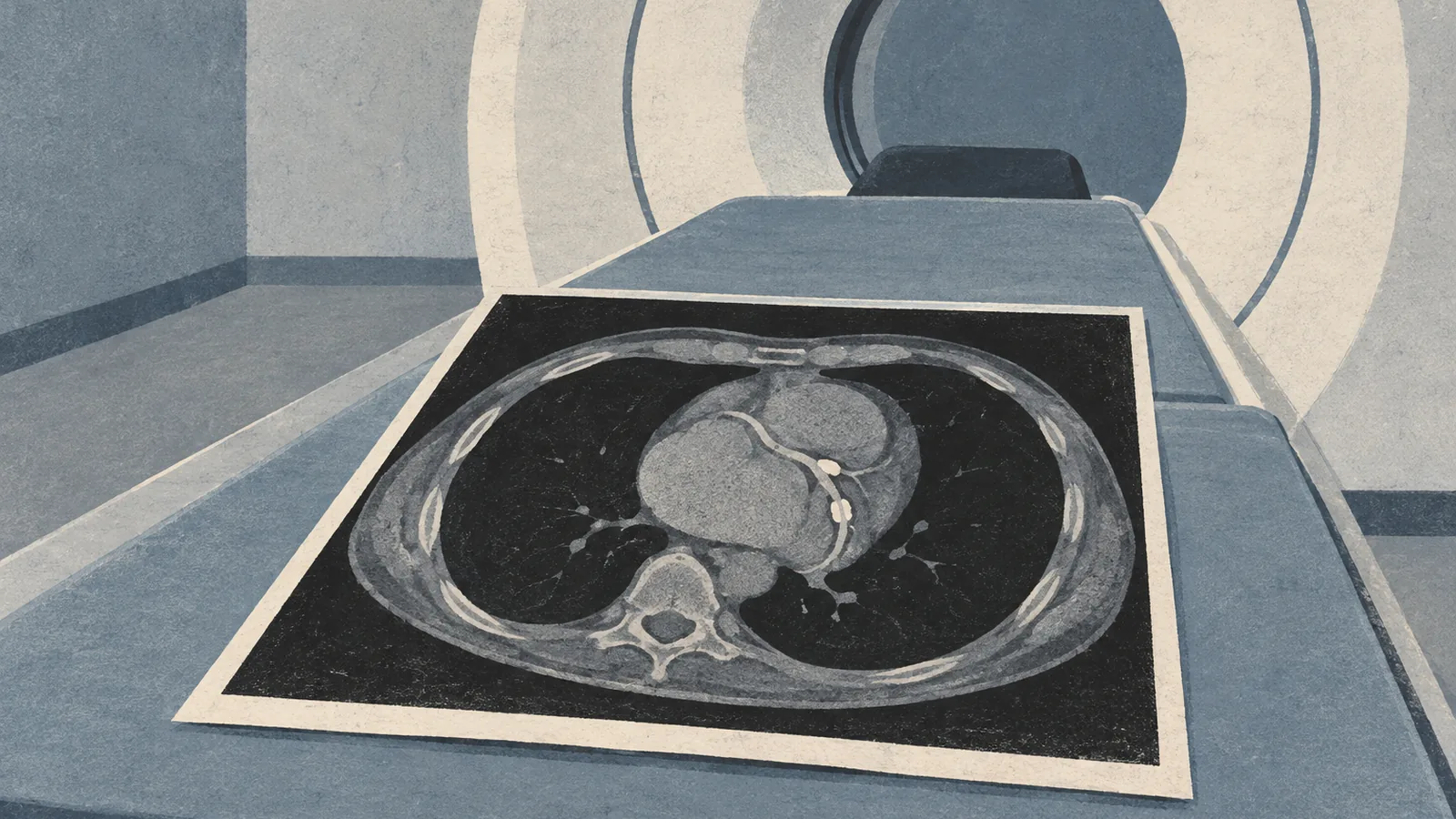
A coronary calcium scan is one of the few cardiac tests that looks straight at the disease instead of a stand-in for it. Not a cholesterol number, not a blood-pressure cuff, but the calcified plaque itself, lit up on a CT slice and tallied into a single figure that has a name and a birthday. Arthur Agatston and his colleagues published the scoring method in 1990, and for most of the three decades since, the pitch for the test kept outrunning the evidence under it. “The power of zero” became the slogan: a score of zero means low near-term risk, so, the reasoning went, anyone worried about their heart should go get scanned. Cash-pay scan shops made the offer easy to take. A Northwestern team has now run that promise against a decade of data, and the answer is a great deal narrower than the slogan.
The study, published in JAMA on August 26, drew on the long-running Multi-Ethnic Study of Atherosclerosis and followed 6,098 adults, average age 61, for ten years, during which 366 of them, about 6 percent, had a heart attack or stroke. The question was whether bolting a calcium score onto the American Heart Association’s free online risk tool, the PREVENT equations, actually sharpened the prediction. Across the whole group it barely did. The model’s ability to sort who would have an event from who would not rose from a C-statistic of 0.73 to 0.75, and the net reclassification improvement came to 0.095. In the authors’ own careful phrasing, adding the score “only modestly improved and, in some groups, did not change” the prediction.
An average, though, is where the interesting cases go to hide. Split the cohort by predicted risk and look at the borderline band, the people a calculator pegs at a 3 to 5 percent ten-year risk, and the scan does real work, because that is exactly the group whose statin decision is a genuine coin flip. Same label, wildly different fates depending on what the CT saw. Among borderline patients, a calcium score of zero came with a 1.9 percent ten-year event rate, a score above zero but under 100 with 3.9 percent, a score of 100 to 300 with 7.4 percent, and a score of 300 or more with 14.3 percent. That is a sevenfold spread in actual event rates inside a single bucket the formula could not tell apart. The scan does not confirm what the calculator already knows. It breaks the ties the calculator cannot.
There is a mechanism under the pattern. When the equation is already shouting high, the scan changes nothing, because that patient gets a statin no matter what the calcium looks like. When the equation says low, the scan mostly just agrees. The information lives in the murky middle, where the number could plausibly break either way and the image is what finally settles it. “Not everyone necessarily needs or would benefit from a CAC scan,” Nilay Shah, the Northwestern cardiologist who led the analysis, told reporters, which is the understated version of what the numbers say outright: the everyone-get-scanned pitch was aimed at the wrong crowd all along.
Here is where the incentives run backward. The patients this study says benefit, the borderline cases with an uncertain call, are largely the ones paying cash, because insurers and Medicare still do not routinely cover the scan, treating it as optional even as they cover the statin that follows and the hospital bill when prevention fails. A scan runs roughly $100 to $400 out of pocket. So the money flows exactly the wrong way: the low-risk worried-well customer who gains almost nothing keeps the storefront-scan economy humming, while the middle-risk patient who would get a genuine answer has to decide whether a few hundred unreimbursed dollars is worth it.
No scanner company paid for this. The money came from the American Heart Association and the National Heart, Lung, and Blood Institute, not a device maker and not a drug company. The business with something to lose in these results is not the pill. It is the scan-for-everyone pitch, the premise that every adult past a certain age ought to be imaged, and that premise is precisely what the data just deflated.
The guideline writers have, to their credit, already drawn the line roughly where this study puts it, steering the calcium score toward the borderline-and-intermediate patient whose statin decision is unresolved rather than toward the general public. The slower actor is coverage. Watch CMS, because once the evidence shows the benefit is both concentrated and identifiable, refusing to pay for the test for exactly the patients it helps gets harder to defend. A test that took thirty years to earn its place in cardiology may spend the next few having that place drawn far more precisely. And for most people the plainest line in the paper is the useful one: if a free calculator already has you pegged, high or low, you probably do not need the scan at all.
Sources
- JAMA – Predictive Utility of Coronary Artery Calcium Score Added to the PREVENT ASCVD Equations (2026)
- STAT – On the fence about a statin? In borderline cases, calcium scans could be a tiebreaker (Aug 26, 2026)
- ScienceDaily – “Who really needs a heart calcium scan?” (2026)
- DAIC – How the Agatston calcium score was created (Agatston, 1990)