For two years I had Ozempic filed under “appetite drug.” You take it, you eat less, the weight comes off, and as far as I was concerned the interesting biology stopped right there. A paper out of Berkeley just took that filing apart on my desk.
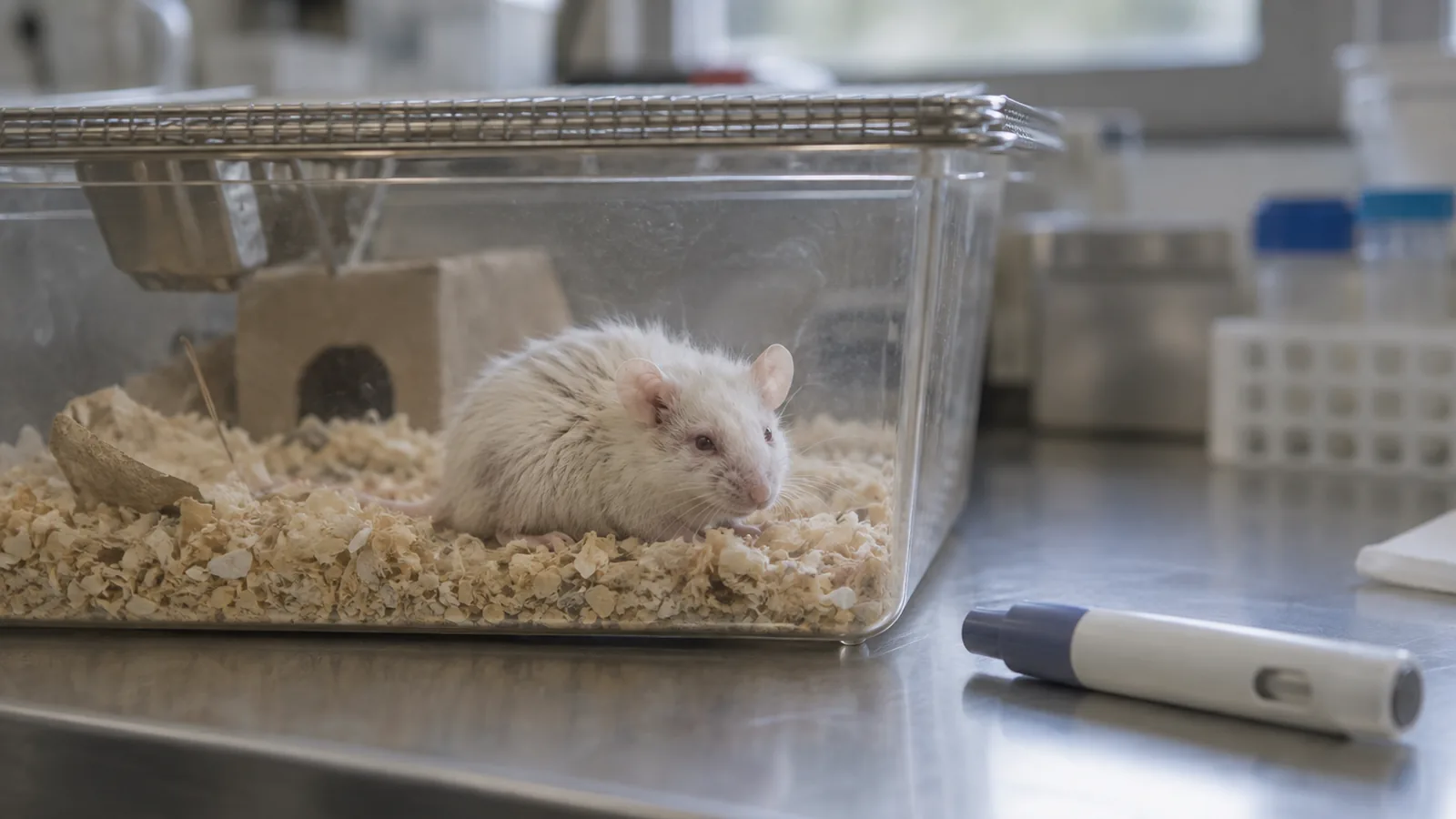
On September 2, a team led by Danica Chen at UC Berkeley reported in Nature that semaglutide, the molecule inside Ozempic and Wegovy, made healthy old mice live measurably longer. These weren’t sick mice or obese mice. They were 20-month-old females, roughly a person in their sixties, dosed for three months, late in a life already tilting downhill. The treated animals reached a median lifespan of 834 days against 742 for the untreated group, about 92 extra days, a 12 percent bump, from a drug that didn’t start until the mice were already old.
My first instinct was to wave it off, because the obvious explanation is boring. The drug blunts appetite, the mice eat less, and eating less has stretched lifespan in lab animals for a century. Semaglutide did exactly that. It cut their food intake by 24 percent, and the weight came off mostly as fat. So far, so Ozempic. If that were all of it, this would be a very expensive way to reproduce a diet.
Except the Berkeley team ran the diet as a control. They put a separate group of old mice on straight calorie restriction, the gold-standard longevity intervention every aging lab measures itself against, and the drug did not just keep pace with it. On spatial memory, exploratory drive, and blood-sugar control, semaglutide pushed the old animals above where they started while calorie restriction mostly held them near it.
Then came the detail that got me out of my chair. Starve an animal and its metabolism downshifts; the body reads the shortage and banks fuel to survive it, and the calorie-restricted mice did precisely that. The semaglutide mice did not. Their metabolic rate stayed roughly where it started, and they collected the longevity payoff anyway. Wait, why would that even work? How do you get the reward of eating less without the body sliding into conservation mode to earn it? It tells you GLP-1 is pulling a lever that sits right next to the calorie-restriction lever, not the same one. Chen’s read is that the drug taps a pathway independent of calorie restriction, and the gene-activity data backs her: the treated mice carried less of the low-grade inflammation and more of the tissue-repair capacity that both fray as a body ages.
Now the skeptic hat, because the headline making the rounds, “Ozempic may slow aging itself,” is carrying weight a mouse study cannot. Give the science its due first: this was not a Novo Nordisk marketing exercise dressed as data. It was funded by the NIH’s National Institute on Aging, academic work published in Nature, with the company that sells the drug nowhere in the funding line. That matters, because most of what you read about these drugs is sponsored one way or another. What should make you wary is who benefits from the “anti-aging” spin regardless: a diabetes drug rebranded as a fountain of youth is about the best thing that could happen to Novo Nordisk’s balance sheet, and the company didn’t have to spend a cent to get the headline.
The same restraint has to cut the other way, too. Every mouse in the study was female, and the researchers say outright they do not know whether males respond the same. Three months of dosing in a mouse is not thirty years in a person. And “beat dieting,” the version tearing around social media, is not what the data shows yet: the head-to-head test of whether semaglutide or calorie restriction extends lifespan more is still running. Nir Barzilai at Albert Einstein, who has spent a career on this exact question, told Scientific American the comparison is unsettled: “Maybe calorie restriction increases the lifespan more? The data is not there, and it bugs me.”
Look at what semaglutide is actually cleared to do. Ozempic’s label covers glycemic control in type 2 diabetes, cardiovascular risk in diabetics with heart disease, and, as of January 2025, slowing kidney disease in diabetics with chronic kidney disease. Every one of those is tethered to diabetes. No regulator has evaluated a longevity claim, for the simple reason that no human longevity data exists to evaluate. The distance between “extended median lifespan in aged female mice” and “slows aging” is exactly the distance that headline erased.
Then there is muscle, and this is where I get wary. In people, GLP-1 drugs strip weight off fast, and a lot of what leaves is not fat. Depending on the trial, between 26 and 40 percent of the weight people lose on these drugs is lean mass, the muscle you spend your later decades fighting to keep. The Berkeley mice mostly lost fat, which is reassuring, but a female mouse dosed for three months is not a seventy-year-old taking this for twenty years. If anyone ever tries to sell semaglutide as an aging drug, muscle is the axis it looks weakest on, and losing muscle is what actually steals independence in old age.
So where does this leave me. More curious than when I started, which is rare for a drug story, because a longevity payoff without the metabolic slowdown is the kind of surprise that makes me want the next experiment yesterday. But curious is not sold. I am not going to treat a diabetes drug as a longevity supplement on the strength of one mouse study, I would not ask my doctor for semaglutide to age more slowly, and I would side-eye anyone who tells you to. What I would do is the exact thing these mice were measured against: eat a little less, guard my muscle, and wait for the human trial that answers the question this sharp little mouse study only had the nerve to raise.
Sources
- Nature – Chen et al., “Late-life semaglutide treatment slows ageing and extends lifespan in female mice” (Sept 2, 2026)
- NIH / National Institute on Aging – “GLP-1 treatment late in life extends lifespan in animal model”
- UC Berkeley Research – “GLP-1 treatment extends the lifespan of older, healthy mice”
- News-Medical – “Semaglutide extended lifespan in older female mice, but that was not the only finding”
- Scientific American – “GLP-1 weight-loss medication could slow aging and extend lifespan”
- Circulation – “Muscle Mass and Glucagon-Like Peptide-1 Receptor Agonists: Adaptive or Maladaptive Response to Weight Loss?”
- FDA – Ozempic (semaglutide) prescribing label, NDA 213051
- National Kidney Foundation – “FDA Approves Ozempic for Type 2 Diabetes and Chronic Kidney Disease”
- ScienceDaily – “Scientists find Ozempic may slow aging itself”
- Nature News – “Can GLP-1 drugs slow ageing? Mouse study shows promise”