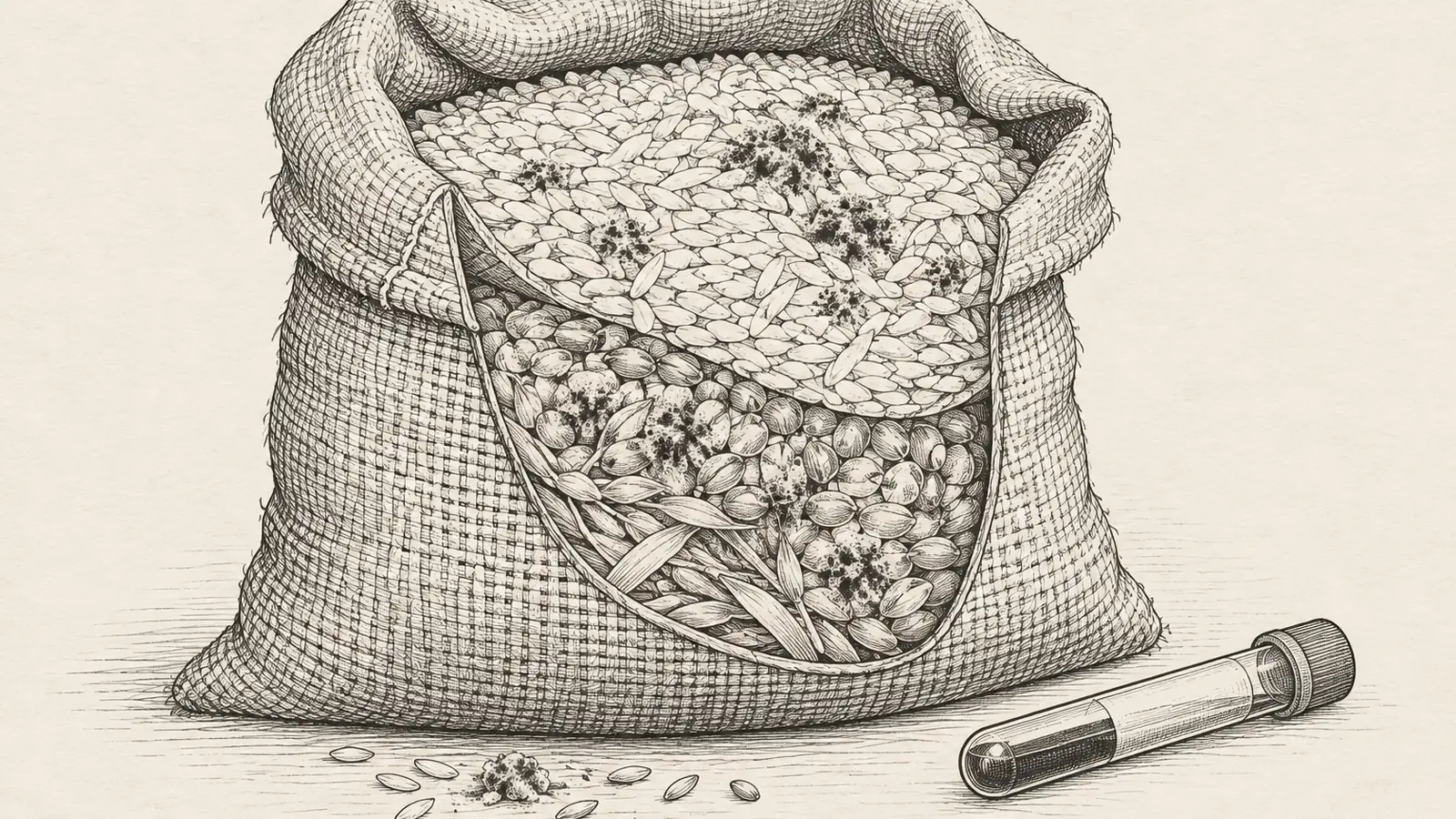
I have spent a lot of time reassuring people that the dose makes the poison, that trace contamination is not the same as harm, that the body clears this stuff better than the wellness internet wants you to believe. So a study that drew blood from 719 women and children in rural Bangladesh and found mold toxins in every single sample made me set my own reassurances down for a minute.
Every whole-blood sample carried at least two of these toxins at once. 84 percent of the people tested were carrying three or more. I read that line twice.
The study, published this month in Environmental Health, pulled residual blood banked during a 2019 endline survey from 433 women and 286 children who were part of a cluster-randomized trial. Researchers ran 712 whole-blood and 578 serum samples through UHPLC mass spectrometry, the kind of instrument that picks a molecule out of a crowd by its exact weight, hunting a family of fungal poisons called mycotoxins: aflatoxin B1, ochratoxin A, and citrinin, the metabolic waste of molds that grow on grain and nuts left warm and damp in storage. It looked routine in this cohort, not a fluke of one bad harvest or one bad shipment. Low-grade fungal poison as an ordinary condition of eating, at least for these families.
The most common offender, aflatoxin B1, isn’t some novel chemical of uncertain danger. It’s one of the most potent naturally occurring carcinogens we know of, which the International Agency for Research on Cancer files in Group 1, its top hazard tier, the same category that holds tobacco smoke and asbestos. That shared class is a statement about how sure we are a thing causes cancer, not about the size of the everyday risk.
But aflatoxin B1 isn’t the poison, not yet. When you swallow it on a contaminated peanut or a bowl of rice, the molecule is fairly inert. Then it reaches your liver, and your liver, trying to be helpful, grabs it with the same cytochrome-P450 machinery it uses to detoxify a thousand other things and converts it into a reactive epoxide. That activated form is the assassin. It slots into your DNA, binds to guanine, and in the liver it has a signature move: it mutates one specific spot, codon 249, on the p53 tumor-suppressor gene, the exact gene whose job is to stop a damaged cell from becoming a cancer. Wait, why would your own detox system be the thing that arms the weapon? Because your liver evolved to make fat-soluble junk water-soluble so you can flush it out, and the chemistry that pulls that off is the same chemistry that turns aflatoxin into something able to grab a chromosome on the way through. Your body activates it in the act of trying to get rid of it.
The way researchers measure this is a small piece of grim elegance. That reactive form doesn’t only hit DNA. It also latches onto lysine, an amino acid on albumin, the most abundant protein in your blood. So they measure the aflatoxin-albumin adduct, a molecular fingerprint of how much active toxin your tissues saw over the past couple of months. It’s a receipt, and the blood keeps it.
To turn detection into risk, the team back-calculated a probable daily intake from the blood levels and ran it through standard toxicology tools: a margin of exposure for the carcinogen, hazard quotients for the kidney toxins. That margin-of-exposure approach exists precisely because for a genotoxic carcinogen like aflatoxin there is no comfortable threshold below which the DNA damage simply stops. The other two toxins are their own problem. Ochratoxin A and citrinin both go after the kidneys, and ochratoxin A is itself flagged as a possible human carcinogen.
The honest version is scary enough without inflating it, so here is what this study does and does not show. It is a biomonitoring snapshot. It proves exposure, widespread and layered, and it estimates the risk that exposure implies. It does not follow these particular women and children forward to count tumors. For that you look at the surrounding literature, and it isn’t comforting. A separate longitudinal study of Bangladeshi children, funded by the Gates Foundation, tracked aflatoxin-albumin in kids at 15, 24, and 36 months and tied chronic exposure to lower cognitive scores (β −0.69), lower receptive language (β −0.90), and lower expressive language (β −1.01). Motor skills came through untouched. It was the thinking and the talking that took the hit. And risk modeling has attributed a share of Bangladesh’s liver cancer to aflatoxin, an effect that multiplies in people also carrying hepatitis B.
The reflex is to file this under poor-country problem, a storage-and-sanitation issue a wealthier food system already solved. I reached for that framing too, and then I read the 2022 biomonitoring work out of Switzerland that detected ochratoxin A and citrinin in the blood serum of Swiss adults. Lower exposure, sure. Absent, no. The gap between rural Bangladesh and a rich Western country is dose and co-exposure, not presence. If you eat grains, coffee, dried fruit, spices, or nuts, some low level of this is plausibly moving through your liver too.
There is a partial defense, at least for one organ. One line of research shows the blood-brain barrier actively pumps ochratoxin A and citrinin back out, keeping the brain’s exposure below the blood’s. The liver and kidneys don’t get that reprieve. They are the tissues that process and concentrate these compounds, so they are where the exposure lands hardest.
What stays with me is who absorbs the rest. The most vulnerable liver in that Bangladeshi dataset belongs to a small child whose brain is still wiring itself, and the exposure doesn’t even wait for solid food: a separate study in rural Yazd, Iran found aflatoxin’s metabolite, aflatoxin M1, along with ochratoxin A, in breast milk. This is a contaminant that finds the people least able to say no to it.
So what do I actually do with this, as someone who is not about to move into a mold-free bunker? I’m not tossing my pantry, and I’m not buying a mycotoxin test kit off an ad. But I have quietly changed two habits. I throw out nuts and grains that smell musty or look off instead of picking around the bad bits, and I keep what I buy dry and cool and don’t let it sit for a year, because heat and humidity and time are exactly what the mold wants. It is a small, unglamorous defense against a toxin my own liver would otherwise be glad to activate on its behalf.
Sources
- Environmental Health – Chronic exposure to aflatoxin B1, ochratoxin A, and citrinin in women and children, blood biomonitoring evidence from rural Bangladesh (2026)
- Aflatoxin B1-induced hepatocellular carcinoma in developing countries: geographical distribution, mechanism of action and prevention (2013)
- Toxins – Chronic aflatoxin exposure and cognitive and language development in young children of Bangladesh, a longitudinal study (2022)
- Food Additives & Contaminants – Risk assessment of aflatoxin-related liver cancer in Bangladesh (2019)
- Mycotoxin Research – Biomonitoring of ochratoxin A, 2′R-ochratoxin A and citrinin in human blood serum from Switzerland (2022)
- Toxins – Efflux at the blood-brain barrier reduces cerebral exposure to ochratoxin A and citrinin (2021)
- Mycotoxin Research – Aflatoxin M1 and ochratoxin A in breast milk, rural Yazd, Iran (2024)