I have spent years quietly treating rice as the thing on the plate to apologize for. The white mound next to the salmon, the carb you have half of, the reason your smartwatch draws that steep little glucose hill an hour after dinner. So when I read that a team of chemists in Japan had gone looking through fifty-six kinds of rice and found a fat worth getting excited about, my first reaction was a flat no, followed by a genuine “wait, there’s fat in rice worth naming?”
There is. And it belongs to a family of molecules your own body already uses to keep insulin working, the same metabolic lever the entire Ozempic economy spent billions of dollars learning to pull. That is a strange sentence to be able to write about a grain, so let me walk you through how it got true.
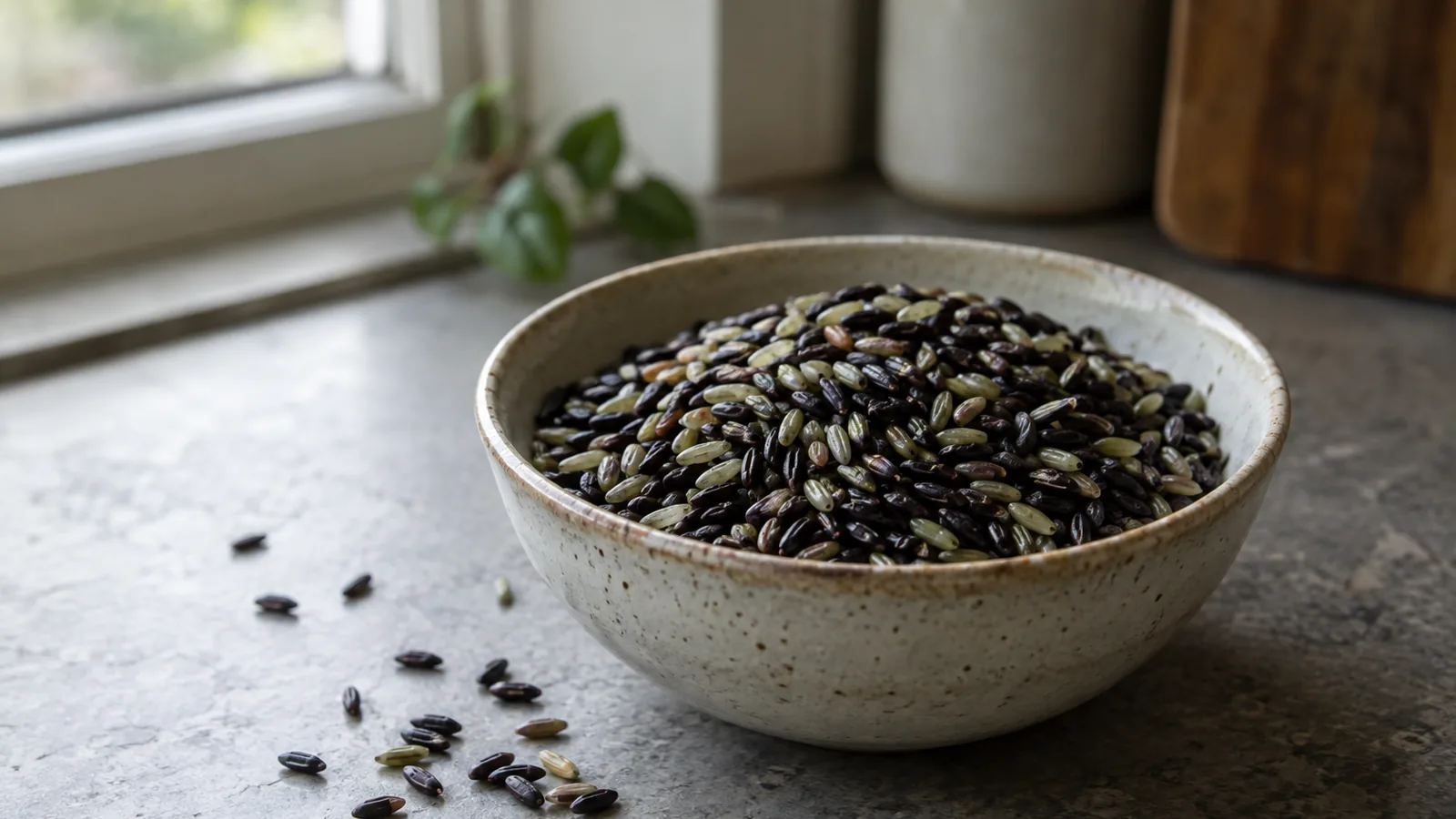
A group at Hokkaido University, led by Associate Professor Siddabasave Gowda, ran 56 japonica rice cultivars from across Japan (brown, red, green, black) through liquid chromatography and mass spectrometry, and catalogued the lipids that make up the tiny fatty fraction of the grain. Their paper in Food Research International reports 196 distinct lipid molecules across five major families. Rice is only about one to two percent fat, so almost nobody bothers to look there. This team did, and inside the pigmented varieties they found a class of lipids that had never been detected in rice before.
They are called FAHMFAs, fatty acid esters of hydroxy medium-chain fatty acids. That is a mouthful, so let me tell you why the name made me sit up. Strip off the “medium-chain” part and you are looking at a cousin of the FAHFAs, and FAHFAs are one of the more quietly remarkable finds in recent metabolic biology.
In 2014, Barbara Kahn’s lab at Harvard was studying mice engineered to be unusually good at handling glucose, and they found a brand-new class of lipids in their fat tissue, elevated as much as 16 to 18 fold. One member, called PAHSA, closely tracked insulin sensitivity: in insulin-resistant people, blood and tissue levels ran low. Give PAHSA to mice and their glucose tolerance improves, and here is where it crossed into my beat. It does part of its work by nudging gut cells to release GLP-1, the same hormone the injectables chase. The drugs mimic GLP-1 at its receptor from the outside. PAHSA coaxes your body into making more of its own. Your metabolism, it turns out, already keeps a version of that machinery on staff. It just runs it down when things are going badly.
So when a rice study surfaces a structural relative of that family, sitting inside black and green grains, the curious question writes itself. Why would a food carry the same kind of molecule your own fat tissue uses to keep insulin honest? I do not have a clean answer, and neither, honestly, does the paper. But that is the thread worth pulling, and it is why “there’s an interesting fat in rice” stopped sounding like a throwaway line to me.
The pigmented varieties also did something with their starch. When the Hokkaido team simulated digestion in the lab, exposing cooked rice to digestive enzymes, the black and green cultivars broke down their starch more slowly than white rice, which could translate to a gentler, more gradual rise in blood glucose. Combined with the lipid profile, that gave the colored rices what the researchers call a higher health-promotion index.
Now let me be the honest friend rather than the excited one, because the boundary here matters. That slower-digestion result happened in a tube full of enzymes, not in a person wearing a glucose monitor. Nobody in this study fed black rice to a human and watched their blood sugar. And the FAHMFA finding is a chemical inventory: the molecules are present in the grain at levels a mass spectrometer can read. Whether eating that grain delivers enough of them, intact, past your stomach acid and into a tissue where they could do anything, is a separate question this paper does not touch. The leap from “black rice contains a FAHFA cousin” to “eat black rice to fix your insulin sensitivity” is one no data here can carry, and I would be shilling if I let the enthusiasm outrun that.
What I appreciate is that this is not a supplement launch dressed up as science. There is no rice-extract capsule with a “clinically studied bioactive” sticker waiting at the end of this press cycle. The work was paid for by Japanese public science grants, the JSPS and JST SPRING programs, with no industry sponsor disclosed. Gowda’s group has spent years on this same patient, unglamorous lipidomics, mapping the bioactive fats in dietary fish, herbal teas, and seaweeds that standard nutrition labels never capture. That is the opposite of the model where a drug company isolates one molecule, patents it, and prices it like a luxury good. It is someone looking hard at the food people already eat and asking what is actually in there.
And that reframes the whole finding for me. We have built a four-figure-a-month pharmaceutical economy around drugs that mimic GLP-1 at its receptor, while the question of whether a pigmented whole grain quietly brushes some of the same circuitry went unasked, because nobody looked at the fat in rice. This one study does not answer it. It makes the question legitimate, and it puts it where it belongs: on real food, funded by public money, instead of on the next injectable.
So what do I actually do with this. I am not going to tell you black rice is a blood-sugar cure, because that evidence does not exist yet and pretending otherwise is the exact move I distrust. But black and green rice are genuinely different grains from the white default, with slower-digesting starch and a richer, stranger lipid profile, and they are delicious. I already reach for them, and after reading this I will keep doing it without waiting for the human trial, because for most people swapping in a whole grain you already tolerate is about as low-stakes a bet as food gets, and the upside is a plate I enjoy that might be doing something quietly good. What I will not do is buy the first “rice FAHMFA” supplement that shows up, and I would bet you a bag of forbidden black rice that one is already in development.
Sources
- Food Research International – Gowda et al., lipidomic profiling of 56 japonica rice cultivars (2026)
- Hokkaido University – “Japanese pigmented rice contains unique beneficial fats” (press release, 2026)
- Cell – Yore et al., “Discovery of a Class of Endogenous Mammalian Lipids with Anti-Diabetic and Anti-inflammatory Effects” (2014; 159:318-332)
- ScienceDaily – “Scientists find a hidden health advantage in black and green rice” (2026)