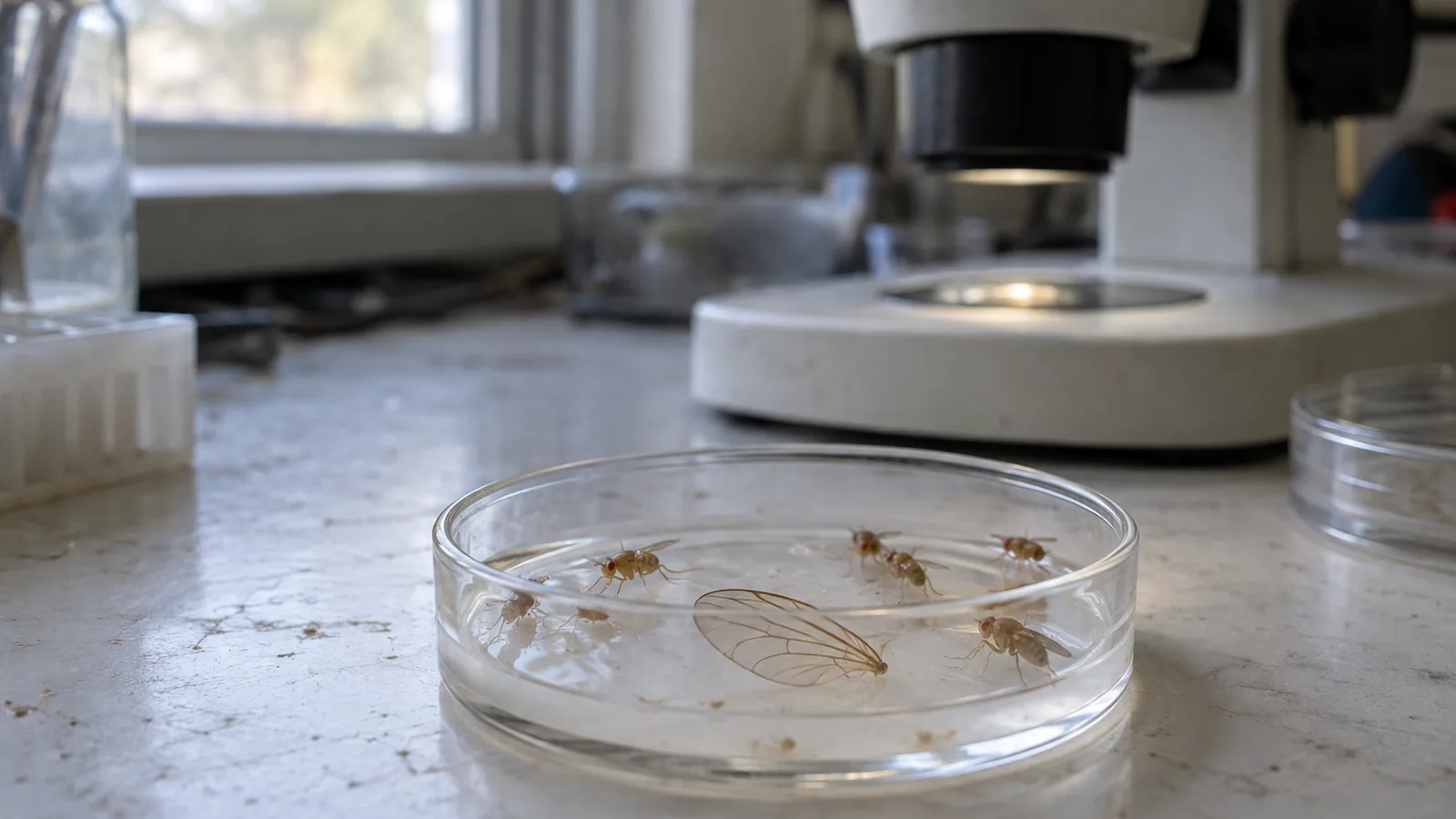
For most of a century, a fruit fly has been quietly embarrassing the rest of us. Cut into the pouch of cells that will grow into its wing, and the larva does something the adult human body mostly gave up long before we are born: it notices the damage, works out what is missing, and grows the part back. Now a lab in Barcelona has found the strange catch. Disturb the way that pouch folds its DNA after a wound, and the fly still builds a flawless wing from scratch. It just can’t fix a damaged one.
Biologists have poked at the wing imaginal disc for generations, cataloguing which genes flicker on when the tissue is torn. The list is long and, by now, familiar. What it never explained was where the instructions to heal actually lived.
A team led by Montserrat Corominas at the University of Barcelona, working with Marc Martí-Renom at the National Center for Genomic Analysis and colleagues at the University of Lausanne, went looking somewhere the old catalogues did not: not in the genes themselves, but in the way the genome physically folds around them. Their answer ran in Science Advances on August 7.
When the wing disc is injured, the DNA inside the nucleus does more than switch genes on and off. It re-folds. Distant stretches of the chromosome reach across the nucleus and make contact, forming physical bridges the researchers call long-range chromatin loops. The team pinned down three of them, L1, L2, and L3, on the left arm of chromosome 2, and confirmed with fluorescence imaging that the contacts were real, that these far-apart regions were genuinely coming together after the wound.
Then came the experiment that settled it. They altered the genomic regions that let those loops form and watched what the tissue could and could not do. Take the anchors away and the fly still built a perfectly ordinary wing; it simply could no longer repair one well. “When we altered the regions responsible for their formation,” said lead author Carlos Camilleri-Robles, “the tissues’ regenerative capacity was significantly reduced,” while normal development carried on virtually untouched.
Sit with that, because it unsettles a comfortable assumption. Development and regeneration read the same genome, in the same cells, using much the same genes, and it has been tempting to treat healing as simply development running a second time on demand. This complicates that picture. The same DNA can construct a wing from nothing without these loops and still be helpless to mend one, which means repair is not just development played back. It has its own architecture, a three-dimensional geometry the cell assembles only when something has gone wrong.
It is worth being precise about what has and has not been shown, because regeneration is a word press releases like to let run ahead of the evidence. This is a fruit fly, and the healing tissue is a larval wing disc, not a person’s skin or spinal cord or heart. Nobody has shown that a mammalian wound answers to the same fold, and the distance between an insect’s imaginal disc and a human’s chronic ulcer is not a gap to wave past. What the Barcelona group has found is a new kind of switch, not a therapy.
The work was paid for out of public money: Spain’s state research agency, the Ministry of Universities, and Catalonia’s regional grants program. No company appears in the funding record. It is the unglamorous kind of science that answers a question because the question is interesting, the kind that does not survive well when public research budgets get treated as discretionary.
For decades the question in regeneration was which genes switch on. The Barcelona group has added a harder one: whether the genome bends itself into the right shape to let those genes talk, and whether that shape can fail on its own. “Our results identify a previously unknown role for genome architecture in tissue repair,” said co-author Palmira Llorens-Giralt. She is describing a fly wing. Whether the same loops, or their equivalents, decide how a human body closes a wound is now a question a lab in Barcelona has made it worth someone’s trouble to ask.
Sources
- Science Advances – Camilleri-Robles, Llorens-Giralt, Corominas et al., “3D genome organization in tissue regeneration involves long-range chromatin loops” (Aug 7, 2026)
- Science Advances open-access full text (Europe PMC, PMC13450218)
- Phys.org – “Three DNA loops prove essential for efficient wing tissue regeneration in fruit flies”
- News-Medical – “Study identifies DNA loops as essential for tissue regeneration” (Sept 15, 2026)
- EurekAlert – “Researchers discover DNA organization is key to tissue regeneration”
- Parc Científic de Barcelona – UB/CNAG press release on the study