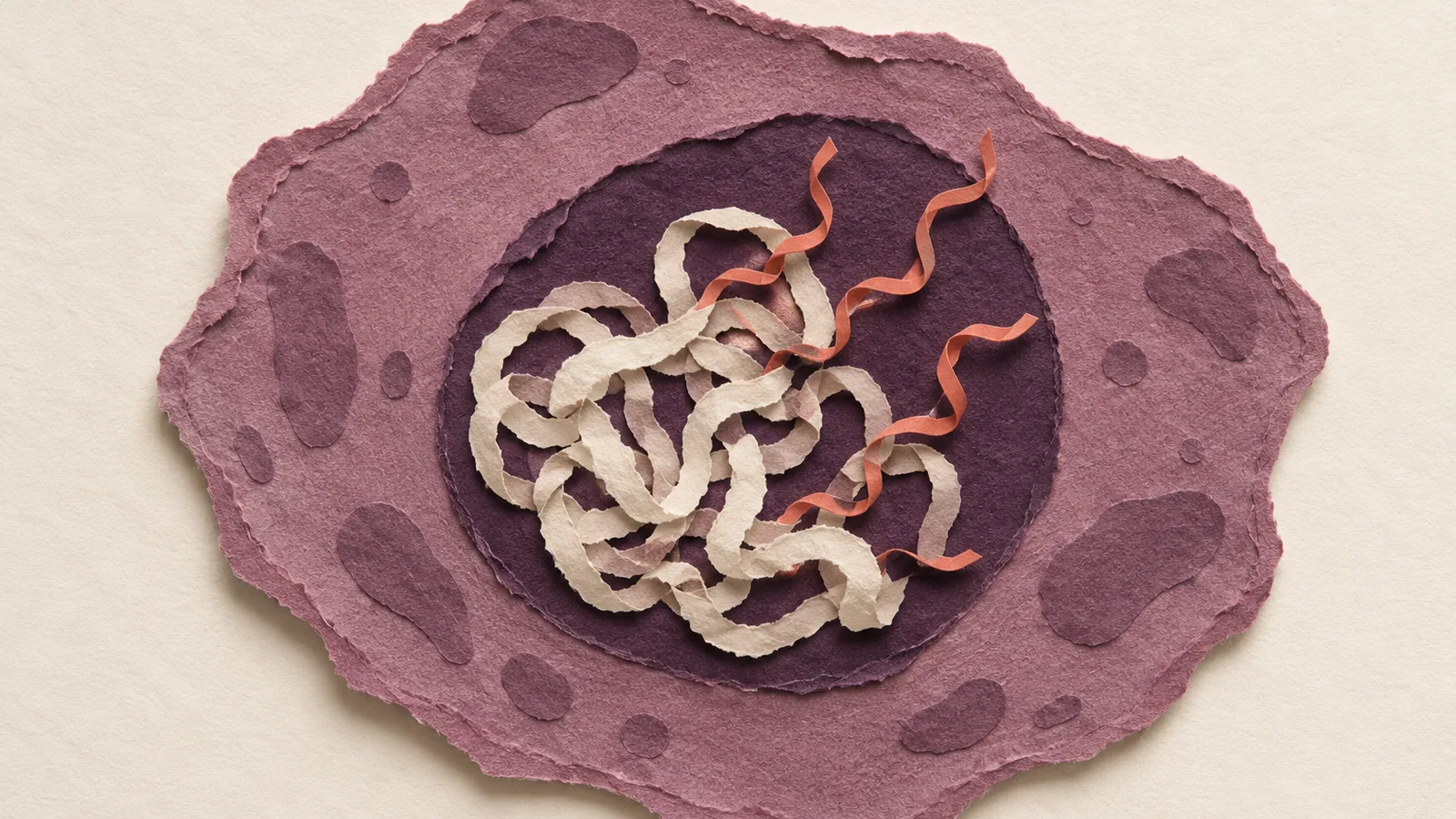
I had always pictured jumping genes as fossils: viral-looking stretches of DNA that got bolted shut a few million years ago and stayed that way. So I wasn’t ready for how fast the bolts came off. Penn State researchers removed a single protein from human colorectal cancer cells, and within two hours transcription had climbed at about three quarters of the LINE jumping genes they were tracking.
Then came the result that sent me back to the figures. The team ran the experiment two ways, once removing a protein called CNOT1 and once removing one called CNOT4, both tied to the same molecular machine. Either removal made the cell churn out more jumping-gene RNA. But once that RNA existed, losing CNOT1 made it linger while losing CNOT4 made it break down faster, so the same machine, it turns out, pulls the same RNA two ways.
The machine is CCR4-NOT, and if you took a cell biology class you met it as an RNA shredder, the complex that trims the tails off messenger RNAs so they can be destroyed. Shardul Kulkarni, an assistant research professor of biochemistry and molecular biology at Penn State and the lead author, wanted to know what it does in the nucleus, where RNA gets made. His answer, now in the Journal of Biological Chemistry, is that it also helps keep the genome’s parasitic DNA quiet. “Our work reveals that a molecular complex best known for controlling RNA also acts as a guardian,” he said in Penn State’s announcement. I like the word less after seeing the RNA-lifespan data, and I’ll get to why.
Penn State puts it this way: as much as half of the human genome is built from jumping-gene sequence, most of it long since broken, and when these elements move they can create mutations that have been associated with neurodevelopmental disorders, autoimmune disease and cancer. LINE-1 is the family that still has teeth, because some full-length copies carry the instructions to turn their own RNA back into DNA and paste it somewhere new.
Two hours, three quarters of the LINEs
The design is what makes me trust the speed. Delete a gene and wait days, and the cell has time to rewire around the loss. Instead, the team tagged CNOT1, the complex’s central scaffold, and CNOT4 so that a dose of the plant hormone auxin destroys them in about an hour. Then they fed the cells a 15-minute chemical label that marks only freshly made RNA, a technique called TT-seq, and read out what was being transcribed in that moment. The cells were DLD-1, a colorectal cancer line, and it’s the only line in the study; cancer cells already run their genome regulation off-script, so all of this still has to be checked in normal tissue. Two NIH National Institute of General Medical Sciences grants paid for the work.
The bioRxiv preprint has the numbers. Pull either protein and transcription rises across the genome by two hours, and of the genes that changed, at least 80 percent went up. Of the 15,611 LINE elements the team analyzed, about 77 percent showed increased transcription at 2 hours, and roughly 79 percent were still elevated at 8 hours. Those figures come with an asterisk, because short sequencing reads are hard to place on repetitive DNA and most of these elements sit inside genes. The team leaned on a new alignment tool, Allo, to sort ambiguous reads, and had to argue the signal wasn’t just spillover from neighboring genes being read through. Their best evidence on that point: several hundred elements far from any annotated gene showed increased transcription too.
| Measure | Share |
|---|---|
| of 15,611 tracked LINE elements, more transcription at 2 hours | 77 percent |
Among the LINEs that rose were several hundred LINE-1 copies longer than 6 kilobases, roughly the length a copy needs to carry its own copying kit, along with most of the copies catalogued as potentially active. Full length isn’t the same as mobile, though, since plenty of intact-looking copies carry disabling mutations, and this experiment measured RNA rather than new insertions. Nobody watched a gene actually jump.
The lock behind the lock
So why would losing an RNA shredder make the cell read more DNA? The team’s answer is a family of bodyguard genes called KRAB zinc-finger proteins, or KZNFs. Humans carry roughly 350 of them, about 200 packed into six clusters on chromosome 19, and as a family they’re known repressors of jumping-gene activity: each one grips particular DNA sequences and recruits silencing machinery to sit on them.
When CNOT1 or CNOT4 went missing, many of those bodyguards dropped. In the cluster of genes whose transcription fell, 109 of the 143 DNA-binding regulators were KZNFs, and more than 90 percent of the repressed zinc-finger genes were the KRAB type, most of them on chromosome 19. “The genome-wide increase in transcription, including jumping gene, is likely due to CCR4-NOT regulation of KZNF genes,” Kulkarni said.
“Likely” is the honest word there. The authors frame the KZNF link as an association, and the test that would settle it, holding the bodyguards at normal levels while CCR4-NOT is gone and seeing whether the LINEs stay quiet, isn’t in this paper. Neither is an explanation of how losing the complex drags KZNF expression down within two hours. The effect didn’t hold still, either: in CNOT1-depleted cells, KZNF messenger RNA had rebounded by 8 hours, which the authors suggest may be why some LINEs went quiet again. It’s a strong hypothesis with a plausible chain behind it, not yet a demonstrated mechanism.
Same machine, opposite pull
Wait, why would two pieces of one machine push the same RNA in opposite directions? In control cells, transposon RNAs had a median half-life of 8.9 hours, according to the preprint. Remove CNOT1 and that stretched to 14.4 hours; remove CNOT4 and it shrank to 6 hours. Those half-lives came from the group’s previously published decay dataset, remapped for repeats, rather than a fresh experiment.
| Group | Value (hours) |
|---|---|
| Control cells | 8.9 |
| CNOT1 removed | 14.4 |
| CNOT4 removed | 6 |
This lab has seen the split before. Their 2025 paper in the same journal found it for ordinary messenger RNAs: losing CNOT1 slowed decay overall, while losing CNOT4 sped it up. CNOT4 is an odd member to begin with; that paper reports it doesn’t form a stable complex with CCR4-NOT, though proximity labeling shows the two associate inside cells. Kulkarni calls the RNA-stability effect “a particularly interesting second layer” in “multiple layers of defense.” With CNOT4 in the picture, one of those layers points the other way. Both losses raise how much jumping-gene RNA gets made, then disagree about how long it survives, which reads to me less like a single guardian and more like a loose committee whose members don’t always vote together. Honestly, that’s a more believable picture of a cell than the tidy press-release version.
Why my mind went straight to aging
In 2019, Marco De Cecco, John Sedivy and colleagues reported in Nature that LINE-1 wakes up in senescent human cells, the worn-out cells that pile up with age. LINE-1 makes DNA copies of itself that pool in the cytoplasm, the cell mistakes that DNA for a viral infection, and it pours out type-I interferon, a chronic low-grade alarm that feeds what researchers call inflammaging. When 26-month-old mice got two weeks of lamivudine, an old HIV reverse-transcriptase inhibitor, their interferon response and inflammatory secretions fell significantly, even though the drug didn’t significantly reduce LINE-1 expression or the presence of senescent cells.
Lamivudine works at the copying step: the LINE-1 RNA still gets made, and the drug stops it from being turned into the DNA that trips the alarm. The Penn State work points one step earlier, at whether that RNA gets made at all. If CCR4-NOT, or the KZNF bodyguards it seems to sustain, weakens in aging tissue, that could help explain why LINE-1 escapes in the first place. That’s my hypothesis, not theirs, and nothing here tests it, since this was one cancer cell line with no tissue, no animal and no person involved. The experiment I want is easy to describe: measure the complex and its KZNFs in old human tissue and see whether they track LINE-1 activity.
Until someone runs it, I’m not spending a cent on anything sold as jumping-gene silencing, and I wouldn’t ask a doctor for lamivudine on the strength of two weeks in old mice.
Sources
- bioRxiv preprint: Kulkarni et al., Human CCR4-NOT suppresses pervasive transcription and retrotransposable elements (2026)
- Journal of Biological Chemistry: Kulkarni et al. (2026)
- Penn State: Keeping jumping genes in place, new role for protein complex discovered
- Nature: De Cecco et al., LINE-1 derepression in senescent cells triggers interferon and inflammaging (2019)
- Journal of Biological Chemistry: Kulkarni et al., Auxin-induced depletion of human CCR4-NOT subunits reveals opposing functions of CNOT1 and CNOT4 in mRNA metabolism (2025)
- News-Medical: Penn State study identifies new regulator of jumping genes (2026)