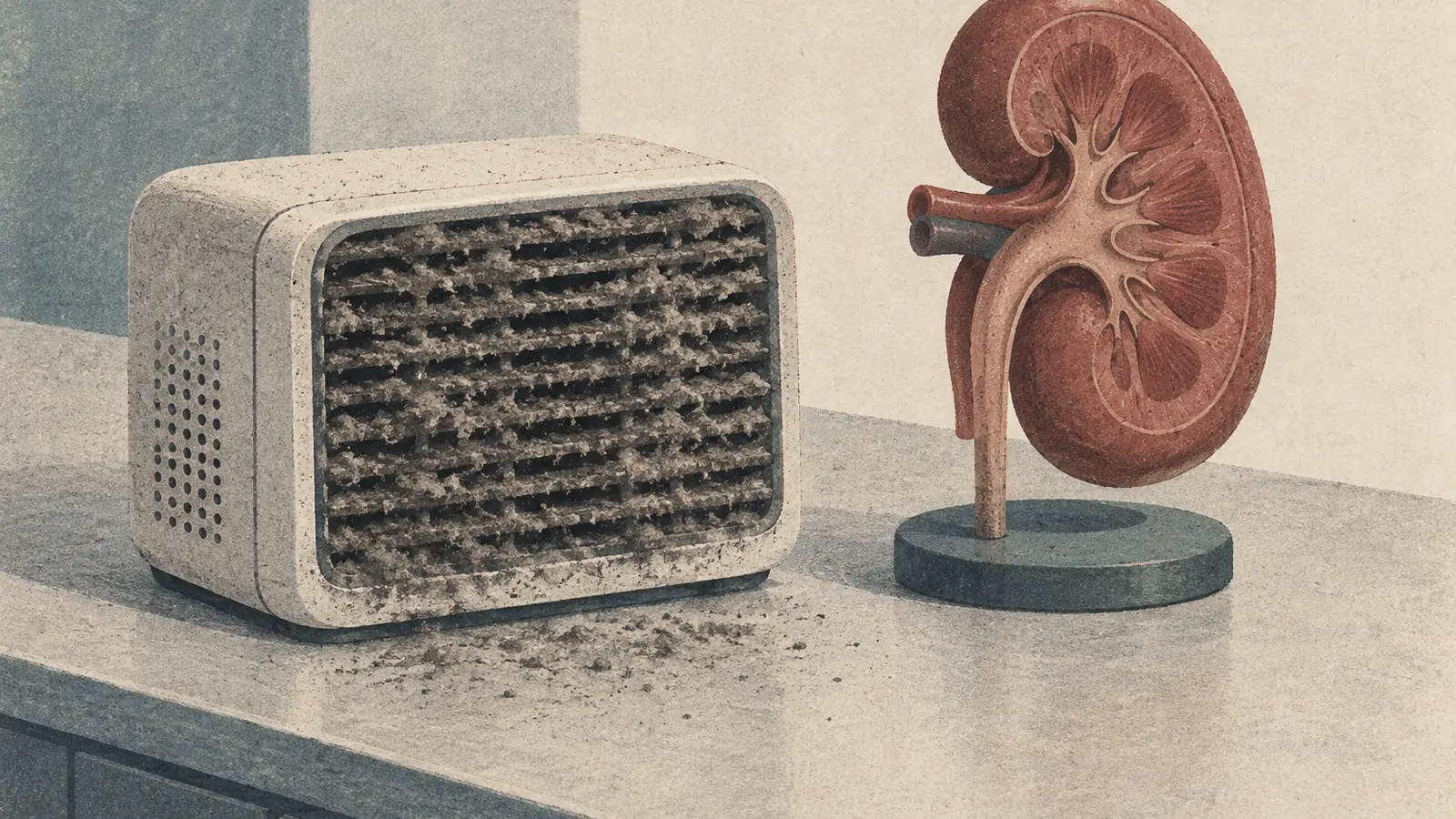
For years I filed kidney disease under things the body does to itself. Diabetes wears the filters out, high blood pressure grinds them down, and the rest is bad genes and a lifetime of sugar. The air outside my window never made the list, which turns out to be a failure of imagination on my part, because the kidney is one of the most blood-hungry organs you own and it drinks whatever is circulating in you.
So a number out of Taiwan stopped me cold. A nationwide cohort published this month in Environmental Health followed 423,855 people with early-stage kidney disease, the quiet stages 1 through 3a where most patients feel completely fine, from 2012 through 2021. Instead of the usual question of who lived in dirty air, the researchers asked what happened when a given person’s air changed, cross-linking National Health Insurance records against the island’s air-quality monitors and watching each person’s local PM2.5 climb or drop year over year. The lever they found sitting on kidney outcomes is one nobody can bottle or bill you for: the air itself.
The gradient is what kept me reading, because it moves one microgram at a time. Every 1 microgram per cubic meter that a person’s air got cleaner tracked with roughly 8 percent lower odds of their kidney disease progressing toward the advanced, dialysis-shadowed stages (hazard ratio 0.923, 95% CI 0.920 to 0.926), about 5 percent lower odds of starting dialysis, and nearly 7 percent lower odds of dying. Sort people into buckets and it gets starker at both ends. The group whose air improved the most saw progression fall 19 percent and death fall 28 percent. The group whose air got dirtier saw their disease turn severe at 2.25 times the rate, hit dialysis 59 percent more often, and die 94 percent more often.
Read that last clause again. These are people who started in the same broad early-CKD stage, and the ones whose air worsened were close to twice as likely to die over the follow-up. This is an association, not a controlled experiment, and I will get to what could be hiding inside it. But an exposure most of them could not see or taste tracked with outcomes on the scale of the risks we take seriously in a clinic.
So why would soot in the sky end up scarring an organ tucked deep in your back? That is the question I chased, because “pollution is bad for you” is exactly the kind of vague truism I do not trust. PM2.5 means particles under 2.5 microns, small enough that your nose and throat cannot catch them. You pull them to the bottom of your lungs, and the smallest ones slip across into the bloodstream. From there the leading explanation is a plumbing problem. Your kidneys take in something like a fifth of everything your heart pumps and filter it pass after pass, all day, so they get a concentrated, relentless dose of whatever inflammatory junk is circulating. Researchers think the particles drive oxidative stress and low-grade inflammation, stiffen and inflame the lining of small blood vessels, and nudge blood pressure up, and blood pressure is already the thing that shreds the kidney’s delicate filtration tufts. The kidney is no innocent bystander to dirty air. It sits downstream of your lungs and drinks the runoff.
What makes me trust there is signal here is that it lines up with everything around it. An earlier Taiwanese cohort of patients already in advanced kidney disease found each 1 microgram drop in PM2.5 cut dialysis risk 11 percent and death 14 percent. A 2020 registry study tied particulate exposure to progression toward kidney failure. And a longitudinal cohort in Environmental Science & Technology found that falling PM2.5 lowered the risk of developing chronic kidney disease in the first place. Different patients, different stages, same arrow. When the dose-response runs that cleanly, coincidence starts to strain.
The limits are worth naming, because they are also why I find it convincing. This is retrospective, and it assigns your exposure from the nearest government monitor rather than a sensor clipped to your collar, so it cannot know how many hours you spent indoors or idling in a tunnel. The confidence intervals are almost impossibly tight, but that is the arithmetic of a 424,000-person dataset, not proof of cause. Smoking, income, how close your nephrologist’s office sits: all of it travels with air quality and can leave fingerprints on the result. What is harder to wave away is the design. It is one thing to dismiss a dirty-neighborhood comparison. It is another to explain why, for the same person, the years their air got worse were the years their kidneys failed faster.
That points at the thing that nags me about how this finding will land, or rather how it won’t. There is no product at the end of it. The kidney field pours its money and its conference halls into the drug pipeline, and those drugs help real patients, but a modifiable environmental exposure this large gets a sliver of the attention precisely because there is no revenue on the other side. Notice who paid for this work: New Taipei City Hospital, a public hospital, with no drug company anywhere on the funding line. That is about what you would expect for a study whose punchline is “clean the air” instead of “buy the pill.”
The regulatory backdrop makes it sting more, because Taiwan is no outlier smog trap. Its recent annual PM2.5 has hovered around 13 to 14 micrograms per cubic meter, nearly triple the World Health Organization’s guideline of 5, while Taiwan’s own national limit sits at 15, a bar set comfortably above the level of harm this very study documents. And this is not a foreign problem you get to look away from. Even the United States, which tightened its annual PM2.5 standard to 9 in 2024, still allows nearly double the WHO’s 5. The “acceptable” number on the books is the one industry and regulators can live with, not the one your kidneys can.
| Measure | Value |
|---|---|
| WHO guideline | 5 |
| US limit (2024) | 9 |
| Taiwan limit | 15 |
The question I actually want answered is whether the benefit shows up fast enough to matter to a person, not just a population. If you move somewhere cleaner at stage 2, do your own filters get a reprieve within a few years, or is the damage already banked? The cohort leans toward yes, but it cannot promise that to any one of us.
Me, I have stopped treating outdoor air as background scenery. I check my local PM2.5 the way I check the pollen count, I run a filter on the bad days, and if I had early kidney disease, or the diabetes that bends you toward it, I would weigh the air where I live as heavily as anything my cardiologist tells me. I would not wait for a guideline to catch up to what these kidneys already seem to know.
Sources
- Environmental Health – Association of PM2.5 changes with advanced kidney disease progression and mortality in patients with early CKD: a nationwide retrospective cohort study in Taiwan (2026)
- Research Square preprint of the Taiwan early-CKD cohort, with the full hazard ratios and change-group estimates
- PubMed – Reduction in ambient PM2.5 associated with decreased risk of dialysis and mortality among advanced CKD patients, Taiwan
- PubMed – Particulate air pollution and progression to kidney failure with replacement therapy: an advanced CKD registry cohort in Taiwan (2020)
- Environmental Science & Technology – Reduced ambient PM2.5 associated with decreased risk of chronic kidney disease
- IQAir – Taiwan air quality, recent annual PM2.5 versus the WHO guideline of 5
- US EPA – 2024 revised annual PM2.5 NAAQS, tightened to 9 µg/m³
- Air Pollution & Climate Secretariat – Taiwan’s PM2.5 standard of 15 µg/m³