When I picture the risk of handing your heartbeat to a machine, I go straight to one word: stroke. One nameable catastrophe you can count, chart, and print on a label. That reflex is exactly the blind spot a device can be marketed into, and one very successful heart pump was.
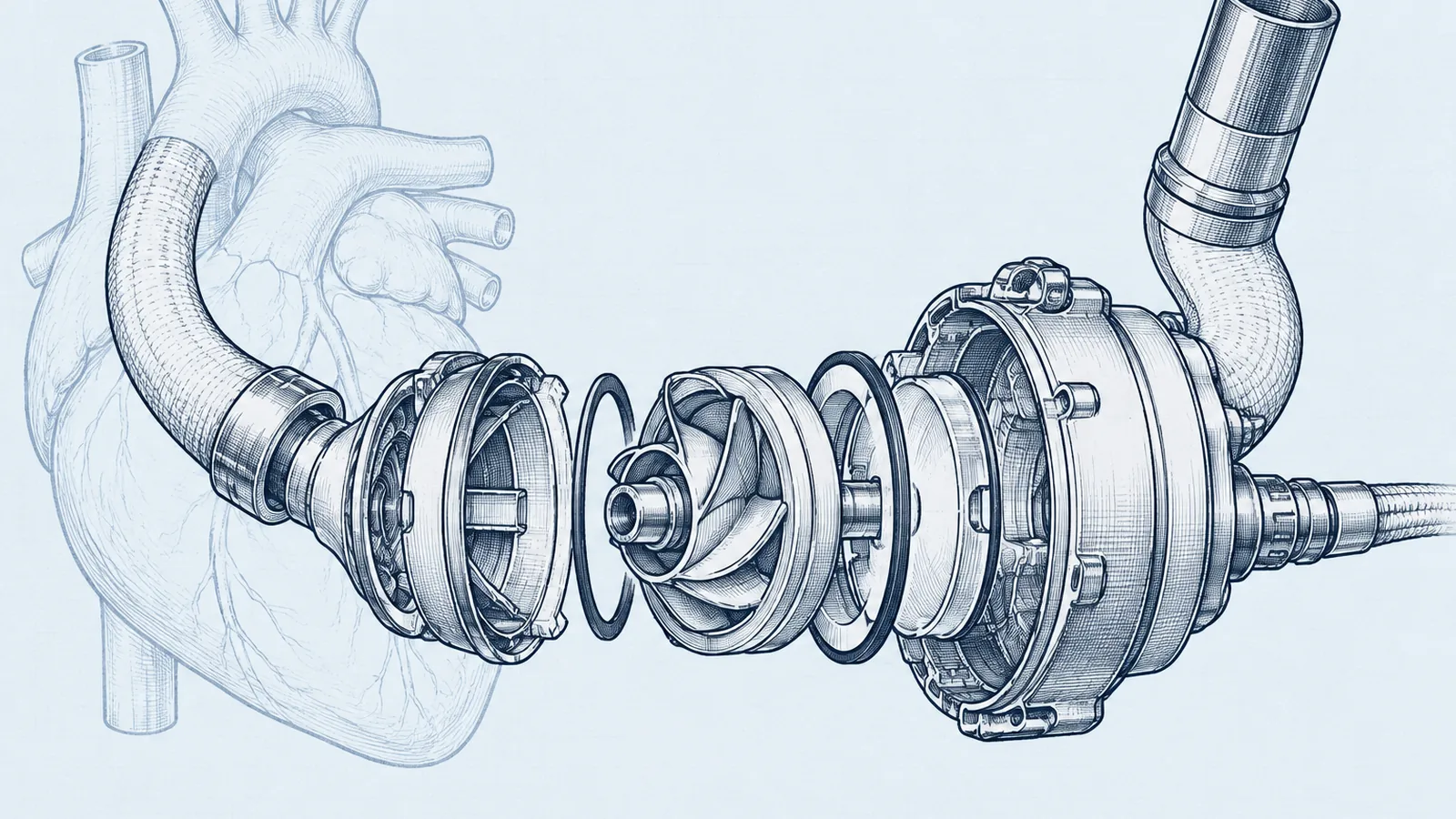
The device is the HeartMate 3, a magnetically levitated pump Abbott implants into people whose hearts can no longer push blood on their own. It spins their circulation for them, often for years, often as the only thing standing between them and the morgue. After Medtronic pulled its competing HeartWare HVAD off the market in 2021 over stroke and neurologic deaths, the HeartMate 3 became the only durable left ventricular assist device you can get in America, and its whole safety identity rests on one number. The trial that won it the market, MOMENTUM 3, scored “survival free of disabling stroke or reoperation,” and on that scoreboard it beat the older HeartMate II handily. Disabling stroke was the brain injury the scoreboard was built to see. It was not the only one happening.
A new analysis of the Society of Thoracic Surgeons Intermacs registry, covering roughly 12,000 HeartMate 3 recipients implanted between 2017 and 2023, found that over a median of about a year and a half, 8 percent of patients had a stroke. Another 8 percent had a neurologic event that was not classed as a stroke: a seizure, a transient ischemic attack, a brain bleed, or another central-nervous-system injury. Run the arithmetic on a cohort that size and each bucket holds close to a thousand people. The category nobody was scoring turned out to be as big as the one everybody was, and together they put the real neurologic rate at 16 percent, not 8.
And the uncounted half was nearly as lethal. Two-year survival was 45 percent for patients who had a stroke and 56 percent for those who had one of the other neurologic events, both far below what patients who avoid any brain injury go on to see. The worst was intracerebral hemorrhage, where survival fell to 43 percent at one year and 35 percent at two. The authors put it bluntly for a registry paper: non-stroke neurologic events deserve “comparable weight with universal nomenclature when evaluating the safety of durable LVADs.” In plain terms, the thing we have been measuring is half the story, and we have been calling it the whole story for years.
| Group | Value (percent) |
|---|---|
| After a stroke | 45 |
| After another neurologic event | 56 |
Because a pump is a pump, and I could not work out why a smooth, continuously spinning rotor would throw off such a sprawling menu of brain injury, clots and bleeds and seizures all at once, instead of one clean failure mode.
The answer sits in the blood itself, and it is stranger than I expected. A healthy circulation pulses. The HeartMate 3 runs mostly flat, a continuous-flow device that adds only a faint artificial pulse, and it drives blood through at high, steady shear. That shear strips the largest, most useful von Willebrand factor multimers out of circulation, the long sticky protein your platelets lean on to plug a leak, and leaves you with a functional clotting deficit: an acquired version of von Willebrand disease. In one Rotterdam cohort the ratio of von Willebrand activity to antigen fell from about 0.94 before surgery to around 0.67 within forty days of the pump going in, and roughly two-thirds of patients, 50 of 74, slipped below the 0.7 line that marks the danger zone. Those low-activity patients were the ones who bled: a hazard ratio of 4.9 for hemorrhagic stroke, nearly five times the risk, with gastrointestinal bleeding in about a third of them.
Then the same study turned my mental model inside out. The patients whose von Willebrand activity stayed higher were the ones more likely to throw an ischemic stroke instead. So the pump sets up a tug of war inside your skull. Spin the blood hard enough to keep a dying heart’s owner alive, and you are stripping out the protein that stops bleeds while churning up the turbulence that forms clots at the same time. Push the anticoagulation one way and you invite a hemorrhage, push it the other and you invite a blockage, and the brain is where both bills come due. That is why the injuries do not read as one disease. They read as a spectrum, because the device is pressuring the clotting system from both ends, and the seizures and quieter CNS injuries are what happens in the blurry middle.
None of this makes the HeartMate 3 a villain. For the people who get one, the alternative is dying of heart failure, and the pump is frequently a genuine rescue. What it is not is the clean, low-risk device its marketing scoreboard implied, and that gap was built into the endpoint. When your headline safety measure is survival free of disabling stroke, the seizures, the bleeds, and the covert injuries simply never make the scoreboard, whether or not anyone set out to keep them off it. There is also reason to think some of the harm is modifiable rather than fated: a Houston Methodist CT study found that how deep and at what angle the surgeon seats the pump’s inflow cannula predicted neurologic events, a shallow cannula carrying roughly five times the risk. At least part of this is technique and attention, not the fixed cost of the machine.
I would still take the pump if it were my father on that list, because when the choice is a mechanical heart or no heart, you take the heart. But I would not let anyone hand me the stroke number and call it the safety profile, and I would ask the surgeon exactly how they plan to seat that cannula. Show me the 16 percent, not the 8.
Sources
- MedPage Today – LVADs Linked to Concerning Neurologic Events, Strokes Aside (2026)
- Cardiovascular Business – HeartMate 3 LVAD linked to 16% risk of stroke, other neurological issues (2026)
- PMC – Early Postoperative Changes in Von Willebrand Factor Activity Are Associated With Future Bleeding and Stroke in HeartMate 3 Patients
- PMC – CT-based cannula position predicts neurological risk in patients with HeartMate 3 LVAD
- Circulation – Comprehensive Analysis of Stroke in the Long-Term Cohort of MOMENTUM 3
- MedTech Dive – The stroke risk that brought down Medtronic’s HeartWare HVAD