About a century ago, Ivan Pavlov’s dogs taught physiology a lesson it keeps having to relearn. Once the bell stopped bringing food, the dogs stopped salivating at it, but the old association had not gone anywhere: give the animals a rest or move them to a new room, and the response came back. Experimental psychology has spent the decades since confirming what that implied. Extinction, the field’s word for learning that a warning sign no longer predicts anything, writes a new memory on top of the old one instead of erasing it. As Mark Bouton and Travis Todd put it in a 2014 review, extinction “results in new learning that is at least partly dependent on the context for expression.” The brain ends up holding two memories in competition, one saying the sign means danger and one saying it no longer does.
- 2014recruitment begins in Boston
- 2018brain scans suggest the safety lesson arrives late
- 2020sleep recordings, no group gap in extinction memory
- 2026arousal model finds a rise once the shocks stop
Every exposure therapy for a phobia or post-traumatic stress is a bet that a patient can write that second memory and keep it. So it is worth sitting with a small paper published this week in PLOS Mental Health, from engineers at NYU’s Tandon School of Engineering and sleep researchers at Massachusetts General Hospital and Harvard Medical School. When the researchers stopped shocking their volunteers, the adults with insomnia disorder became more physiologically aroused, while the good sleepers settled down slightly. The insomnia group’s bodies seemed to be reacting to safety as if it were a new threat.
Shocks on day one, a test on day two
The setup is the standard human version of Pavlov’s bell. Twenty-four adults with diagnosed insomnia disorder and 24 good sleepers, 18 women and 6 men in each group, lay in an MRI scanner while a colored image appeared on a screen. During conditioning, the image came paired with a shock to the index and middle fingers of the right hand, set for each person at a level the paper describes as “highly annoying but not painful.” During extinction, the image kept appearing and the shocks stopped. A day later, the researchers ran a recall test: would the safety lesson hold, or would the old response come back?
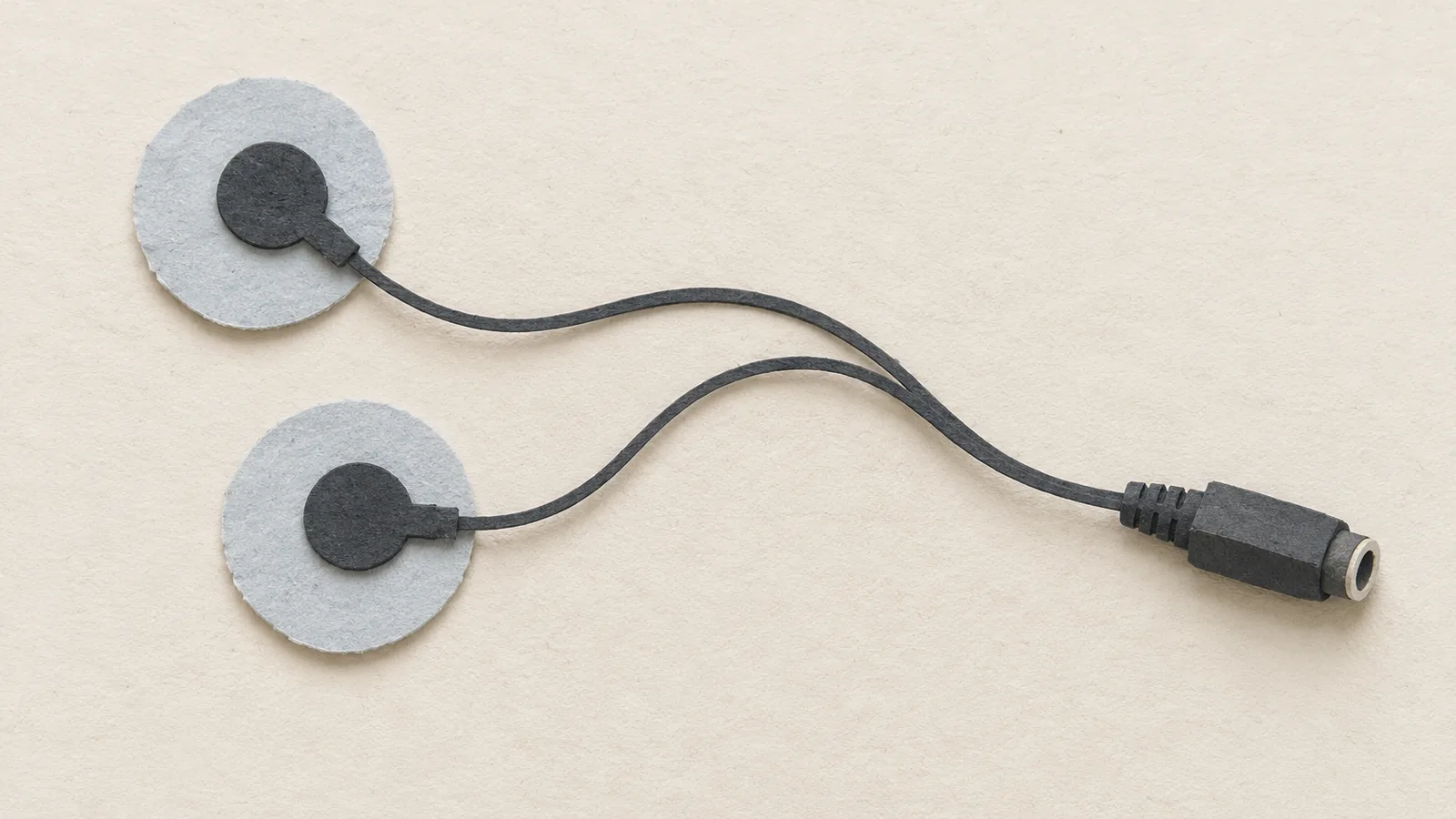
This analysis ignored what volunteers said and read their sweat instead. Skin conductance tracks how easily a tiny current crosses the skin, which climbs as sweat glands fire, and those glands answer to the sympathetic nervous system, the involuntary fight-or-flight wiring rather than anything a person decides to do. It measures arousal, not fear itself. Senior author Rose Faghih’s lab builds models that turn that signal into an estimate of hidden arousal. Their model separates the sharp bursts of sweating (the phasic response) from the slow background level underneath (the tonic component), then estimates moment by moment the probability that a person’s arousal sits above a high threshold. The team calls that number the High Arousal Index.
From conditioning to extinction, the index increased significantly more in the insomnia group than in good sleepers (p = 0.0236, effect size r = 0.51). “This hyperarousal could oppose subsequent learning that a stimulus has become safe, which may explain why anxiety treatments like exposure therapy are more successful in people with good sleep,” co-author Edward Pace-Schott of Mass General told News-Medical. Faghih went further, saying insomnia “is associated with a reduced capacity to extinguish physiological threat responses.”
Forty-eight people, read three ways
Those 48 volunteers are not new. The paper says they were recruited between February 2014 and February 2017, and the dataset is the one Pace-Schott’s group already analyzed in two earlier papers in the journal Sleep.
The first, in 2018, was an fMRI study titled “Delayed fear extinction in individuals with insomnia disorder”, built on 23 insomnia patients and 23 good sleepers. During extinction learning, good sleepers activated both the brain’s fear network and its extinction network, including the ventromedial prefrontal cortex and hippocampus, while the insomnia group showed little change. On recall day the pattern flipped, and the insomnia group engaged regions the good sleepers no longer needed, as if the safety lesson had arrived a day late. Its skin-conductance data showed no significant group differences.
The second, in 2020, added the volunteers’ overnight sleep recordings between the two sessions and found that REM sleep tracked with worse extinction memory in insomnia and better extinction memory in good sleepers. On the headline question, though, it found no group difference in extinction memory, measured either by sweat responses or by how strongly people still expected a shock.
The new analysis brings a different instrument to that same body of data, and its own numbers show how much depends on the instrument. A simpler version of the model that left out the slow tonic level found no group difference at all; the effect appeared only once the background level went in. The authors present that as their methodological contribution, arguing the tonic signal carries information that burst-focused scoring discards. That may well be right, but it means the finding lives under one reading of the sweat and not another. The recall-day result, the one closest to the claim that insomnia impairs fear regulation, came in at p = 0.072, and a lower conditioning-phase index in the insomnia group at p = 0.073. Neither is significant. Even the starting line shifts: the 2020 analysis found the insomnia group more physiologically reactive during conditioning, while the new model puts their conditioning-phase arousal lower than good sleepers’, and a lower starting point makes a larger rise easier to see. Depending on how you read the sweat, the insomnia group begins either hotter or cooler than everyone else.
The authors call the work a methodological proof of concept and concede that the sample is too small to reliably detect group differences below about r = 0.3. The work was paid for by NIH and National Science Foundation grants plus NYU start-up money, the authors declare no competing interests, and the analysis code is public on GitHub.
So the three papers do not agree on an established deficit, since the 2020 analysis and this year’s recall test both came up empty on extinction memory itself. What they share is a location. Brain imaging, sleep physiology and now arousal modeling keep circling the same step, the moment the brain is supposed to register that a threat has ended, and in people who sleep badly that step keeps looking late, weak or backward. Pace-Schott said the modeling “revealed the same effect we had previously observed using fMRI.” Strictly, it is the same volunteers seen through a new lens, which is a hypothesis gathering support rather than a replication.
If the hypothesis holds, it fits epidemiology that has been sitting in plain view for more than a decade. In the military’s Millennium Cohort Study, Philip Gehrman and colleagues followed 15,204 service members through their first deployments and found that insomnia symptoms before deployment were significantly associated with higher odds of new-onset PTSD, depression and anxiety afterward; 522 of them developed PTSD. A brain that struggles to file a danger as finished is exactly the kind of brain you would expect to come home from a war zone still on alert. “Insomnia isn’t just about poor sleep,” lead author Tianyu Hwang told News-Medical. It “directly relates to the body’s ability to learn and remember that a threat is gone.”
It also bears on how insomnia gets treated. Back in 2016 the American College of Physicians said cognitive behavioral therapy for insomnia should be the first-line treatment for chronic insomnia, noting that sleep medications “can be associated with serious adverse effects” and are approved for short-term use. Three years later the FDA ordered its strongest warning, a boxed warning, onto zolpidem, eszopiclone and zaleplon after identifying 66 cases of sleepwalking, sleep-driving and other complex sleep behaviors over 26 years, cases that included serious injuries and 20 deaths. A pill that sedates a hyperaroused brain does nothing, as far as anyone has shown, to teach it that the danger is over.
The therapy, by contrast, is built on conditioning. One of its core components, stimulus control, aims to undo a learned link between the bed and lying awake, which makes it a relearning exercise of the same family as extinction. If people with insomnia are slow to absorb that a cue has turned harmless, that could shape how the therapy works and how long it takes, though this paper does not test it. Co-author Saman Khazaei suggested wearable skin-conductance sensors could one day track arousal in daily life, which is a long way from 48 volunteers in a Boston scanner.
The more immediate test needs no new volunteers from these labs at all. With the code public, any sleep lab sitting on its own fear-conditioning dataset, collected on people Faghih and Pace-Schott have never seen, can run the model and check whether insomnia patients still grow more aroused once the shocks stop. If they do, the 2018 brain scans and this week’s sweat data start to look like one finding. If they don’t, the 2026 paper will have been one more way of reading the same 48 people.
Sources
- PLOS Mental Health: Hwang, Khazaei, Pace-Schott, Bottary & Faghih, “Disrupted fear regulation in insomnia disorder revealed by arousal estimation from skin conductance” (2026)
- Sleep: Seo et al., “Delayed fear extinction in individuals with insomnia disorder” (2018)
- Sleep: Bottary et al., “Fear extinction memory is negatively associated with REM sleep in insomnia disorder” (2020)
- Sleep: Gehrman et al., predeployment insomnia and new-onset mental health disorders, Millennium Cohort (2013)
- News-Medical: “Skin conductance measurements reveal link between insomnia and disrupted fear regulation” (2026)
- RAPS: FDA adds boxed warnings to zolpidem, eszopiclone and zaleplon (2019)
- American College of Physicians: CBT-I recommended as initial treatment for chronic insomnia (2016)
- Behavioural Processes: Bouton & Todd, “A fundamental role for context in instrumental learning and extinction” (2014)
- GitHub: Computational Medicine Laboratory, Insomnia-Arousal-Estimation code