I already had my eye-roll ready by the time I finished reading the headline, because “plastic-eating enzyme” has been announced so many times in the past decade that it barely registers anymore. Then I got to the second ability. The enzyme a University of Konstanz team pulled out of forest soil chews through an experimental bioplastic, and it also cuts penicillin open.
sequences recovered from plastisphere environments may be incorrectly classified as ARGs
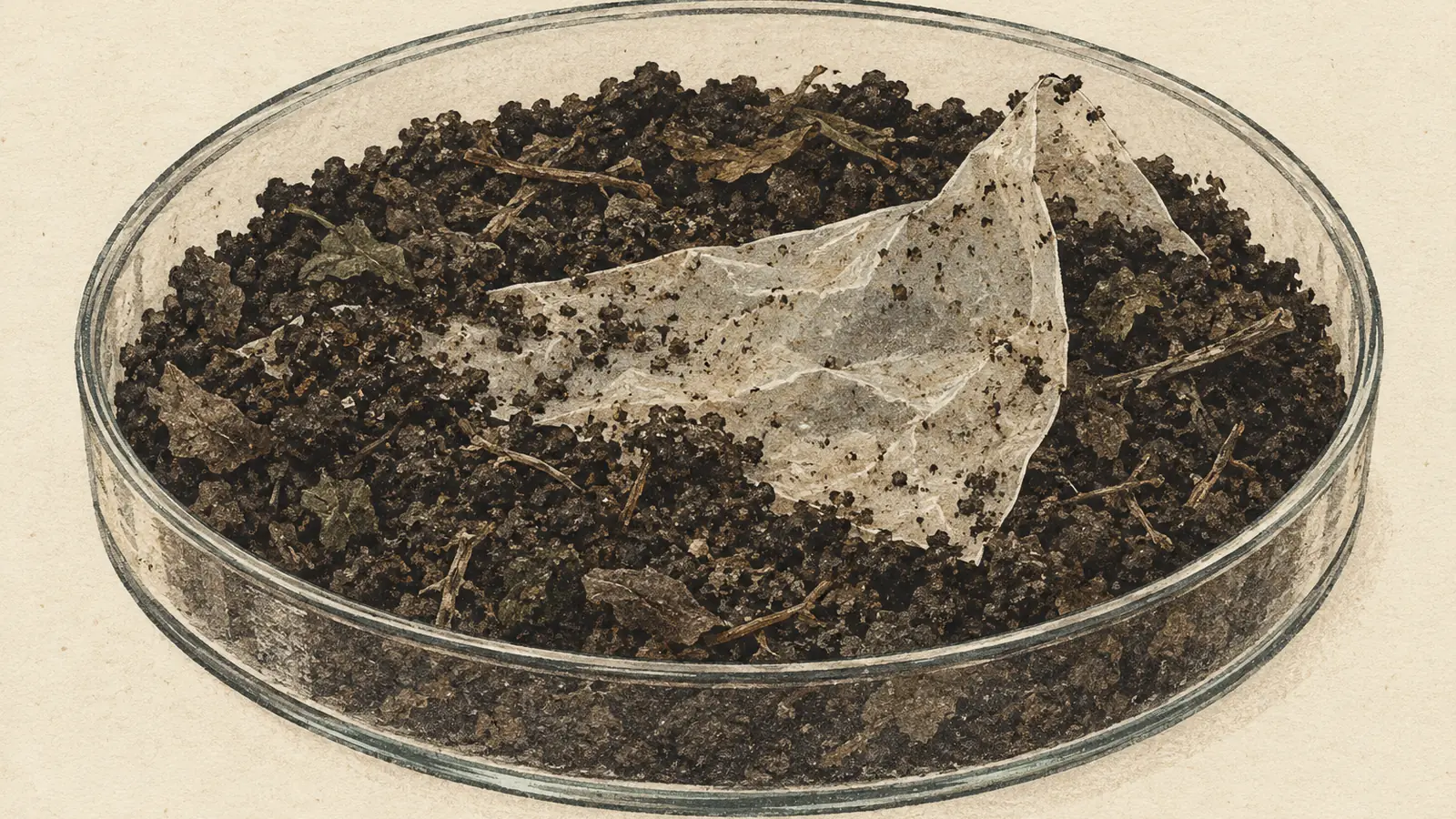
The study, published in The ISME Journal by microbiologists Harry Lerner, David Schleheck and five colleagues, started with a burial. The team placed films of a long-chain aliphatic polyester, or LCAP, about 10 centimeters deep in the humus of a forest in the university’s botanical garden and left them there for roughly a year. You can’t buy this plastic. Co-author Stefan Mecking’s chemistry group at the same university designed it. Back in the lab, the team mixed powdered versions into the same soil and measured the carbon dioxide the microbes breathed out as they ate. They compared it against cellulose, which Lerner says broke down in about 80 days, and against high-density polyethylene, the milk-jug plastic, which never gave up more than 3 percent of its carbon.
When the films came back up, they looked whole to the naked eye. Under the electron microscope they were covered in clusters of cavities, rod-shaped and roughly the size of a single bacterium. The cells were mostly gone, and the authors note that empty pits were far more common than pits with a bacterium still inside. That image changed how I’d pictured the whole process. I had assumed microbes eat plastic lazily, leaking enzymes into the soil and soaking up whatever dissolves. Pits shaped like cells point to something much more hands-on: a bacterium parked on the surface, eating its way down, with its cutting tool held right against its own body. That is an inference from shapes, but the genetics point the same way.
A blade bolted to the outside of the cell
To find the tool, the team sequenced all the DNA in their soil samples and looked for genes that became much more abundant when LCAP was available to eat. One standout came from an uncultured bacterium in the order Acidobacteriales, a common soil group that is famously hard to grow in a dish. Its closest known relative in the databases was a beta-lactamase from a Granulicella strain. The gene encodes an esterase, an enzyme that cuts the ester bonds holding polyester chains together. Its sequence carries a secretion signal, and the authors read its features as pointing to a home on the cell’s outer membrane, a location they say “must await future research” to confirm. They named the enzyme LCPH1.
An AlphaFold model placed the enzyme’s active site in “a large, wide-open groove, rather than in a tunnel.” A mouth that open has room for a bulky polymer chain and, the team proposes, for a penicillin molecule too. That wide mouth is where the Pac-Man nickname comes from.
So why would one enzyme handle both? This is where I stopped skimming. LCPH1 is a family-VIII esterase, and that family shares its catalytic serine-and-lysine motif with class C beta-lactamases, the enzymes bacteria use to break the strained four-membered ring that makes penicillin-type drugs lethal. Its active site has the same machinery as a drug-defeating enzyme, so a protein that cuts polyester bonds was never going to be a stranger to penicillin.
What happened in the test tube
The researchers tried to produce the full native enzyme in E. coli, with its signal sequence and membrane-anchor features intact, and got no protein at all. Every experiment therefore used a shortened soluble version. Incubated with that enzyme for 24 hours, penicillin G “disappeared nearly completely,” and mass spectrometry found penicilloic acid, the broken and inactive form of the drug. Ampicillin went the same way, ending up as ampicilloic acid. PETase, the well-known plastic-eater from Ideonella sakaiensis, released similar amounts of LCAP building blocks in the comparison but left both antibiotics intact. When the team added LCPH1 to ampicillin discs on agar, the drug lost its ability to stop a lab strain of E. coli.
The enzyme’s specific activity against penicillin G was 8.92 units per milligram. Against LCAP powder it was 0.5, peaking in the first 4 hours. Those numbers come from different assays, one with a dissolved drug and one with a solid powder, so they don’t rank the enzyme’s two jobs. They do rule out the comforting picture of a plastic specialist that only tolerates penicillin. On the bench, it destroys the drug readily.
Where the press release outran the paper
The university’s announcement, and the ScienceDaily write-up built from it, quote Lerner saying “all bioplastic materials were completely degraded within roughly 250 to 330 days.” The paper is more careful than the quote. It tracks how much of each plastic’s carbon came back out as CO2. By the authors’ own reasoning, a microbe that fully digests something exhales about half the carbon and builds the other half into new cells, which they call an “idealized 50:50 carbon allocation.” Two LCAP formulations and a PHBV control plateaued at 49 to 58 percent, a result the paper treats as near-complete. A third formulation, PE-12,12, stalled at about 22 percent, less than half of the 50 percent the model expects. The authors don’t explain why, beyond noting that its crystallinity and chain lengths were comparable to the others. The other half of the carbon is assumed to have gone into microbial biomass, which nobody measured.
The films buried in the forest, the ones with the photogenic pits, came out of the ground after about a year “macroscopically intact.” That is a long way from completely degraded. All of this comes from one soil, one sampling schedule and one family of in-house polymers, tested by a team that includes the chemist who designed them.
Is the plastic paying bacteria to keep a resistance tool?
The antibiotic question has an even bigger gap. This study never put LCPH1 into a living bacterium to check whether that bacterium survives antibiotics better, which is the experiment that would settle it. The failed full-length expression explains why. Without the native signal and anchor, nobody could test the enzyme where it supposedly lives, on the cell surface, doing whatever it does there. The disc assay shows that purified protein can neutralize a drug. It doesn’t show that a cell carrying the gene is harder to kill. The authors still go further than their data, writing that “it is likely that LCPH1 provides resistance to β-lactam antibiotics.”
The question matters because the plastisphere, the film of microbes living on plastic debris, already looks like a place where resistance genes pile up. A 2024 metagenomic study of two rivers near Tokyo, published in the Journal of Hazardous Materials, found 3.46-fold higher enrichment of antibiotic resistance genes on microplastics than in the surrounding water, with beta-lactam resistance subtypes among those selectively enriched. Network analysis tied host bacteria, resistance genes and mobile genetic elements together more tightly on the plastic than in the water, a pattern the authors read as co-selection. “The plastisphere is a new habitat in our environment,” Schleheck said in the university’s announcement.
Then the Konstanz paper adds a twist I didn’t see coming. Some of what plastisphere surveys count as resistance genes (ARGs) might be plastic-eaters that only resemble beta-lactamases. In the authors’ words, “sequences recovered from plastisphere environments may be incorrectly classified as ARGs.” That cuts both ways, and the team lays out the branches. In one, LCPH1 does double duty, feeding its owner on polyester while protecting it from penicillin-type drugs. If that’s right, every biodegradable polyester that escapes into soil or water is food that rewards bacteria for keeping a resistance-shaped enzyme. In the other, enzymes first recruited through co-selection could drift toward specializing in polyester, and some alarming resistance-gene counts from plastic debris would partly be miscounted plastic-eaters. The study can’t say which branch is true. The ScienceDaily summary still opens on “new hope in the fight against plastic pollution.”
The work was funded by the Carl-Zeiss Foundation and a Konstanz start-up grant, and the authors declare no conflicts. Schleheck’s prescription is “using only polymers with biochemical breaking points,” such as the hydrolysable ester bonds in polyesters. Against high-density polyethylene, which the announcement says may take several hundred to a few thousand years to fully biodegrade, a polyester that bacteria can pit and digest is still the better trade.
I’d still back that trade. But I won’t count this as good news until someone gets LCPH1 into a living bacterium, membrane anchor and all, and checks whether ampicillin still kills it.