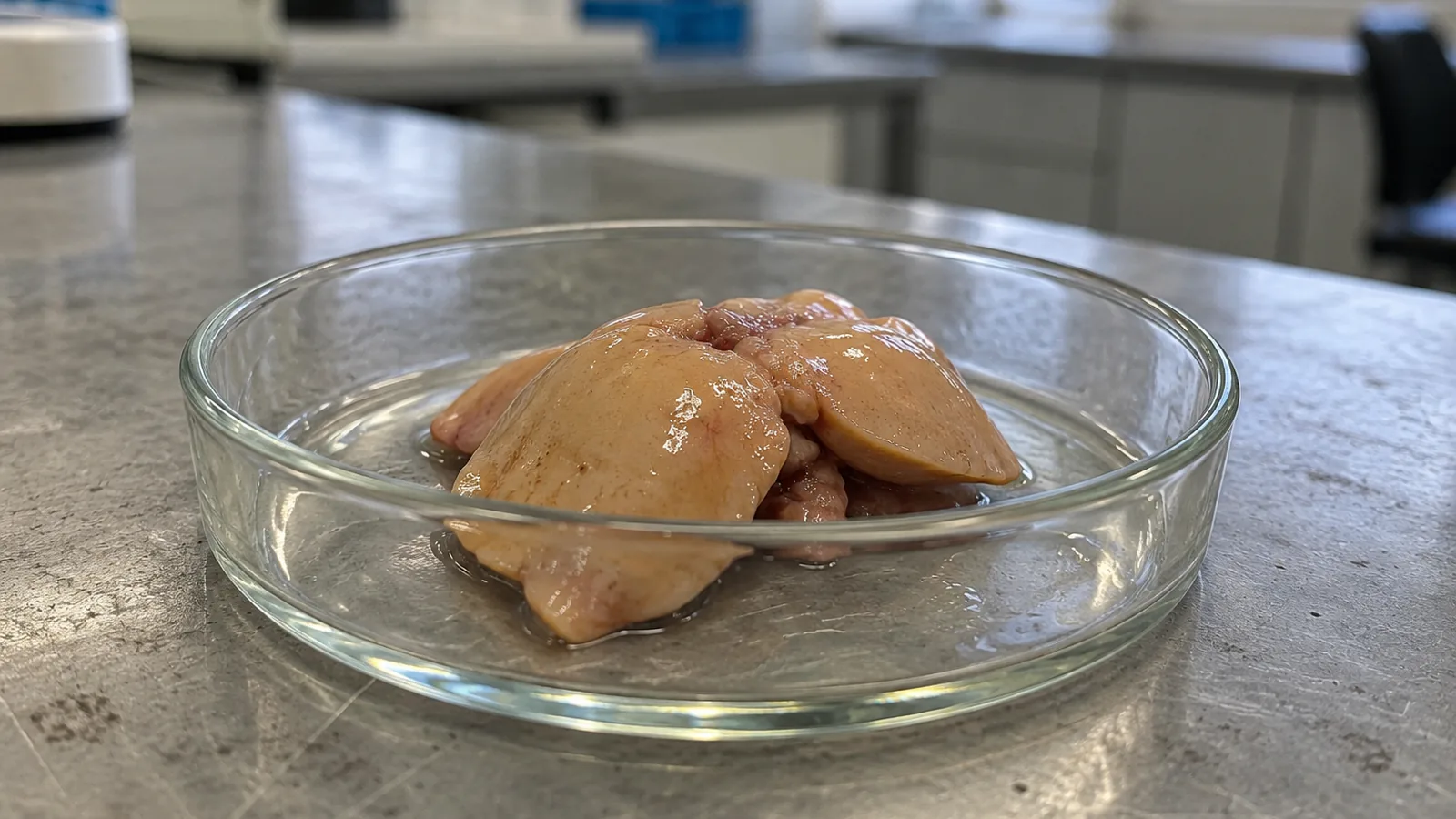
For most of the last decade, a patient diagnosed with the aggressive, scarring form of fatty liver disease left the clinic with instructions to lose weight, and that was the entire treatment plan, because there was no approved drug to offer. That changed in March 2024, when the FDA granted accelerated approval to Madrigal’s Rezdiffra, the first drug ever cleared for MASH. Seventeen months later Novo Nordisk’s Wegovy joined it. In a year and a half, a disease doctors had managed with diet advice became a market, and markets are always hungry for the next target.
Future studies can test whether enhancing this protective pathway can complement existing treatments
That’s the backdrop for a paper out of Cedars-Sinai, and to understand what it found you have to start inside a liver cell. Mitochondria, the structures that burn fat for energy, wear out, and a healthy cell tags the damaged ones, pulls them apart and recycles them before they leak harm into everything around them. Biologists call that housekeeping mitophagy. In a paper in Nature Metabolism, a multicenter team whose co-corresponding author is Cedars-Sinai hepatologist Ekihiro Seki reports that an enzyme called UBE2N helps keep the process running, letting liver cells clear damaged mitochondria and break down fat, and that the cells lose the enzyme as the disease advances. “When levels of the enzyme fell, we saw more damaged cells and injury to the liver,” Seki said in the Cedars-Sinai announcement. The paper’s title lays out the chain: UBE2N deficiency drives MASH through p62-regulated mitophagy and PANoptosis, a form of programmed cell death. Lose the enzyme and you lose the cleanup, and a liver cell tips from merely fatty toward dying and scarred.
Then came the experiment that made the finding worth a press release. When the researchers restored UBE2N to normal levels in the livers of laboratory mice, fat accumulation, inflammation and scarring all fell, according to the study summary, which presents the work as preclinical evidence that the enzyme could be a treatment target. It’s a mouse result, with no drug, no dose and no patient behind it. Still, most of the field’s effort has gone into the damage that shows up downstream, and this is a switch upstream whose loss tracks the slide into disease.
The pool of people standing on that slope is enormous. An estimated 100 million Americans have metabolic dysfunction-associated steatotic liver disease, according to the American Liver Foundation figure Cedars-Sinai cites, and roughly 20 to 25 percent of them go on to develop MASH, the stage defined by inflammation, cell injury and scarring. When hepatologists renamed the condition, formerly nonalcoholic fatty liver disease, they wrote “metabolic dysfunction” straight into its name. The specialists who know this disease best named it after what is happening to the American metabolism.
of people with MASLD go on to develop MASH
- Lower bound
- 20
- Upper bound
- 25
So it’s fair to ask what the first two drugs actually bought. In Rezdiffra’s pivotal trial, MASH resolved without worsening fibrosis at 52 weeks in 25.9 percent of patients on the 80 mg dose and 29.9 percent on 100 mg, against 9.7 percent on placebo, per Drug Topics.
Wegovy posted the bigger headline. At a 72-week interim analysis, 63 percent of patients on the drug saw their MASH resolve with no worsening of scarring, against 34 percent on placebo, according to the FDA. That means about one in three placebo patients watched their disease resolve without a single dose of semaglutide. Both drugs also came through the accelerated pathway, so neither company has yet shown its product prevents the outcomes patients actually fear. The FDA says Novo’s trial will run 240 weeks in total to learn whether the liver improvements turn into fewer deaths, transplants and other liver-related events.
UBE2N lands squarely in that market. Shelly Lu, who directs Cedars-Sinai’s Karsh Division of Gastroenterology and Hepatology, framed the next step in the study summary: “Future studies can test whether enhancing this protective pathway can complement existing treatments.” Complement existing treatments, in other words, as an add-on to the two drugs already on the market. The discovery itself was paid for with public and academic money. The funders listed by Cedars-Sinai are the U.S. National Institutes of Health, the National Research Foundation of Korea, a liver-society research award, an NIDDK-backed pilot grant and China’s National Natural Science Foundation, and no drug company appears among them. We have seen this arrangement many times in drug development. Public grants find the switch, and if it ever becomes a prescription, a company sells it and sets the price.
Before UBE2N gets anywhere near a patient, someone has to show the enzyme can be pushed back up safely inside a human liver, which is a much harder job than doing it in a mouse. The nearer deadlines belong to the drugs already on shelves. Novo Nordisk’s outcomes data, due at the end of that 240-week trial, and Madrigal’s confirmatory results will decide whether the first two MASH drugs keep their accelerated approvals. If those trials disappoint, the market UBE2N was pitched to complement will look a lot shakier, and the case for fixing what goes on the American plate first will look a lot stronger.
Sources
- Cedars-Sinai: enzyme may help protect against severe liver disease
- Nature Metabolism: UBE2N deficiency contributes to MASH development
- ScienceDaily: this protective enzyme could help stop fatty liver disease from getting worse
- FDA: Wegovy approved to treat MASH
- Drug Topics: FDA approves resmetirom as first-ever MASH treatment