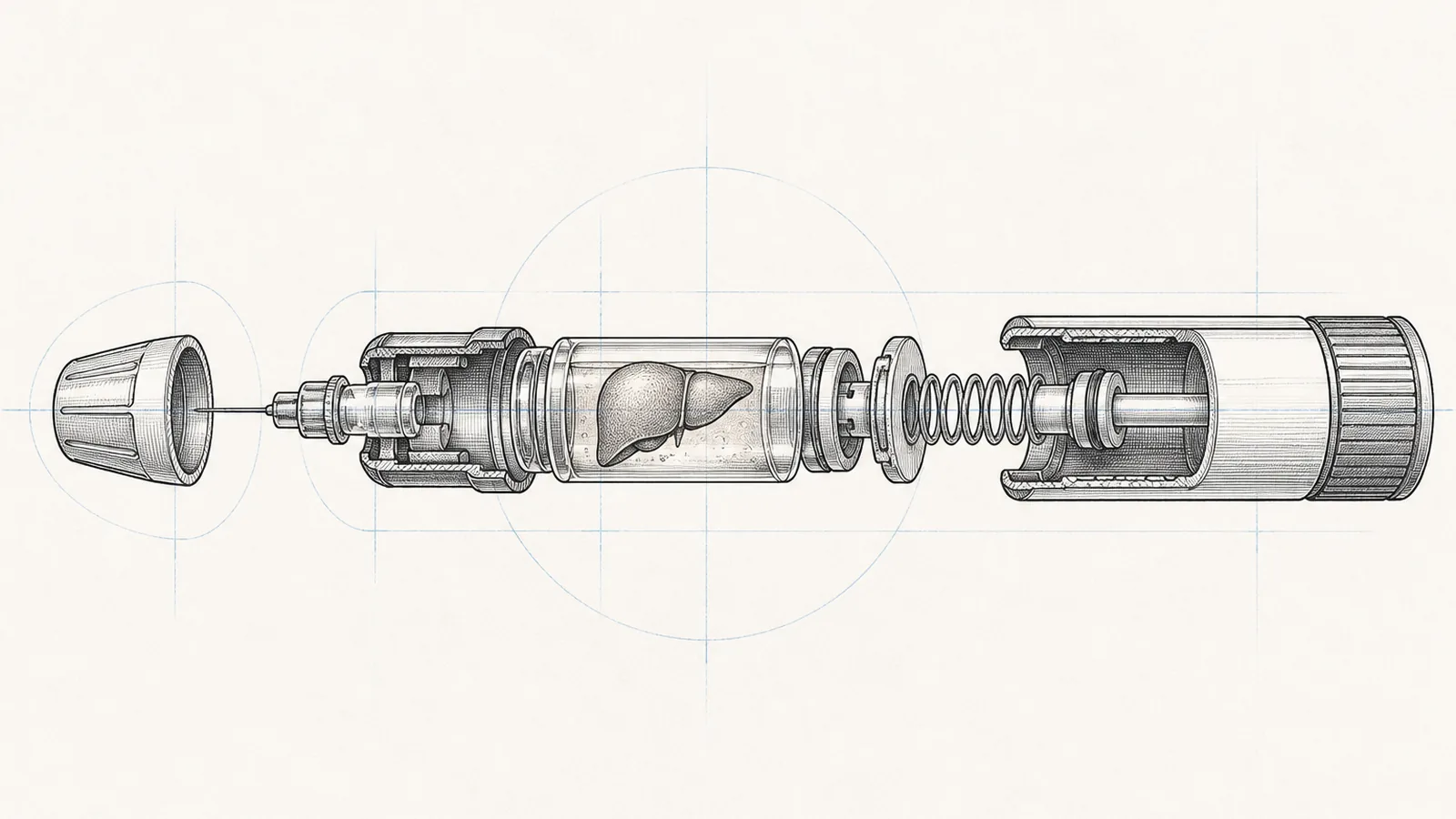
For years I had filed the liver benefits of the new weight-loss drugs under “obvious.” You lose the weight, the fat that was marbling your liver leaves with it, the inflammation cools down. Cause, effect, done. So when a hormone shows up claiming it protects the liver without any weight loss at all, my first reaction was not excitement. It was suspicion. What exactly is doing the work, if not the pounds? The answer runs through the same brainstem switch that makes these drugs nauseating, and the company that wants to sell this hormone supplied it, helped fund the study, and put two of its scientists on the author list.
The hormone is GDF15, and the circuit, according to a study published August 10 in Cell Metabolism by a McMaster University team led by Gregory Steinberg, is one almost nobody would have drawn on a whiteboard. GDF15 does not march down to the liver and clean house directly. It talks to the brain first. It docks onto a receptor in the brainstem, the brain fires a signal back down through the nervous system to the adrenal glands, the adrenals pour out glucocorticoids, and those steroids are what settle the liver down, tamping inflammation and slowing the scarring of fibrosis. In mice engineered to mimic human MASH, the fatty liver disease that used to be called NASH, the researchers report this happened no matter how much the animals ate or weighed.
Here is the part that stopped me cold. Glucocorticoids are the last thing I would have bet on as the liver’s rescuer, because this is the same steroid family we blame for fatty liver in the first place. Give someone long-term prednisone, or let a tumor flood them with cortisol in Cushing’s disease, and the liver fills with fat while the whole metabolism goes sideways. So why would a burst of the exact same hormones protect the organ they are famous for wrecking? Wait, why does that even work?
The honest answer is that glucocorticoids were never simple. They are the body’s built-in anti-inflammatory switch, which is precisely why synthetic versions get handed out for everything from asthma to arthritis. The damage comes from the wrong dose at the wrong duration: chronic, unrelenting, high. What this study describes is the opposite kind of signal, a regulated pulse routed through the nervous system, hitting the liver in a context the body actually controls. Same molecule, different choreography, opposite result. That difference between a steady toxic flood and a targeted pulse is the whole biology here, and it is the kind of nuance that gets flattened the second a press release calls something a “liver-protecting hormone.”
Now for the part the cheerful coverage skips. GDF15 is not some overlooked curiosity. It is one of the hottest drug targets in metabolic medicine, and the brainstem receptor it binds, GFRAL, is being chased by Eli Lilly, Amgen, Novartis, and Novo Nordisk as the next appetite switch after the GLP-1 gold rush. That same review lays out the catch. The brainstem real estate GFRAL sits on does not only govern appetite; it also governs nausea and vomiting. In human trials so far, GDF15 analogues have delivered modest weight loss while making people queasy, and Novartis’s candidate produced “minimal” weight reduction after 14 weeks. The very circuit that might calm your liver is the one that could make you miserable, and threading that needle is exactly what nobody has managed yet.
Which brings me to the funding line, the one I now read before I read anything else. The work was supported by Canada’s NSERC, the Canadian Institutes of Health Research, and Diabetes Canada, all fine. It was also supported by Novo Nordisk, which is developing its own GDF15 drug candidate. Novo Nordisk supplied the GDF15 hormone the experiments ran on, funded part of the work, and put two of its own scientists on the author list. The lead researcher, Steinberg, is himself co-founder, shareholder, and chief scientific officer of a liver-disease drug company called Espervita Therapeutics. None of that makes the mouse data wrong; mechanism papers live or die on their experiments, not their sponsors. But it should make you notice the shape of the finding. “Even without weight loss” is not a neutral scientific caveat. It is a market expansion. A weight-loss hormone that also treats liver disease independently of weight is a drug you can sell into a far bigger room, and the company that would sell it helped supply, fund, and staff the study that widened the room.
The biology deserves a fair hearing, because a liver benefit that survives weight regain would actually matter to people. Weight regain is the rule, not the exception. Even with intensive personalized support, keeping the weight off stays brutally hard, so a protective effect that outlasts the regain would be a genuine gift to patients who cycle. That is the prize worth wanting. It is also still a hypothesis. A brain-to-adrenal-to-liver circuit in a genetically tidy mouse is a claim about humans, not a result in them, and steroids as a liver therapy is a road paved with reasons for caution.
So the biology I’ll keep, cautiously; it’s clever, and it might even matter. The market story wrapped around it I’ll hold at arm’s length. And the next time a company’s own hormone protects an organ “even without weight loss” in the company’s own study, I’m reading the funding line first and the finding second.
Sources
- Cell Metabolism – Steinberg et al., GDF15 brain-to-liver pathway in MASH (Aug 10, 2026)
- ScienceDaily – “This weight-loss hormone may protect the liver even without weight loss” (Aug 2026)
- Targeting GDF15 Signalling for Obesity Treatment: Recent Advances and Emerging Challenges (review, PMC)
- JAMA Network Open – Weight Loss Maintenance Remains Challenging, Even With Personalized Support (2025)