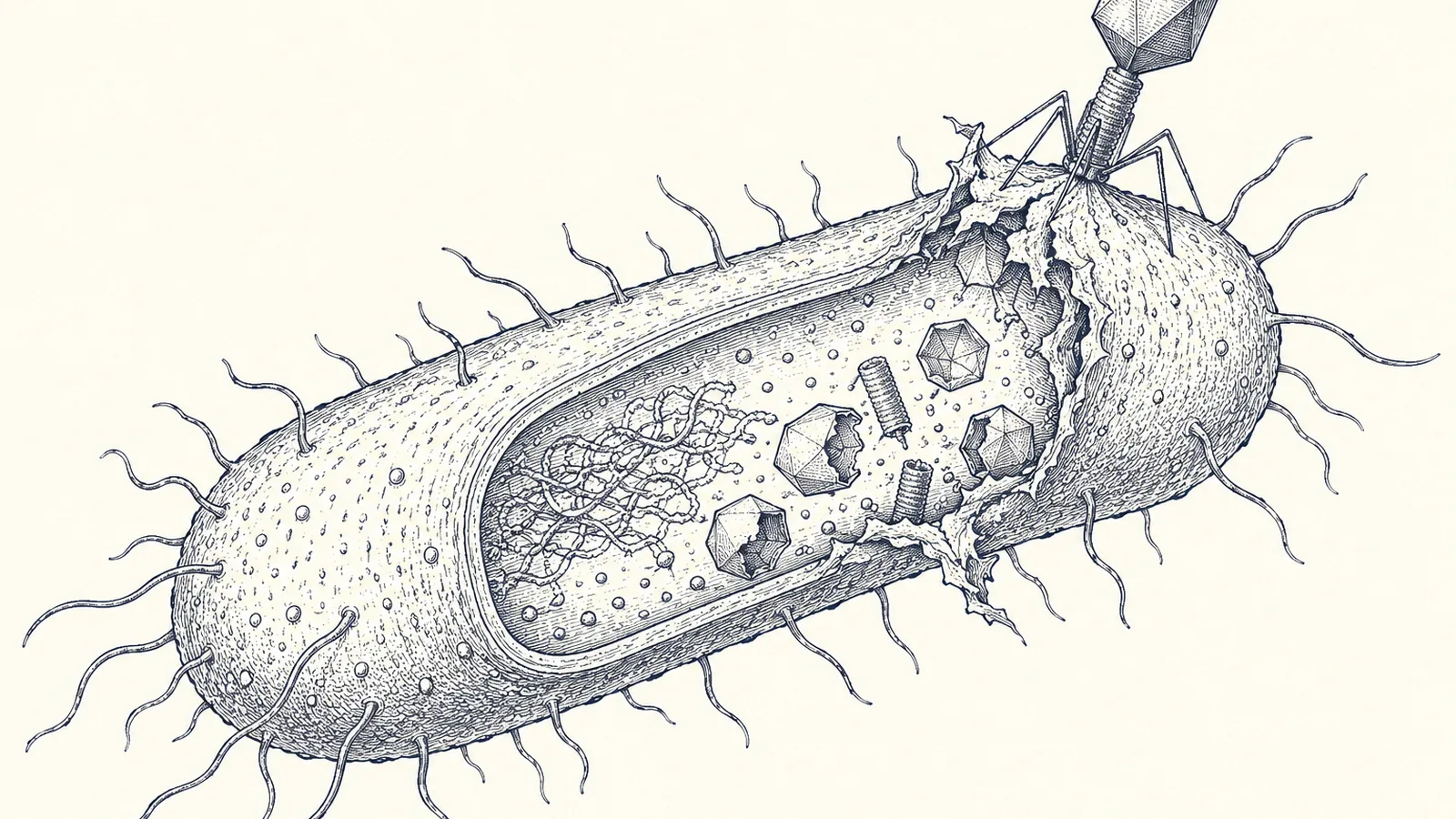
For most of my life I filed bacteria under too simple to be interesting. A bag of chemistry, no strategy, just growth until something kills it. So I did not expect to spend this week marveling at one: a single cell with no brain and no nerves runs a threat-detection trick cleverer than most home alarm systems. It sits and waits for an invading virus to reach for the one tool the virus cannot build a copy of itself without, and the instant that tool goes to work, the cell turns it into a trip wire.
Here is how the attack normally goes. Viruses that hunt bacteria are called phages, and a phage breaks in by injecting its genome, hijacking the cell’s machinery, and stamping out copies of itself until the cell bursts and the new viruses spill into the neighbors. To finish each copy, the phage has to pack its fresh DNA into a protein shell, and to make that shell mature it runs a specific pair of molecular scissors, an enzyme called a prohead protease. No working protease, no finished capsid, no next generation.
That scissor is exactly the weakness the bacterium learned to exploit, according to work by Sam Hobbs, a biochemist at University of Utah Health, published October 1 in Science. The cell keeps a sensor protein sitting out in the open, almost like bait. When the phage’s protease starts cutting, it also nicks that sensor, and the cut itself is the alarm. “The protease from the phage actually acts directly on the host protein,” Hobbs told reporters, and that cleavage is what switches the whole pathway on.
Why would a cell wait to be cut instead of scanning for the virus directly? That is the question that got me, and the answer is the clever part. The defense doing this is CBASS, short for cyclic-oligonucleotide-based antiphage signaling, one of the most common immune systems on Earth, present in thousands of bacterial species. Most of its known versions trip on viral genetic material, foreign DNA or RNA sitting where it should not be. But a virus can mutate its genome to hide that. What it cannot do is stop building capsids, and it cannot build capsids without the protease. So this CBASS system ignores the thing the enemy can disguise and reads the thing it cannot drop. It senses the enzyme’s activity, not its sequence.
Once the sensor is cut, a cascade fires. CBASS runs on enzymes called CD-NTases, close relatives of the cyclase at the center of our own immune system, and they pump out small cyclic nucleotide signals that switch on an effector protein. In many CBASS systems that effector turns on the cell’s own membrane and wrecks it from the inside. The cell kills itself. It self-destructs before the phage finishes copying, so the invader dies trapped in a corpse instead of pouring out into the colony. One cell goes down and the neighborhood lives, which is the bacterial version of a sailor dogging the hatch on a flooding compartment with himself still inside.
The part I keep circling back to is how old this is. The cyclase at the heart of CBASS is the structural ancestor of cGAS, the alarm protein that kicks off the cGAS-STING pathway inside your own cells when they catch viral or stray DNA. Researchers have found bacterial versions of STING sitting right inside these same defense operons, which is why the field now treats our innate immune system as something we inherited, in rough draft, from microbes that were fighting viruses billions of years before the first animal took a breath. It is also why the funders behind this work are not who you would guess. The money includes the Parker Institute for Cancer Immunotherapy and the Cancer Research Institute, because STING, the human descendant of this pathway, is a hot target for cancer drugs. Studying how a microbe decides to blow itself up turns out to be cancer research.
So what changes? Not your medicine cabinet, not yet. Nobody was treated here and no infection was cured; this is molecular detective work done entirely in the lab. What it hands over is a map. Phage therapy, the idea of using these viruses as living antibiotics against drug-resistant bacteria, keeps stalling because bacteria carry defenses like CBASS that kill the phage before it can work. Knowing the exact tripwire means you can engineer phages that step around it, or that build their capsids without waving the one enzyme that sets off the sensor. Every lock on the bacterial door you can name is a lock you can start to pick.
The stakes are not abstract. By 2050, drug-resistant infections are projected to kill 10 million people a year worldwide, more than the 8.2 million expected from cancer. Against a number like that, the policy is moving at a crawl. There is still no FDA-approved phage therapy in the United States. Most Americans reach these viruses only through a single-patient compassionate-use request, a last resort a doctor files after every approved drug has failed and the clock is running out. We have known how to grow phages for a century. We are only now learning the molecular locks they have to pick, and the regulatory door is still bolted while people with untreatable infections wait.
| Group | Value (million per year) |
|---|---|
| Drug-resistant infections | 10 |
| Cancer | 8.2 |
I am not about to order a phage cocktail off the internet, and anyone telling you this paper means you can is selling something. But here is what I took from it. I now think of my own immune system as the newest edition of a very old microbial idea, and I find that strangely comforting. And if I ever end up in a bed with a bug that shrugs off every antibiotic on the chart, I would not sit quietly and wait for the system to approve the obvious. I would ask my doctor to file for the phages that same day.
Sources
- Hobbs, “Phage proteases activate CBASS antiphage immunity,” Science (Oct 1, 2026)
- ScienceDaily – “Bacteria turn a virus’ own weapon against it,” reporting Hobbs, Science
- Genetic Engineering & Biotechnology News – phage proteases trigger the conserved CBASS antiviral pathway (CD-NTases, cyclic-nucleotide signaling)
- News-Medical – phage proteases activate the bacterial immune response, with Hobbs’s description of the mechanism
- STAT – pressure on the FDA to loosen restrictions on phage therapy for antibiotic-resistant infections
- PMC / Viruses – “Current State of Compassionate Phage Therapy,” on the single-patient IND last-resort pathway
- Review on Antimicrobial Resistance (2016)