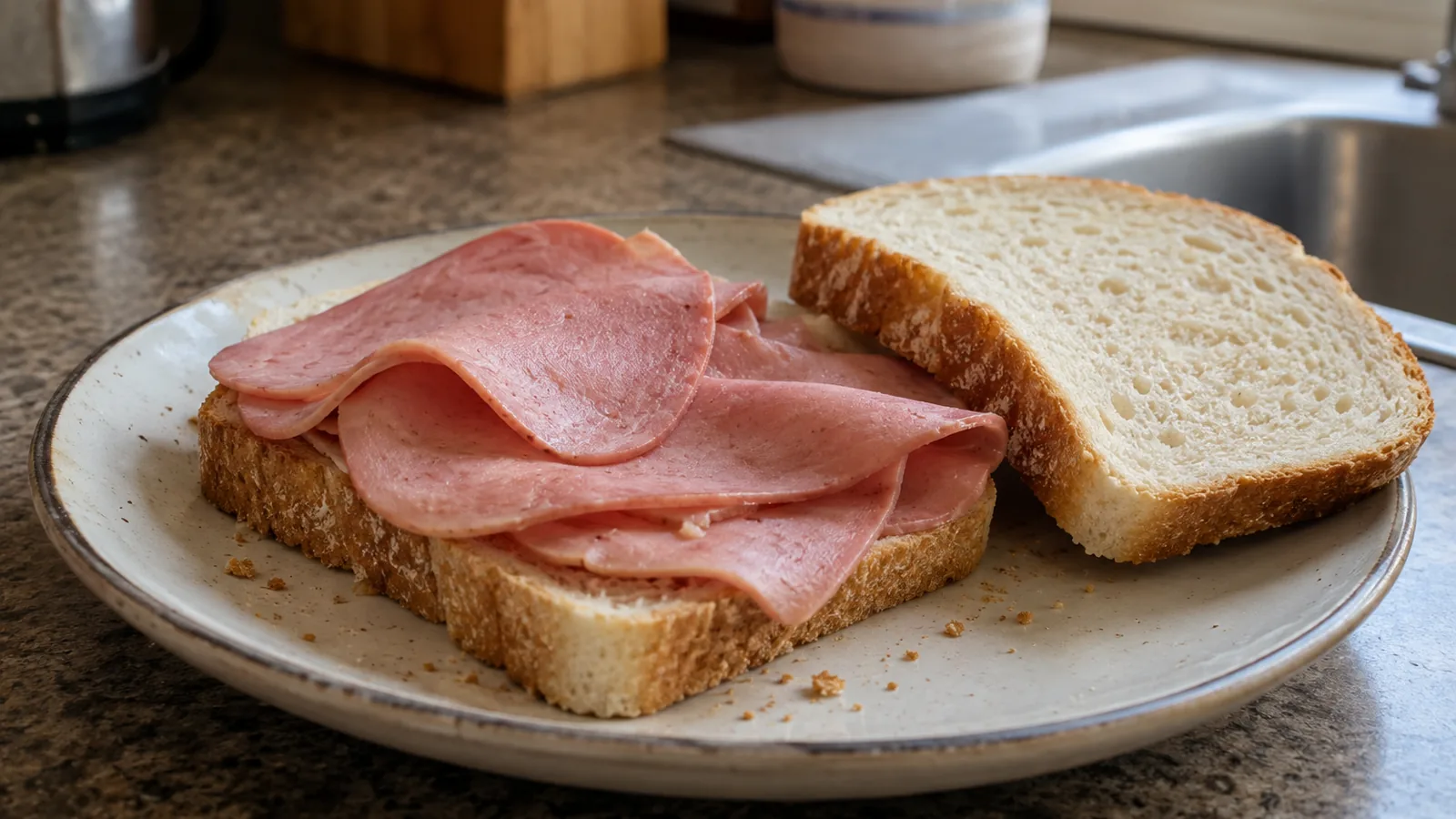
For about two years I’ve been a little ashamed of my sandwich bread. It’s sliced and bagged, with a best-by date suspiciously far off, and by any definition I know it counts as ultra-processed. So when a study of 461,682 Americans came out this month reporting that ultra-processed food as a whole showed no link to colorectal cancer, I didn’t feel forgiven. I wanted to know what else was in that category sitting next to my bread.
Mostly packaged meat, it turns out. Inside the data the meat and the bread went in opposite directions, and that’s landing just as Washington holds a proposed federal definition that could file them under the same label.
The paper, published October 15 in PLOS Medicine by Leila Abar, Erikka Loftfield and colleagues at the National Cancer Institute, uses the NIH-AARP Diet and Health Study. That cohort is 461,682 cancer-free adults aged 50 to 71 who filled out a food questionnaire once, in 1995 and 1996, and were then followed for a median of 18.8 years. Over that time, 10,075 of them developed colorectal adenocarcinoma. The typical participant got 43 percent of their calories from ultra-processed food.
People in the top fifth of ultra-processed eating had a hazard ratio of 0.97 (95 percent confidence interval 0.91 to 1.03) compared with the bottom fifth, which means no association. Once the team broke the category into its parts, those parts pointed different ways. Reconstituted meat and fish products, the bin that holds things like hot dogs and sausages, came in at 1.10 (1.04 to 1.18), about 10 percent higher risk at the top. Ultra-processed bread came in at 0.91 (0.86 to 0.97) and breakfast cereals at 0.84 (0.79 to 0.90), roughly 9 and 16 percent lower. Frozen desserts and milk drinks also came in lower.
The authors write that the null total “may be explained, in part, by opposing associations” among these foods. I’d keep that phrasing as cautious as they did, because subgroup hazard ratios don’t add up like a ledger. Still, the headline number is an average over foods that don’t seem to do the same thing in the body. ScienceDaily’s write-up ran under “Massive study of 460,000 people challenges ultra-processed food cancer fears.” Quote that sentence without the subgroups and it hands an easy line to anyone who wants “ultra-processed” to look too fuzzy to regulate.
Two side analyses lean toward what the whole-food crowd has said all along. In a model that swapped 10 percent of ultra-processed food grams for minimally processed foods, risk was 2 percent lower (HR 0.98, 0.96 to 0.99). That’s small and it comes from modeling, but it isn’t zero. People with a poor-quality diet in the top fifth of ultra-processed intake had 22 percent higher risk than low-intake eaters on a good diet. That comparison changes two things at once, though, and the formal interaction test didn’t reach significance. The study’s limits also need stating plainly. Diet was measured once, almost 30 years ago, in an older and mostly white group. The questionnaire couldn’t tell plain yogurt from the sweetened kind, and food additives weren’t measured at all.
Wait, why would a factory loaf help anyone?
The answer is in where the nutrients came from. In this cohort, 82.8 percent of all whole grain came from ultra-processed sources, along with 33.5 percent of the fiber and 31.7 percent of the calcium. For an American over 50 in the mid-1990s, the boxed cereal and the sandwich loaf were where the fiber was.
| Measure | Share |
|---|---|
| of whole grain came from ultra-processed sources | 82.8 percent |
When the researchers tracked nutrients by source, fiber from ultra-processed foods went with 28 percent lower risk for every extra 10 grams a day (HR 0.72), and calcium from those foods with 23 percent lower risk per 300 milligrams. Ultra-processed dairy was protective per daily serving, and so was dairy from everything else. Meat went the other way regardless of source: each daily serving carried 8 percent higher risk when it came from ultra-processed foods and 4 percent when it didn’t.
This is where the result started to make sense to me. Your gut bacteria ferment whatever fiber actually reaches them. Calcium ends up sitting in the bowel. Meat arrives either way. My read, and it’s a read rather than a proven mechanism, is that the processing label was mostly standing in for what was in the food, and in this cohort it stood in for opposite things. Fiber doesn’t explain all of it. Frozen desserts don’t fit a fiber story, though dairy and calcium might account for some of that, and with additives unmeasured nobody can say processing has no effect of its own.
The deli counter doesn’t get the pass
None of this helps processed meat. In 2015 the World Health Organization’s cancer agency, IARC, classified processed meat as carcinogenic to humans (Group 1) and estimated that each 50-gram portion eaten daily raises colorectal cancer risk by 18 percent. IARC’s “processed meat” and the PLOS paper’s “reconstituted meat and fish products” overlap without being the same thing, but 74.3 percent of the processed meat in the NIH-AARP data came from ultra-processed sources, and the risk showed up there.
The strongest earlier US evidence points at the same aisle. Wang and colleagues’ 2022 BMJ analysis of three Harvard cohorts found that men in the top fifth of ultra-processed intake had 29 percent higher colorectal cancer risk (HR 1.29, 95% CI 1.08 to 1.53), rising to 1.72 for distal colon cancer. The biggest driver was ready-to-eat meat, poultry and seafood products, at 1.44. Women in that analysis showed no overall link, and their ultra-processed dairy, yogurt included, was tied to lower risk (0.83). “Ultra-processed foods, including processed meats, are low in dietary fiber, are also energy dense,” co-author Xuehong Zhang said at the time. The overall result in men doesn’t match the new null, and nothing here settles that difference. What the two studies share is the direction of the meat-product signal.
The PLOS paper cites a 2024 BMJ umbrella review that rated the evidence tying ultra-processed food to colorectal cancer as very low quality. That doesn’t clear ultra-processed food. It means the broad category hasn’t been able to answer the question.
The new study’s own disclosures are clean. It was funded by the NCI’s intramural program, the funder had no role in design, analysis or the decision to publish, and the authors declared no competing interests. The risk comes later, when people repeat the headline and leave out the parts that complicate it.
The timing matters because Washington is deciding what “ultra-processed” means. A joint FDA and USDA request for information in July 2025 drew more than 5,000 comments before closing October 23, 2025. On August 10, 2026, HHS and USDA announced they had sent a proposed definition to the White House Office of Management and Budget. OMB’s calendar lists a series of review meetings on the “White Paper: Proposed Definition of Ultra-Processed Food” running through September and into October, and as of October 13 the text still hadn’t been released. The agencies describe it as a research tool, not a regulation. California has already written a statutory definition into its school-food law, AB 1264, which bans sales of “ultra-processed foods of concern” in schools starting July 1, 2032. Texas, Louisiana, Arizona and Florida have pursued their own labeling and school-meal measures.
Here the MAHA push to fix the American diet either gets sharper or gets argued into mush. A definition that puts a seeded whole-grain loaf and a pack of bologna in the same bin can’t do what this study says needs doing. The fix is a definition that can tell them apart, so processed meat can’t hide behind the bread.
I’m keeping the seeded loaf in my cart and dropping the guilt, and the packaged salami is going back on the shelf.
Sources
- PLOS Medicine: Abar et al., NIH-AARP Diet and Health Study (2026)
- Healio: Wang et al., BMJ 2022, ultraprocessed food and colorectal cancer risk in men
- UICC: IARC Monographs evaluate consumption of red meat and processed meat (2015)
- Greenberg Traurig: Why the coming federal definition of ultra-processed foods matters (2026)
- ScienceDaily: “Massive study of 460,000 people challenges ultra-processed food cancer fears” (2026)