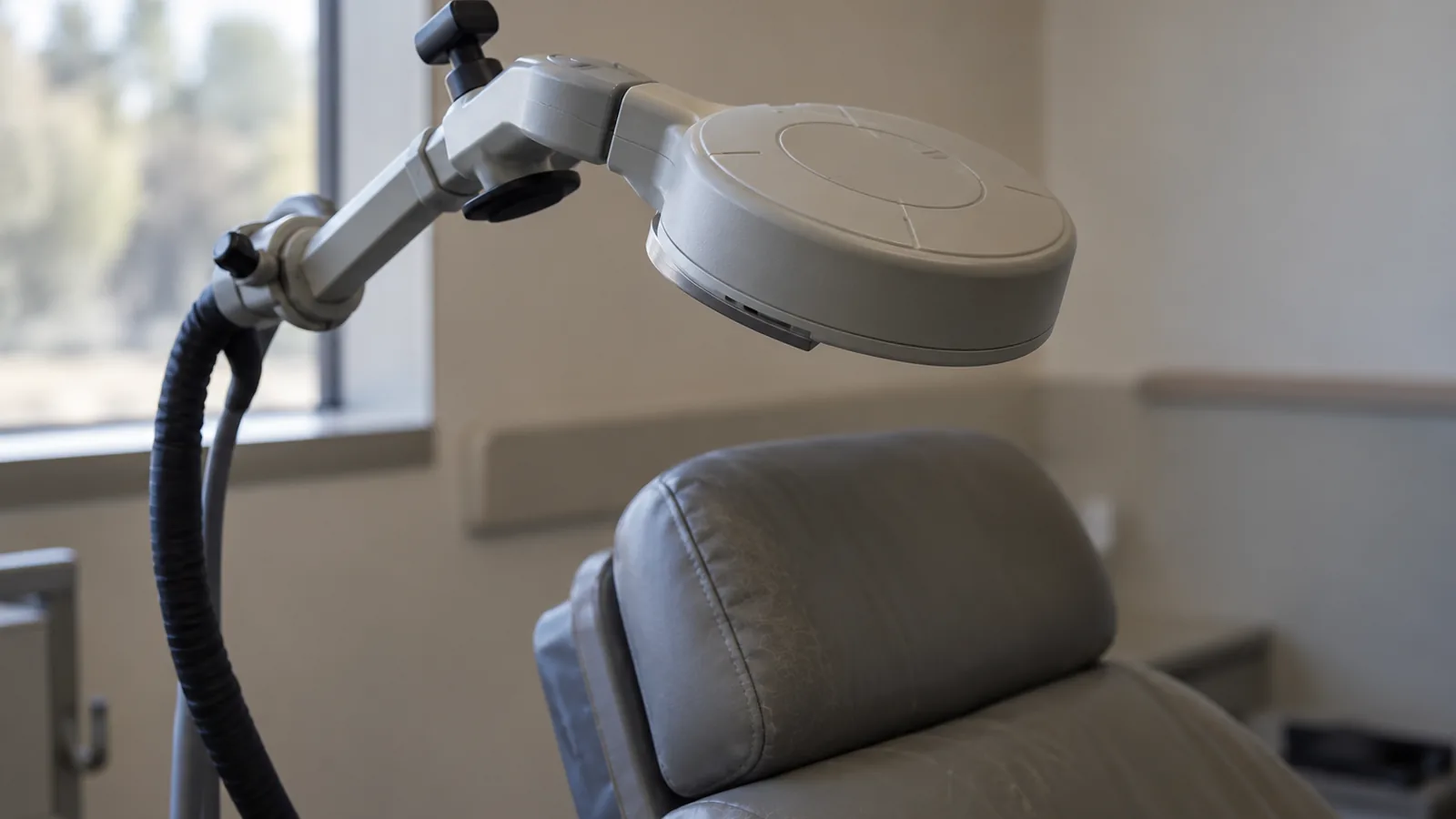
I wanted this one to work. Here was a PTSD treatment that reads your brain’s own rhythm and tunes a magnetic coil to match it, now cleared by the FDA and backed by a clinical trial reporting 68 percent remission. Then I went looking for the number that tells you whether 68 percent means anything, which is how the people under the fake coil did. Nobody has put it on the record.
So the trial was built to answer one question, active coil versus sham, and that answer is the result still sitting with the sponsor.
I ask two unglamorous questions of every remission figure. Sixty-eight percent of whom? And compared with what? The release that carried the number this week answers neither. It doesn’t define remission, doesn’t say when it was measured or how many people it was counted across, and concedes that “the full findings are still being prepared for public release.”
A trial built around a fake coil
The device is the MeRT System from Wave Neuroscience of Newport Beach, California, tested with Texas A&M’s Institute of Biosciences and Technology. The FDA’s 510(k) record shows the agency found it “substantially equivalent” on June 3, 2026, under the product code for transcranial magnetic stimulation systems for PTSD. MagVenture, whose stimulators the system runs on, describes the clearance as covering “the adjunct treatment of post-traumatic stress disorder (PTSD) in adult patients.” Adjunct means an add-on to whatever care someone already gets, not a replacement for it.
The 52 percent symptom reduction and the 68 percent remission come from Wave, repeated by its chief medical officer, Erik Won, in a Texas A&M release that ScienceDaily ran under the word “breakthrough.” Texas A&M’s own clearance announcement says only that results showed “significant and clinically meaningful reductions in PTSD symptom severity,” with no effect size and no sham-group figures.
The trial is registered as NCT02990793: 158 people enrolled and randomized, with participants, investigators and outcome assessors all masked. One group got active stimulation, and the other got a coil that, per the registry, “does not emit magnetic stimulation,” on the same schedule. The primary endpoint isn’t remission at all. It’s the change on the PCL-5, a standard PTSD symptom checklist, at five weeks. Primary data collection ended September 18, 2025, and the study was marked complete that November. The registry shows no posted results, the sponsor lists no plan to share individual participant data, and I couldn’t find a journal paper.
So the trial was built to answer one question, active coil versus sham, and that answer is the result still sitting with the sponsor.
The idea itself is lovely, and I’ll give it its due. Conventional TMS, as a UTHealth Houston psychiatry post describes it, runs at a “fixed stimulation frequency” under a standard protocol. MeRT listens first, using brain-wave and heart recordings to find your individual alpha frequency, the slow idle your brain sinks into when you close your eyes and stop trying to do anything, and then delivers pulses six seconds a minute, 30 minutes a day, five days a week for five weeks. Tuning the beat to the rhythm a brain is already humming sounds like it should beat a one-tempo approach. Does it? The same UTHealth post notes that clearance “does not necessarily establish superiority over existing treatments,” and says that question “will require additional high-quality comparative studies.”
Wave has run this experiment before
The company’s earlier sham-controlled trial does have posted results, on ClinicalTrials.gov NCT02268084. It enrolled 96 combat veterans at a San Diego clinic between 2014 and 2016, ran two weeks double-blind, active versus sham, and then gave everyone active stimulation for two more weeks. At two weeks, with 40 veterans analyzed per arm, active stimulation had cut scores on the PCL-M, the military version of the symptom checklist, by 22.45 points, while the sham group’s fell by 14.75. That 7.7-point gap was statistically significant (p = 0.007), so the device beat the sham, even as the sham group’s scores fell about two-thirds as far on a coil the record says “simulates behavior of the intervention magnetic coil without applying the magnetic field.”
| Group | Value (points) |
|---|---|
| Active stimulation | 22.45 |
| Sham coil | 14.75 |
Wait, how does a coil that applies no field move a PTSD score that much in two weeks? Wave’s own record offers part of an answer: its sham “inadvertently delivers some treatment through magnetically shielded coil” and forehead stimulation, and “placebo effects may modulate brain regions and neural networks similar to active treatment.” My guess at the rest is plainer. Someone with PTSD who shows up five mornings a week to a quiet room, where a team studies their brain waves and expects them to improve, is getting a structured, attentive routine, and that’s a hypothesis worth taking seriously, because it’s exactly what a sham arm exists to subtract.
After the crossover, the arms finished week four almost level, down 32.53 and 30.90 points (p = 0.326). Both groups had active stimulation by then, so that tells you nothing about placebo, only that the open-label phase couldn’t separate four weeks of treatment from two. The record has rough edges too. Its description says “a total of 2004 subjects will be treated in two phases” against the 96 actually enrolled, and it lists no data monitoring committee. Neither is damning on its own, but together they make a topline-only press release a lot to take on faith.
A drug comparison the release itself disowns
Won didn’t set his numbers against a sham group. He set them against pills. The release cites a 2020 study in which medication remission reached “only 10.9% at most,” and in an interview with Soldier Systems Won said “our FDA trial reported a 52% reduction in symptoms, so more than a four-fold increase in efficacy,” then cited the 68 percent and called it “a quantum change.”
That study is Shiner and colleagues in the Journal of Clinical Psychiatry, which followed 834 VA outpatients who started fluoxetine, paroxetine, sertraline, topiramate or venlafaxine in routine care and had symptom scores at baseline and at 12 weeks. Mean PCL-5 improvement ran 6.8 to 10.1 points, and remission ran 0.0 to 10.9 percent. A percentage drop from one trial set against point changes and remission rates from another isn’t one yardstick. The MeRT trial also screened hard: ages 18 to 65, a PCL-5 of at least 30, no antipsychotics, benzodiazepines or anticonvulsants within 30 days, and nobody whose index trauma happened before age 16. Veterans in routine clinic care against a screened trial cohort is not a fair fight, and to its credit the release says the results “come from different studies and should not be interpreted as a direct comparison of treatment effectiveness.” The headline didn’t get that memo, and neither did “four-fold.”
The release also calls MeRT “the only FDA-cleared nonmedication treatment specifically for PTSD once it reaches patients.” But Freespira, a drug-free breathing-training device, was cleared by the FDA to treat PTSD in 2018, on a study in which half of patients no longer met criteria for PTSD. Striking remission numbers turn up regularly in this field. Numbers stacked against a sham are much rarer.
Fifteen thousand customers before the clearance
Won says the clearance “should open up market access to about 13 million people who may be struggling with PTSD.” MagVenture tells customers it could expand the addressable market “from approximately 3 million treatment-resistant depression patients to more than 16 million individuals across both conditions.” And MeRT was being sold long before any of this. A 2023 Orange County Business Journal profile described Wave as “a Newport Beach-based wellness company” that had treated 15,000 people, and reported a $1.5 million Engelstad Foundation donation for its second phase of clinical trials. In 2019, Defense One’s headline had it “Curing Navy SEALs of PTSD,” with more than 650 veterans treated. Even then, Won told the reporter, “It’s certainly not a panacea.”
The need is no sales pitch. Israel Liberzon, the Texas A&M psychiatrist who served as the study’s lead psychiatrist, points out that “the FDA has approved only two medications for PTSD,” and that many people drop out of psychotherapy because “it’s too anxiety provoking.” The veterans’ trial looked safe, too, with no serious adverse events and mild headaches in 4 of 49 active patients against 1 of 47 on sham. A low-risk, drug-free add-on that tunes itself to your own brain rhythm is something I’d love to see hold up.
Wave has the five-week PCL-5 results for both arms of a 158-person trial whose data collection ended in September 2025, and it can tell us how it defined remission, when it measured it and how many people the 68 percent covers. If someone I loved had PTSD and a clinic offered MeRT tomorrow, I’d ask for the sham arm’s five-week numbers before booking the first session, and until Wave posts them I wouldn’t pay out of pocket for a 68 percent that comes with no comparison attached.
Sources
- ScienceDaily / Texas A&M: “Breakthrough PTSD treatment achieves 68% remission rate in clinical trial” (2026)
- ClinicalTrials.gov NCT02990793: MeRT pivotal sham-controlled PTSD trial (Wave Neuroscience)
- ClinicalTrials.gov NCT02268084
- FDA 510(k) database: K260402, MeRT System, substantially equivalent decision (June 3, 2026)
- Texas A&M Institute of Biosciences and Technology: MeRT FDA clearance announcement (2026)
- MagVenture: MeRT cleared as adjunct treatment for adult PTSD
- Journal of Clinical Psychiatry: Shiner et al., Comparing Medications for DSM-5 PTSD in Routine VA Practice (2020)
- UTHealth Houston Psychiatry: MeRT receives FDA clearance for PTSD (2026)
- Soldier Systems: Won and Liberzon interview on the MeRT clearance (2026)
- Chief Healthcare Executive: Freespira digital therapeutic gets FDA OK to treat PTSD (2018)
- Orange County Business Journal: Wave Neuroscience lands new funds (2023)
- Defense One: “Zap: How Electric Therapy Is Curing Navy SEALs of PTSD” (2019)