In 2014, a sham procedure stopped the most hyped blood pressure device in cardiology. Early, uncontrolled trials of Medtronic’s renal denervation catheter had reported systolic drops as high as 32 mm Hg. Then SYMPLICITY HTN-3 randomized 535 patients to either the real procedure or a sham one. Office systolic pressure fell 14.13 points with denervation and 11.74 with the sham, a 2.39-point gap that did not reach significance, and in their editorial Franz Messerli and Sripal Bangalore wrote that the trial brought “the renal-denervation train to a grinding halt.”
This year a Cardiff-made ear clip faced its own sham, and the result came out under a much gentler headline. In SCRATCH-HTN, a trial run out of Queen Mary University of London, daytime systolic pressure fell 3.15 mm Hg in patients using the active device and 5.50 mm Hg in patients using an identical unit that delivered no current at all. Those numbers come from Cardiology Now’s report from the American College of Cardiology meeting, where chief investigator Dr. Ajay Gupta presented the results on March 28. In September, Queen Mary announced the published paper as “Non-invasive nerve stimulation shows potential for treating uncontrolled high blood pressure,” and this week ScienceDaily ran the release as “Could lowering high blood pressure be as simple as stimulating your ear?” The device failed to beat the fake.
| Group | Value (mm Hg) |
|---|---|
| Active ear stimulation | 3.15 |
| Zero-current sham | 5.50 |
A nerve that surfaces at the ear
The idea has an elegant piece of anatomy behind it. The vagus nerve is the body’s main parasympathetic brake, the system that slows the heart and relaxes blood vessels, and one of its sensory branches reaches the skin of the outer ear. The tragus, the small flap of cartilage in front of the ear canal, is one of the few spots where that wiring can be reached without surgery. Persistent hypertension is associated with weak vagal tone and excess sympathetic drive. The proposal, as the trial’s design paper sets it out, is that stimulating the ear could shift that autonomic balance back toward normal. SCRATCH-HTN was built to test that proposal, and it did not establish it.
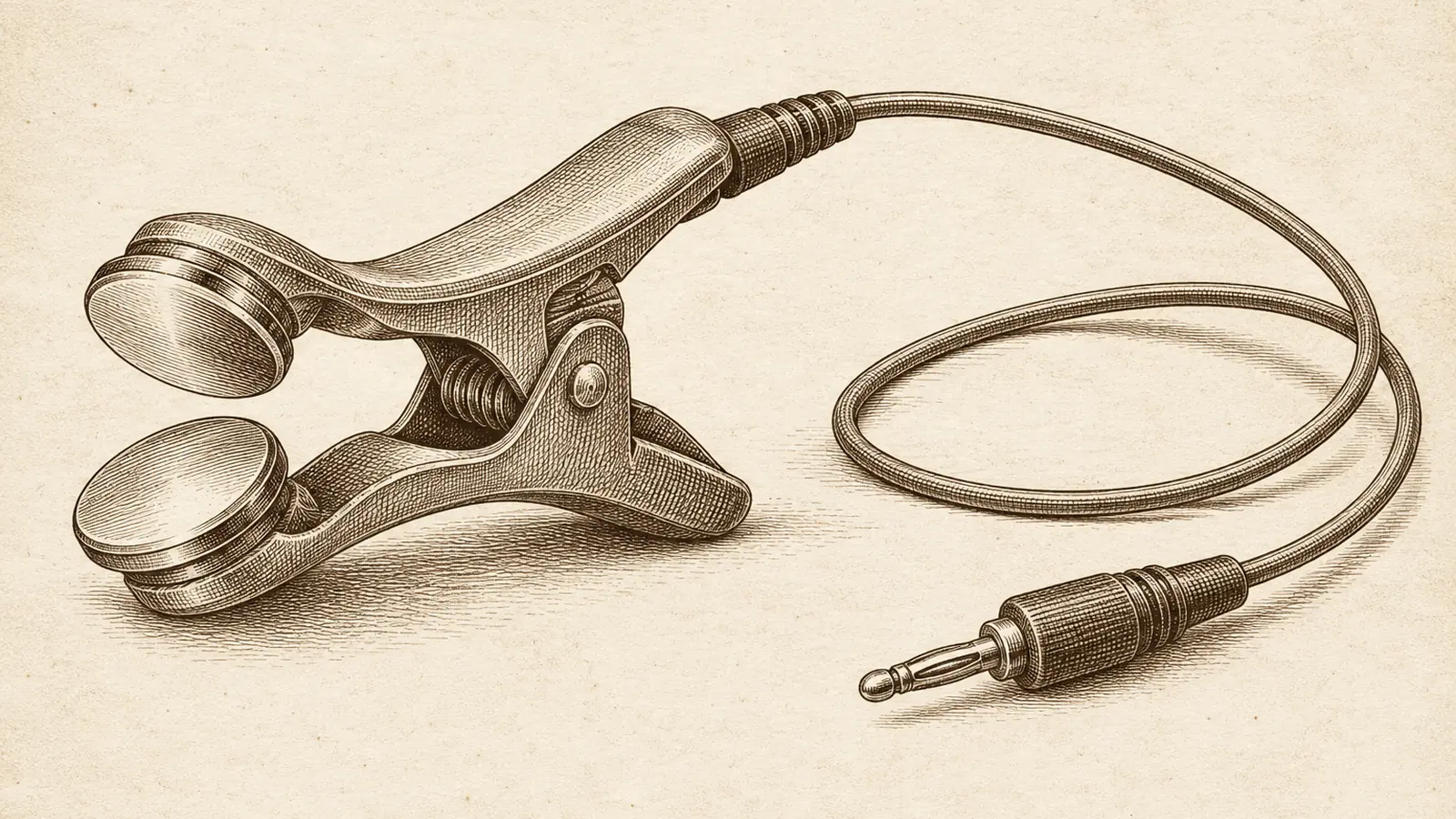
The device is the AffeX-CT from Afferent Medical Solutions, a handheld unit with clips on both tragi that sends 200-microsecond pulses at 30 Hz. The current is set about 1.5 mA below each patient’s tingling threshold, so the active stimulation is meant to sit below sensation, and the sham, which runs at 0 mA, is meant to feel identical. Participants, the clinical team and the analysts were all blinded. The design paper planned to ask participants which arm they thought they were in, and no public account of the results has reported that answer yet. Even so, Queen Mary’s William Harvey Research Institute ran this test properly. Most device stories never get a zero-current control.
What the fake did
Sixty-three adults whose blood pressure stayed high despite an average of two drugs were randomized two to one, 41 to the active device and 22 to the sham. They averaged 150/95 on daytime ambulatory monitoring and were fairly young, with an average age of 47.2. Each used the clip at home for 30 minutes a day for two weeks and then once a week for ten more.
The efficacy endpoint was the change in daytime ambulatory systolic pressure at three months, measured by a cuff that records all day rather than by a single reading in a clinic. The meeting report says neither arm’s fall was statistically significant, unadjusted or adjusted, and Gupta was blunt in his presentation: “there is no significant difference in BP reduction on tAN versus sham treatment in this cohort of uncontrolled hypertensive patients.” Twenty-four-hour pressure, office pressure, heart rate variability, sleep quality and six-minute walk distance also showed no significant differences between the arms. With 63 patients, that is not proof the device does nothing. It does mean the trial found no sign that it beats switching it off.
The trial was designed around a much bigger expectation. According to the design paper, 63 participants were enough to detect a between-group difference of 8.4 mm Hg in the device’s favor, or 9.3 if a fifth dropped out or skipped sessions. The raw averages differed by about 2.35 points, and in the sham’s favor. The grounds for expecting more were thin from the start. The authors cited their own unpublished, single-arm study of 10 patients with drug-resistant hypertension, in which 24-hour systolic pressure fell by an average of 14 mm Hg, and an earlier study by Stavrakis and colleagues that used the same device in heart failure patients and found no change in office pressure. In 2024, Afferent’s chair, Prof. Michael Spyer, called the technology “truly a game changer that will improve the health of millions”, in a piece crediting its phase I trial with reductions “up to 20 mmHg.”
Renal denervation went the same way, on a bigger stage. Open-label numbers look dramatic, and then a blinded sham produces an effect that is small or missing. The 5.50-point fall in the zero-current arm shows how far a pressure reading can drop with no active treatment. Several things could explain it: regression to the mean, better pill-taking by people who know they are being monitored, and the medication changes in a minority of participants that the meeting report flags as a possible confounder. An uncontrolled study cannot tell any of those apart from a device effect, which is why you need a sham. The report adds that the sham response was larger than expected, which reduced the trial’s statistical power.
Potential, with the numbers left out
The university does acknowledge that the trial missed its main goal. Its release says the active and sham groups did not differ significantly overall, and ScienceDaily repeats that early on. Neither, though, gives a single blood pressure figure for either arm, so a reader of the release never learns that the fake device produced the larger drop. What readers do get is a subgroup of patients with more severe hypertension, where Gupta said those patients “exhibited a clear blood pressure reduction in the active group compared to sham,” along with his description of the technology as potentially “a cheap, scalable solution for millions.” The release gives no price. Every patient stayed on their medication, so at best this is an add-on to drugs, not a replacement for them.
The subgroup was planned in advance, and the investigators should get credit for that. The design paper lists baseline daytime systolic pressure below versus at or above 160 as a planned subgroup analysis and used it in balancing the randomization. The meeting report describes a significant treatment-by-baseline interaction, meaning the device’s effect appeared to depend on how high a patient’s pressure started. An interaction alone does not show the device lowered pressure in the sicker group, though, and no public account gives that group’s size, the size of its reduction relative to sham, or a confidence interval. In a 63-person trial split two to one, the active and sham arms of that subgroup could each be a handful of people. Severe hypertension did not protect SYMPLICITY HTN-3 from its sham, either. That trial enrolled only patients with office systolic pressure of at least 160, and the sham still came within 2.39 points of the catheter. The investigators say the subgroup finding needs larger trials. A headline promising “potential” presents it as the result.
The money trail is short. Britain’s National Institute for Health and Care Research paid for the trial under grant NIHR202116, so public money tested a private company’s product, with Queen Mary as sponsor. Three of the design paper’s authors list Afferent Medical Solutions, the device maker, as an affiliation. The paper’s acknowledgements say the company supported the study and helped with “device-related regulatory aspects.” The university and the company both gain when a null result goes out sounding promising.
The safety and usability findings did hold up. Neither arm reported a serious adverse device effect, and median adherence was 100 percent of days in both. That is three months in 63 people, not a broad safety record, but it shows patients will use the clip at home without complaint. Whether it lowers their blood pressure is the part this trial could not show.
The next move belongs to Queen Mary and Afferent, and the next trial has one question to answer: in patients whose daytime systolic pressure starts at 160 or above, does the active clip lower ambulatory pressure more than a zero-current sham, in a study large enough to detect the effect the subgroup implies? SCRATCH-HTN is registered on ClinicalTrials.gov as NCT05179343, so a confirmatory trial would need its own registration. Watch the registry for one that limits enrollment to that severe group, keeps the 0 mA sham, makes ambulatory pressure the primary endpoint and reports whether patients could guess their arm. If that record shows up, the ear clip gets a fair second test. If the subgroup turns up in sales material first, the company will have made its choice before running the test that could decide the question.
Sources
- Cardiology Now: SCRATCH-HTN at ACC 2026
- Queen Mary University of London: “Non-invasive nerve stimulation shows potential for treating uncontrolled high blood pressure” (September 2026)
- Gupta A, et al., and the SCRATCH Trial Investigators, “Safety, Acceptability and Efficacy of Noninvasive Transcutaneous-Autonomic Neuromodulation in Uncontrolled Hypertension,” Hypertension (2026), DOI 10.1161/HYPERTENSIONAHA.126.27847
- medRxiv: SCRATCH-HTN rationale and study design (December 2025)
- ScienceDaily: “Could lowering high blood pressure be as simple as stimulating your ear?” (October 2026)
- William Harvey Research Institute: SCRATCH-HTN trial page
- ClinicalTrials.gov: NCT05179343, SCRATCH-HTN
- NEJM CardioExchange: SYMPLICITY HTN-3 (March 2014)
- Blood Pressure UK: Ongoing trials to harness neuromodulation for blood pressure control (July 2024)