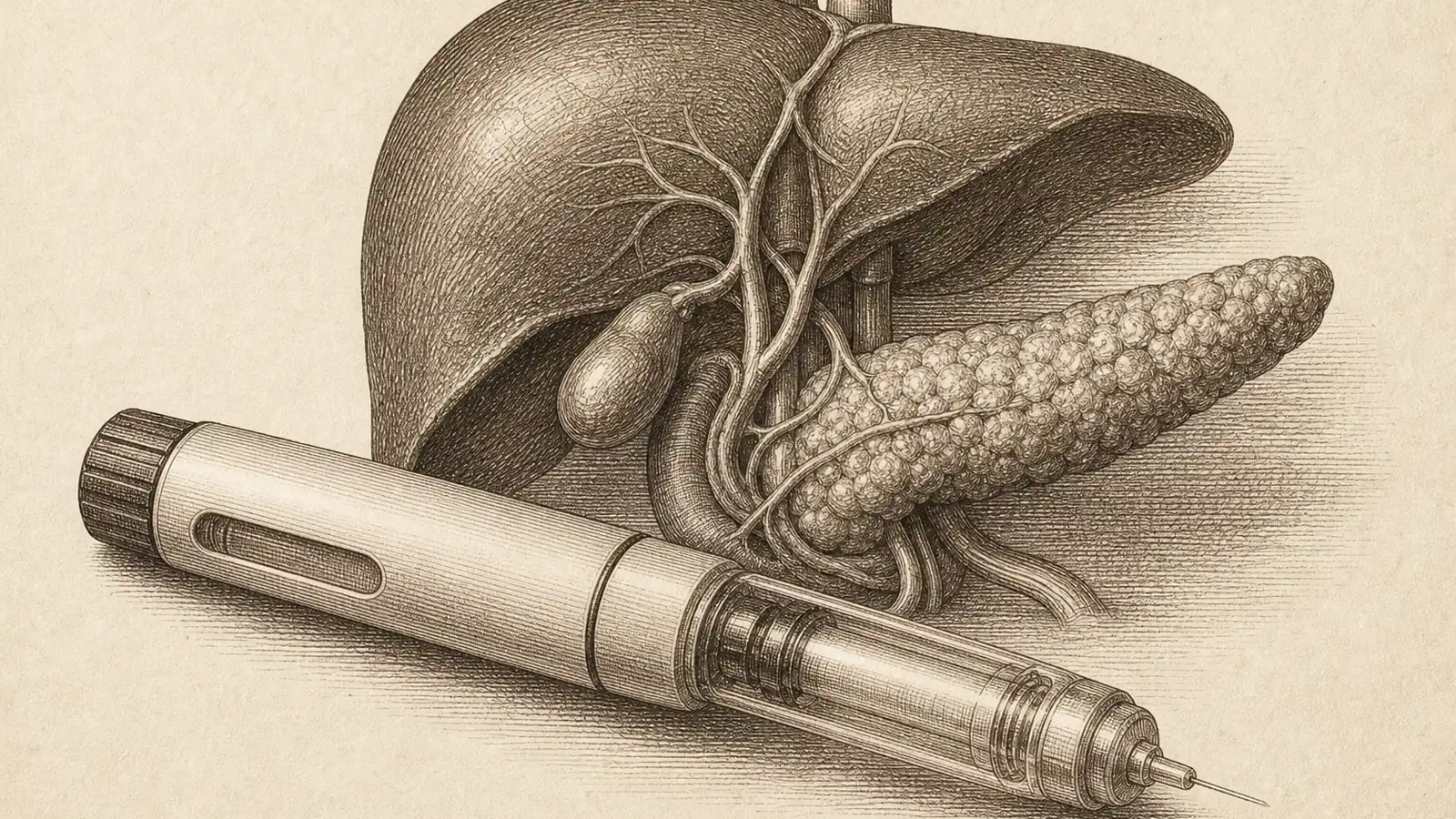
Lilly’s phase 3 readout from New Orleans this week is the one the obesity field has been waiting on, and the move that makes retatrutide different from Ozempic and Mounjaro is not stronger appetite suppression. It is glucagon. The hormone every previous obesity drug has tried to dial down, retatrutide deliberately turns on, and that decision is the reason the numbers look the way they do.
I went into the ADA presentations skeptical. Eli Lilly sponsored both trials. The investigator who used the word “staggering,” Harpreet Bajaj, takes Lilly research support. So does Ania Jastreboff, the lead investigator on the obesity trial, who also sits on scientific advisory boards for Lilly, Novo Nordisk, Pfizer, and other obesity-drug developers. Robert Dubin, who called the drug “historic” and said it “closes the medical-surgical gap,” consults for Lilly. None of that is scandal; it is just how phase 3 obesity trials get reported in 2026. But it is the context the conference floor would rather you forget.
The data is something.
TRIUMPH-1 followed 2,339 adults with overweight or obesity for 80 weeks. At the top 12 mg dose, average weight loss on the treatment-regimen estimand was 25 percent, about 62 pounds (28.3 percent on the efficacy estimand, which excludes those who stopped the drug). A 532-person extension cohort kept going to 104 weeks and landed at 29.9 percent, about 83.9 pounds. That extension is roughly a quarter of the original trial population, which matters when you cite the bigger number, but the retention is respectable and the curve was still bending downward when the extension ended. About 87 percent of people on the top dose lost at least 15 percent of their starting weight; 45 percent lost at least 30 percent; 27 percent lost at least 35 percent. Two-thirds dropped below a BMI of 30. A third dropped below a BMI of 25, which is the line where the chart in your doctor’s office stops calling you overweight at all. Tirzepatide tops out around 22 percent at three years. Semaglutide tops out around 15 percent at 68 weeks. We are now looking at a pharmaceutical reaching into the range that used to require a surgeon and a stapler.
TRANSCEND-T2D-1, the diabetes trial, ran 537 adults for 40 weeks. A1C dropped 1.94 percentage points on the top dose against 0.81 for placebo. Weight came down 15.3 percent on the treatment-regimen estimand against 2.6 percent. Fasting glucose dropped 30 mg/dL. No severe hypoglycemia. Bajaj called the weight-loss number for diabetes patients “staggering” and he has a point: people with type 2 diabetes have always lost less weight on GLP-1 drugs than people without it, and that gap has been a frustration in the field for years. Retatrutide narrows it more than any prior incretin drug appears to have, though “closes it” overstates what 40 weeks of data can claim against TRIUMPH-1’s much longer arc.
So why does this molecule do things the other ones do not? This is the part I had to read twice.
Semaglutide hits one receptor, GLP-1, which mostly works by slowing your stomach and dialing down appetite in the hypothalamus. Tirzepatide hits two, GLP-1 plus GIP, the second receptor sharpening the same conversation with better insulin response, better satiety, and probably some direct effects on fat tissue. Retatrutide adds a third receptor, glucagon, and that is where the bet gets interesting. Glucagon is the hormone that tells your liver to release stored sugar when you are fasting, tells your fat cells to release fatty acids for fuel, and bumps up your resting energy expenditure. Every metabolic textbook puts glucagon in the “anti-insulin” column, and every previous diabetes drug treated it as an enemy to suppress, not a tool to use. Lilly’s bet is that you can suppress appetite through GLP-1 and GIP, then use glucagon to make the body burn the resulting deficit harder, mostly by oxidizing liver fat and turning up the metabolic furnace.
Lilly is not the first to try the glucagon angle. Mazdutide, a GLP-1/glucagon dual agonist, was approved in China for chronic weight management in 2025, and that approval was the proof that the glucagon arm could be tolerated in a chronic-use weight-loss drug at all. Retatrutide is the first triple agonist to read out phase 3 obesity data, and it is the molecule taking the glucagon thesis to its full version: not a chaperone bolted onto a GLP-1, but a load-bearing piece of the metabolic intervention.
The phase 2 body-composition substudy gave a first look at how that plays out. Roughly 62 to 75 percent of weight lost came from fat mass, with 25 to 38 percent from lean mass. That ratio is broadly in line with semaglutide and tirzepatide, which is the bar most clinicians wanted to clear. Retatrutide clears it. It does not obviously beat it, and the more excited coverage glosses over that. The glucagon arm is not, so far, a free lunch on muscle, which means the resistance-training-and-protein advice every responsible clinician already gives Wegovy and Zepbound patients applies just as forcefully here.
The other thing the third receptor does is mess with how food feels in your head. A Lilly-funded phase 2 substudy in adults with type 2 diabetes found something I find interesting: people on retatrutide reported less hunger, less preoccupation with food, and a measurable shift away from craving fatty foods specifically. That last detail surprised me. GLP-1 drugs in general reduce overall food intake by changing the brain’s reward response, but a preferential drop in fat cravings is unusual. The authors are careful that the mechanism is not nailed down, and they should be; this is a clue worth chasing, not a closed pathway. I came in expecting another “you just feel full” story and left thinking the gut, the liver, and the brain are having a more interesting three-way conversation on this molecule than the simpler GLP-1 drugs ever engaged.
Now the parts of New Orleans that did not make the headline.
UTIs turned up at 7.5 percent, 8.8 percent, and 8.4 percent across the retatrutide dose arms in TRIUMPH-1, against 5.3 percent on placebo. Of those reported cases, 92 percent were in women. That signal is new. Semaglutide and tirzepatide do not show a UTI bump of that size, and no one at the podium had a clean mechanistic story for it. Glucagon does some unusual things to renal handling of glucose and urea, and one working hypothesis is that the combination of glucagon agonism with rapid weight loss shifts urinary chemistry in a way that favors bacterial colonization. That is speculation. It will need a proper investigation before women, who picked up almost all of the reported infections, can decide what to make of it.
Discontinuations from adverse events ran 11.3 percent at the top dose against 4.9 percent on placebo, mostly GI: nausea, vomiting, diarrhea, the familiar GLP-1 tax. Three deaths occurred in the 9 mg arm, one in the 12 mg arm, and two on placebo; investigators did not link any of them to the drug. Serious adverse events were modestly elevated at 10.5 percent on 12 mg against 5.5 percent on placebo.
The mainstream framing of this week’s news is “another GLP-1, more weight loss.” That framing is not wrong. It is just shallow. We now have three obesity drugs at three different points on a receptor map, and each is teaching us something specific about which receptor does what. Semaglutide showed how much appetite suppression alone could buy. Tirzepatide showed that adding GIP buys a meaningful additional slice. Retatrutide is showing that turning on glucagon, the thing the textbooks told you not to touch, buys another slice on top of that, mostly through fat oxidation and energy expenditure, and probably through a different conversation with the liver than either of the others has.
So what do I make of it. Lilly is expected to file retatrutide with the FDA as early as the end of 2026 if the remaining trials hold up, which puts the soonest realistic approval in 2027. By then, the questions worth watching are the ones the conference floor isn’t centering yet: whether durability past two years holds in a broader population, whether the UTI signal turns out to have a mechanism Lilly can do something about, whether the lean-mass margin against tirzepatide is meaningfully different in head-to-head data, and what Lilly decides to charge for a molecule that finally, plausibly, reaches into bariatric-surgery territory without a surgeon. The biology underneath this drug is the most interesting thing happening in obesity medicine in a decade. Those questions will be the ones we are all asking next.
Sources
- Healio – Retatrutide benefits in obesity, type 2 diabetes ‘quite staggering’ – ADA 2026 (2026)
- Research Square preprint – Efficacy and safety of retatrutide for overweight/obesity or type 2 diabetes: systematic review and meta-analysis
- Diabetes, Obesity and Metabolism – Retatrutide phase 2 substudy: food preferences and fat cravings in type 2 diabetes (2026)
- Expert Opinion on Investigational Drugs – Retatrutide as a triple receptor agonist (2023)