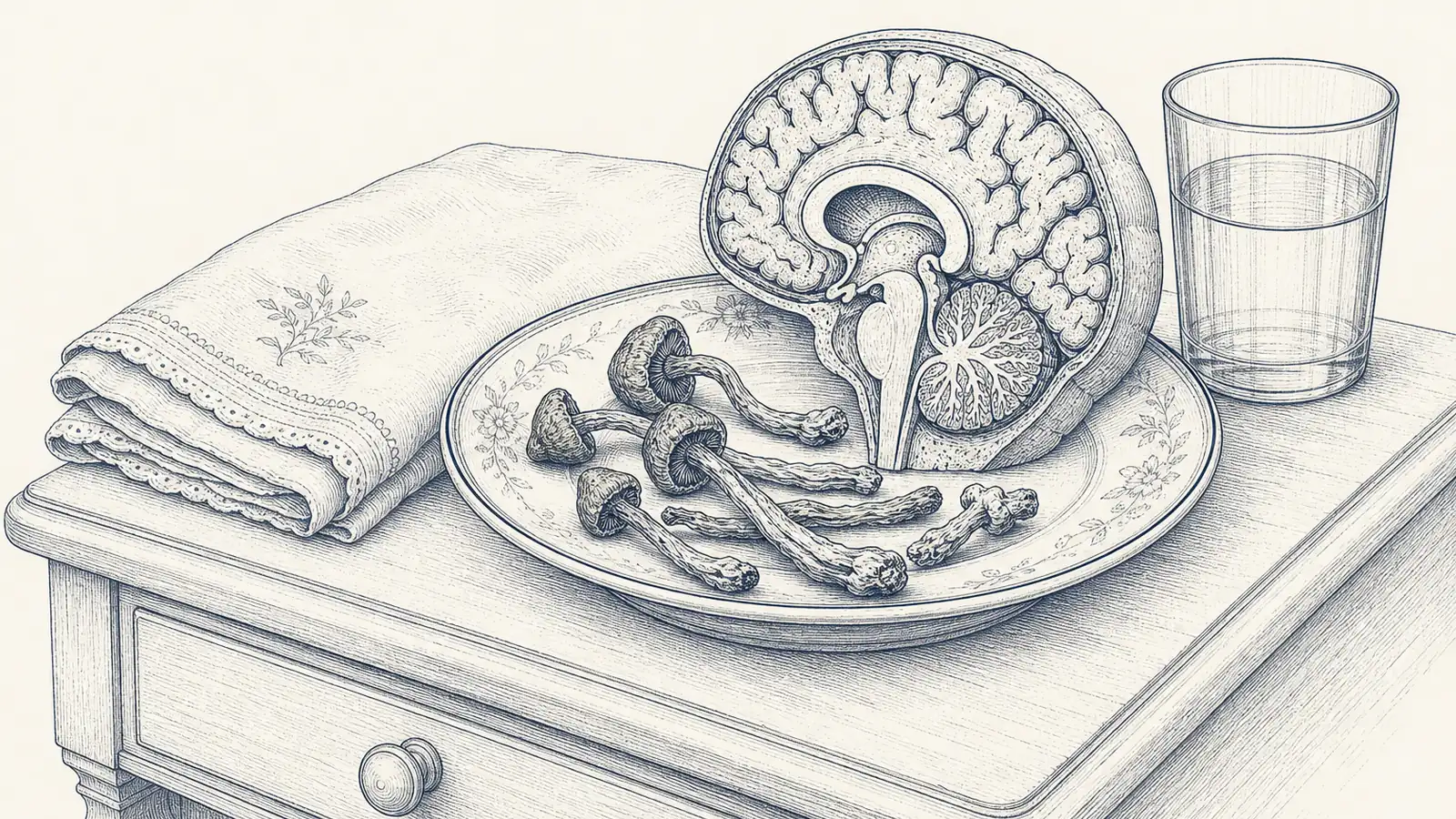
An 80-something woman with advanced Alzheimer’s hadn’t really spoken in five years. Her speech had narrowed to single syllables. She wore diapers, needed help walking, ate by hand from her caregivers. In one case report published in Frontiers in Neuroscience, she received five grams of psilocybin-containing mushrooms in a supervised session, slept for what the authors describe as a long, deep, sweat-soaked stretch, and roughly 19 hours later started talking. Recalling names. Recognizing family. Dressing herself. Walking on her own. Continent again.
One woman, one case, one journal. No control group, no biomarkers, no MRIs, no standardized cognitive testing. The authors say so plainly, and I cannot stop thinking about it. The bigger problem is one nobody covering this story is foregrounding: psychedelic-assisted therapy ran almost its entire first wave of modern trials without the people who actually develop dementia. Across 36 trials through September 2023 with more than 1,400 enrolled participants, exactly 19 were 65 or older. Nineteen people. A field now claiming brain-aging relevance, almost entirely tested on brains under 65.
My default with this kind of headline is to roll my eyes. Every few years a class of compounds gets nominated as the next dementia miracle, and every few years the same field has to clean up after the same press release. So when the same week brought UC Berkeley’s announcement of the first dedicated psychedelic neuroimaging study in older adults, the viral case report, and a stack of fresh review papers asking whether psilocybin can rebuild aging neurons, I expected another hype cycle. Both halves turned out to be true at once. The mechanism story is stranger and better-evidenced than the eye-roll deserves. The clinical evidence base is much thinner than the wellness internet admits. Which one you lead with is basically the whole debate.
The biology first, since it is doing the actual work. Serotonergic psychedelics, the family that includes psilocybin, LSD, and DMT, hit the 5-HT2A receptor on cortical neurons and set off a cascade that ends in structural changes to the neuron itself: more dendritic spines (the little knobby protrusions where neurons make contact with each other), more synaptic connections in the hippocampus and prefrontal cortex, and a measurable bump in brain-derived neurotrophic factor (BDNF), the growth-and-survival signal your neurons depend on. Most of that work is in rodents, which matters a lot. Human plasma BDNF does rise after a single dose, and the cellular plasticity findings have been replicated across multiple labs. In a brain that’s losing connections, you would, in principle, want a drug that grows them. Not a small if.
So why aren’t there serious aging-brain trials yet. Same reason oncology, cardiology, and most of clinical medicine routinely skip older patients: older bodies are messier. They have more comorbidities, more concomitant medications, more cardiac risk, more dropout. Sponsors prefer cleaner data, so they age-cap. Then the press release goes out about a breakthrough that has never been tested in the population most likely to need it. The cost lands later, on the geriatricians asked to extrapolate.
Which is why the Berkeley PLASTICITY study, launched this month and led by neuroscientist Michael Silver with William Jagust on brain aging, Dacher Keltner on emotion, and Brian Anderson as medical director, matters more than it sounds on paper. Full name: Psychedelic Longitudinal Aging Study In Cognitively Healthy Older Adults. It is the first dedicated psychedelic neuroimaging study in older adults. Single doses of synthetic psilocybin between one and thirty milligrams, baseline diffusion MRI on hippocampal microstructure and functional MRI during memory encoding and retrieval, then repeat scans at one week and one month, plus cognitive testing, emotion regulation measures, and vagus-nerve activity. If the cellular plasticity story holds in older humans, this is the study that should see it. If it doesn’t, this is the study that should tell us so.
What the case report cannot do, and what social media is asking it to do, is settle whether psilocybin treats Alzheimer’s. Single-case reversal in advanced dementia is the highest-noise corner of clinical evidence there is. People with advanced AD have day-to-day fluctuations large enough to look like miracles. Lucid intervals are documented in the literature. There is no biomarker confirmation in this case, no standardized cognitive scoring, no functional MRI before-and-after. The authors flagged “suspected hyperthermia” and a sweat-drenched sleep state during the session and did not record temperatures. The growing Alzheimer’s-and-psychedelics review literature generally lands in the same place: the mechanism is plausible enough to study seriously, and the human evidence is nowhere near supporting clinical use. One ongoing pilot, NCT04123314, is testing psilocybin in people with mild cognitive impairment or early Alzheimer’s who also have depression. It is small, and it is for the depression, not for dementia reversal.
The safety conversation belongs on this table too, because almost no one is putting it there. The largest pooled analysis to date, 536 psilocybin sessions across 14 Johns Hopkins studies, reports a median peak heart rate of 85 bpm (a median increase of 14 bpm from baseline) and a median peak systolic blood pressure of 145 mm Hg (a median increase of 22 mm Hg). In a healthy 30-year-old in a clinical trial, those are modest, transient bumps. In an 80-year-old with atrial fibrillation, calcified arteries, antihypertensives, and a serotonergic antidepressant on board, those are numbers a cardiologist will want to look at carefully. The case report patient survived a five-gram mushroom dose with no acute cardiac event. One data point, and you should not file it as reassurance. PLASTICITY’s dose range starts at one milligram for a reason.
So where does that leave a reader who, fairly, just wants to know whether the headlines mean anything. The cell biology is interesting, the mechanism for why a serotonergic psychedelic might do something useful in an aging brain isn’t crazy, and the field that excluded older adults from its first wave probably owes them the second. I want PLASTICITY’s data. I want the geriatric arm of the Alzheimer’s pilot to read out. I want a properly controlled trial in mild cognitive impairment, not a viral case report. What I do not want, and what the wellness internet is already selling, is a five-gram mushroom dose as a take-home dementia treatment based on one woman’s story. The quieter scandal here is the one nobody is writing about. A field that built its credibility on rigorous double-blind trials managed to test its aging-brain hypothesis on nineteen old people total, then watched a case report do the marketing for it. The brains it skipped are the ones it is now going to have to answer to.
Sources
- Lago, Cerveira, and Simonet, “Transient multidomain functional improvement in advanced Alzheimer’s disease following high-dose psilocybin-containing mushroom administration: a case report,” Frontiers in Neuroscience, 2026
- Berkeley News, “Tripping into old age: Can psychedelics protect the aging brain?” PLASTICITY study announcement, 2026-06-08
- Bouchet et al., “Older adults in psychedelic-assisted therapy trials: A systematic review,” Journal of Psychopharmacology, 2024
- “Acute Cardiovascular Effects of Psilocybin: A Pooled Analysis of 14 Studies with Safety Recommendations,” medRxiv, 2026
- “Exploring novel therapeutic strategies: Could psychedelic perspectives offer promising solutions for Alzheimer’s disease comorbidities?” Discoveries in Mental Health (Tandfonline), 2025
- University of California system summary on PLASTICITY and the mechanism literature
- ClinicalTrials.gov, NCT04123314, Psilocybin for Depression in People With Mild Cognitive Impairment or Early Alzheimer’s Disease