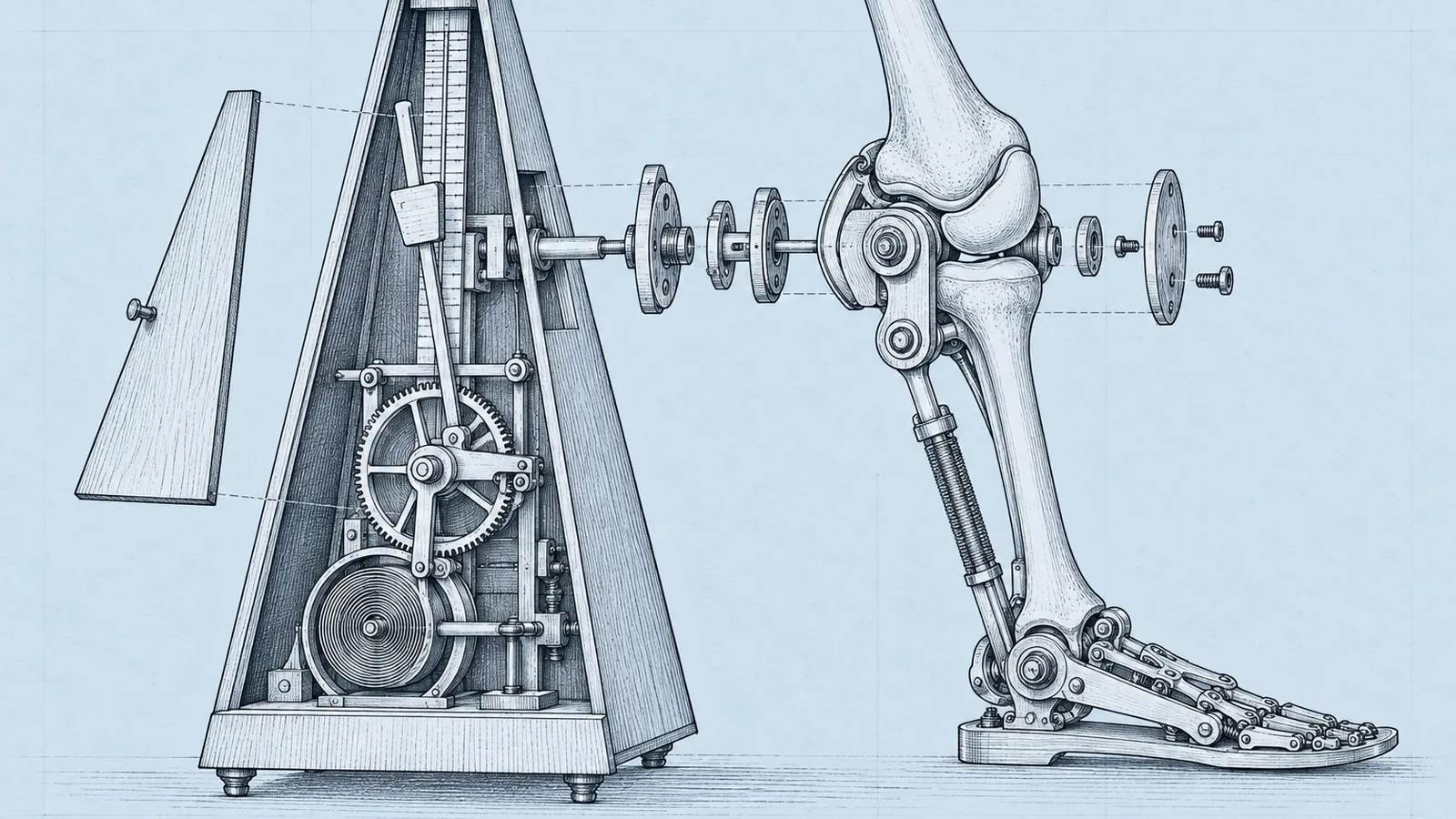
For as long as I’ve written about longevity, I’ve treated aging as a race between two clocks. There’s how long you live, and there’s how long you live well, the years before some named disease moves in and starts taking things. Lifespan and healthspan. Two numbers, and the whole field fights about how to widen the gap between them. So I did not expect a kinesiologist to tell me I’d been ignoring the clock that runs out first.
The claim comes from Professor Li Li at Georgia Southern University, in an opinion paper published in the Journal of Sport and Health Science. The news writeups are calling it “groundbreaking”, which is a strange word for an essay that contains no trial, no cohort, and no original numbers. What Li actually wants is smaller, and I think more useful: to formally add a third construct he calls movement span, the stretch of life during which you can still move with confidence. Cross a crowded room without doing math about it. Stop short when a kid darts in front of you. Turn on uneven ground and trust your feet to sort it out.
Li’s real move is the ordering. Movement span, he argues, sits nested inside the other two, and it’s the first to start closing. Lifespan is the outer boundary. Healthspan lives inside it, the years free of disabling disease. Movement span lives inside both, and in Li’s framing it begins to erode earlier than healthspan, a leading indicator of the compromise that shows up later. By the time a doctor writes down a diagnosis, the quiet narrowing has been underway for a while, and nobody was measuring it, because we don’t have a column for it.
An essay with no data doesn’t get to be groundbreaking. It gets to be an argument, which means it either earns its place on the strength of what it explains or it doesn’t. I think this one earns it, and the reason is the mechanism.
So why would simply moving less make you worse at kinds of movement that have nothing to do with raw strength? Li’s answer is that your sensorimotor system is use-dependent. It tunes itself to the range you actually demand of it. Spend your days on flat floors and predictable paths, never reaching or pivoting or catching yourself, and the system doesn’t just idle. It gets efficient inside that narrow band and quietly lets go of the edges: the fast correction, the odd angle, the recovery from a stumble. You feel fine, because inside your daily groove you are fine. The capacity that thinned out is the capacity you stopped asking for.
But if the loss is invisible from inside the groove, when does anyone notice? Usually the fall. In Li’s framing a fall is often the first moment your movement capacity is handed a demand it can’t meet, and falls aren’t rare: they hit roughly 1 in 3 adults over 70. The fall isn’t where the decline starts. It’s where the decline finally becomes legible, after a long, silent erosion that never showed up on a chart.
And you can measure this, which is what keeps it from being a nice metaphor. Li points to tools that already exist and mostly gather dust outside physical therapy: gait speed at both a usual and a maximal pace, balance under different sensory conditions, reaction time to something unexpected, the ability to string together starting, stopping, turning, and changing direction. The one he leans on is the Timed Up and Go, where you rise from a chair, walk 3 meters, turn, come back, and sit. It takes under a minute and packs half of movement span into a single number. Your annual physical measures your blood pressure and your cholesterol. It almost never measures whether you can get out of a chair and turn around like you mean it.
Reading this with my skepticism up, what I keep landing on is what the framework doesn’t do. It doesn’t sell you anything. There’s no molecule here, no supplement stack, no proprietary panel, none of the machinery the longevity industry runs on. The prescription hiding inside “use-dependent” is almost insultingly cheap: keep demanding range from your body, and it keeps giving it back. That’s exactly the kind of idea that gets ignored because nobody can put a price on it, and it’s part of why I trust it more than the average longevity headline. Li, for his part, declares no competing interests; he serves as an associate editor at the journal but was walled off from the review of his own paper.
The open question is whether movement span survives contact with real data, and Li hasn’t supplied any yet. It’s a proposal waiting for the cohort study that tracks these measures across a life and proves the nesting order holds. Until then it’s a lens, not a finding, and I won’t pretend otherwise.
But I don’t need the cohort study to change what I do this week. I’ve started treating the crowded-room test as a real number I owe myself, and spending my movement on the edges I’d otherwise let go quiet: turning fast, catching my balance on purpose, walking on ground that argues back. I’m not going to wait for a guideline to tell me the first clock was already running.
Sources
- Journal of Sport and Health Science – Li, L., “Movement span: Extending the discourse on aging beyond life span and health span” (2026), full text on PMC
- Journal of Sport and Health Science – Li (2026), publisher DOI record
- News-Medical – “Groundbreaking movement span framework redefines how we measure aging” (Sept 10, 2026)