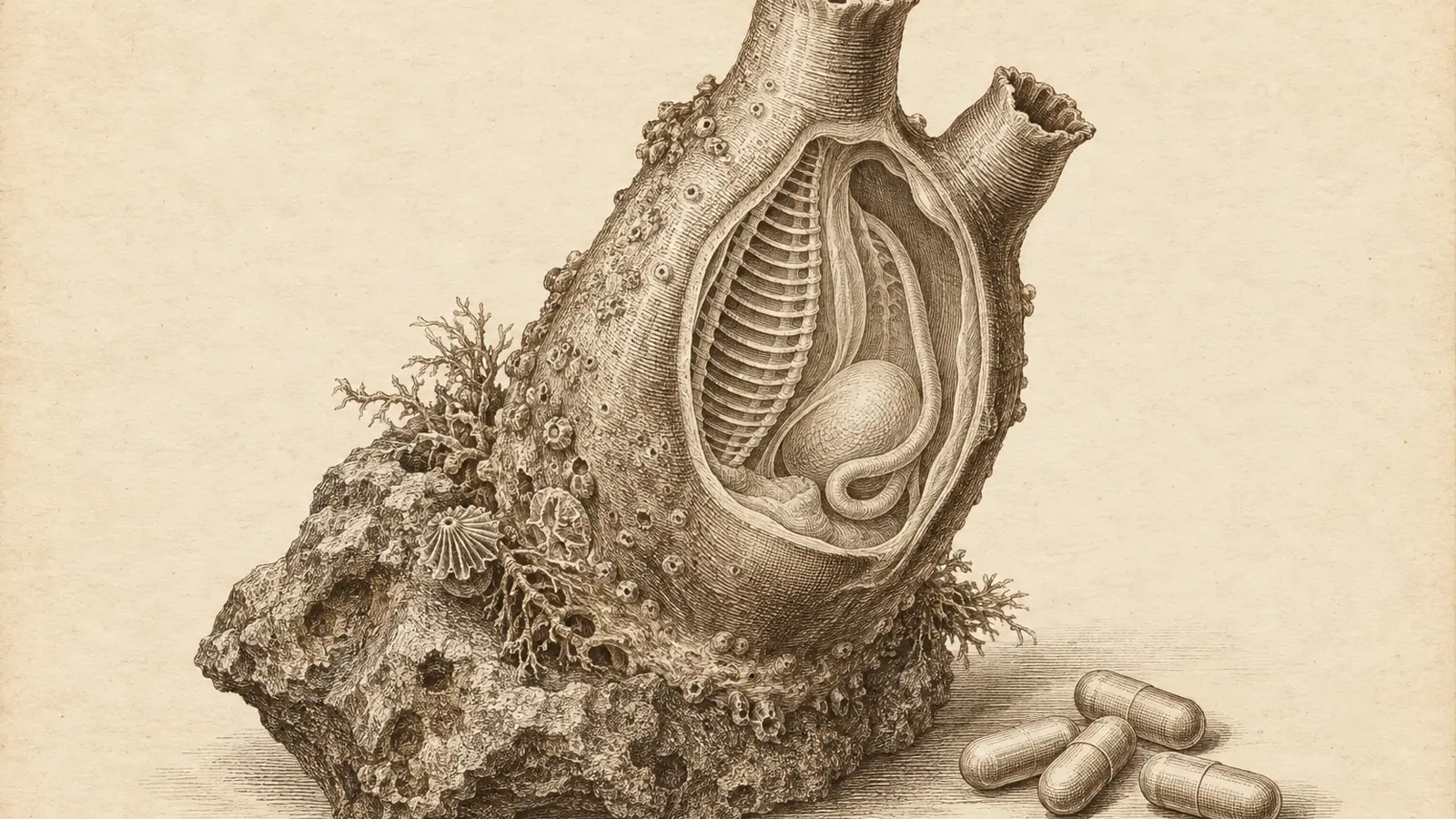
“Stanford scientists discover a seafood that reverses aging” is the kind of headline I click before I can stop myself. Not out of skepticism. Out of appetite. I love it when some weird animal turns out to be carrying a molecule we have been quietly losing our whole lives, and the sea squirt is about as weird as animals get: a blobby filter-feeder that digests its own brain once it settles down and stops needing to swim. So I went looking for the study behind the headline, expecting it fresh off the press.
It came out in 2022.
The paper everyone is suddenly citing ran in Frontiers in Molecular Biosciences four years ago, and the “Stanford” in the ScienceDaily writeup driving this month’s round of coverage is doing an enormous amount of lifting. The corresponding author is Lei Fu, whose labs sit at Shanghai Jiao Tong University and Xi’an Jiaotong-Liverpool University; the work was led out of Chinese institutions and funded by the National Natural Science Foundation of China. Stanford’s contribution is James P. Collman, a chemist there, one name on the author list. That is the whole “Stanford discovers” story.
So consider what happened in that lab, because the biology is lovely even where the sales pitch built on top of it is not. The aged mice were female, 16 months old, and got 300 milligrams of plasmalogen per kilogram of body weight, delivered straight into the stomach by feeding tube, five days a week for two months, until they were 18 months old. The plasmalogens came from Halocynthia roretzi, the edible sea pineapple. And the old animals genuinely changed. In the Morris water maze they found the hidden platform faster, swimming more like young mice than like their untreated littermates. Under the electron microscope, their hippocampal synapses had gone from sparse and deteriorated back to dense and vesicle-rich. Their inflammatory markers, IL-1β, IL-6 and TNF-α, dropped. Their neural stem cells, marked by Sox2, came back. Even their fur grew back thicker and darker.
Now wait: why would a fat you eat end up rebuilding synapses in an old brain? That is the question that kept me reading, and the answer is the good part. Plasmalogens are not ordinary fat. They are a class of phospholipid built into the membranes of your brain, heart and immune cells, with an unusual chemical bond that lets them soak up oxidative damage and keep membranes fluid, and their levels fall as you age. The study’s proposed mechanism is that topping them back up quiets the brain’s resident immune cells, the microglia, which in an aging brain get stuck in a low-grade inflammatory sulk that chews on synapses. Calm the microglia, and the neurons get to keep their connections while the stem-cell niche wakes back up. It is a clean, physical story about pouring a missing building material back into a system that had run low. I came in wanting it to be true.
Then I looked at the dose, and the appetite went away.
The mice got 300 milligrams for every kilogram they weighed, by feeding tube, most days, for two months. The sea squirt plasmalogen capsules already selling online deliver on the order of 1 milligram a day, total, for a person who weighs sixty or seventy kilograms. Per kilogram of body weight, that is thousands of times less than what rejuvenated the mice. Nothing about a mouse gut-fed that much plasmalogen tells you the capsule does anything. And the supplements did not wait for anyone’s permission. REMORY and CEREGAIN, both sea-squirt-derived, are on the market now; the 2022 mouse paper is the credibility they are borrowing.
So what happens when you give plasmalogens to actual people, at the dose actually in the bottle? The human record turns cold, and it turns cold in a consistent direction. ConsumerLab’s roundup walks through it trial by trial. A U.S. study of 30 adults reported better cognition but ran no placebo group, which means it reported almost nothing. In healthy adults with self-reported forgetfulness, most of them middle-aged, 1 milligram a day for twelve weeks produced at best a slight bump in memory scores and nothing for attention, in a trial funded by Nihon Pharmaceutical. Trials of scallop- and chicken-derived plasmalogens, run by the companies selling them, mostly showed no significant benefit over placebo. And the cleanest test, 276 adults with mild Alzheimer’s or mild cognitive impairment given plasmalogen daily for 24 weeks, found no significant improvement in cognition or memory at all. The people with the most to gain got nothing measurable on the tests that mattered.
I keep coming back to the conflict-of-interest line in the 2022 paper: the authors declared the work “was conducted in the absence of any commercial or financial relationships.” I believe them. The mouse study reads clean. But the human trials being used to move product were, over and over, funded by plasmalogen sellers or their industry society, and even those could not clear placebo. When the friendly-funded studies come up empty, that is the signal, not the noise.
None of this makes plasmalogen biology fake. Plasmalogen levels do fall as we age, the microglia-and-synapse mechanism is a serious hypothesis worth chasing, and I would love to see a large, independent, properly dosed human trial run by people who do not sell the capsule. What is missing is not the idea. It is any evidence that a milligram in a capsule does something for a person that thousands of milligrams per kilogram did for a mouse.
So this is my verdict. I will happily eat the sea pineapple if it ever turns up on a menu, because it is food and it is interesting. I will not buy the 1 milligram capsule, and I would not spend a dollar on it until an independent trial at an adequate dose beats placebo in actual people. The mice have their evidence. I do not have mine, so the capsule stays on the shelf and my money stays in my pocket.
Sources
- Frontiers in Molecular Biosciences – dietary plasmalogens ameliorate aging-associated synaptic defects and neuroinflammation in aged mice (2022)
- ScienceDaily – “Stanford scientists discover a seafood that can reverse signs of aging” (September 2026)
- ConsumerLab – human trial evidence on plasmalogen supplements for cognition and memory
- Amazon – REMORY sea squirt plasmalogen supplement product listing