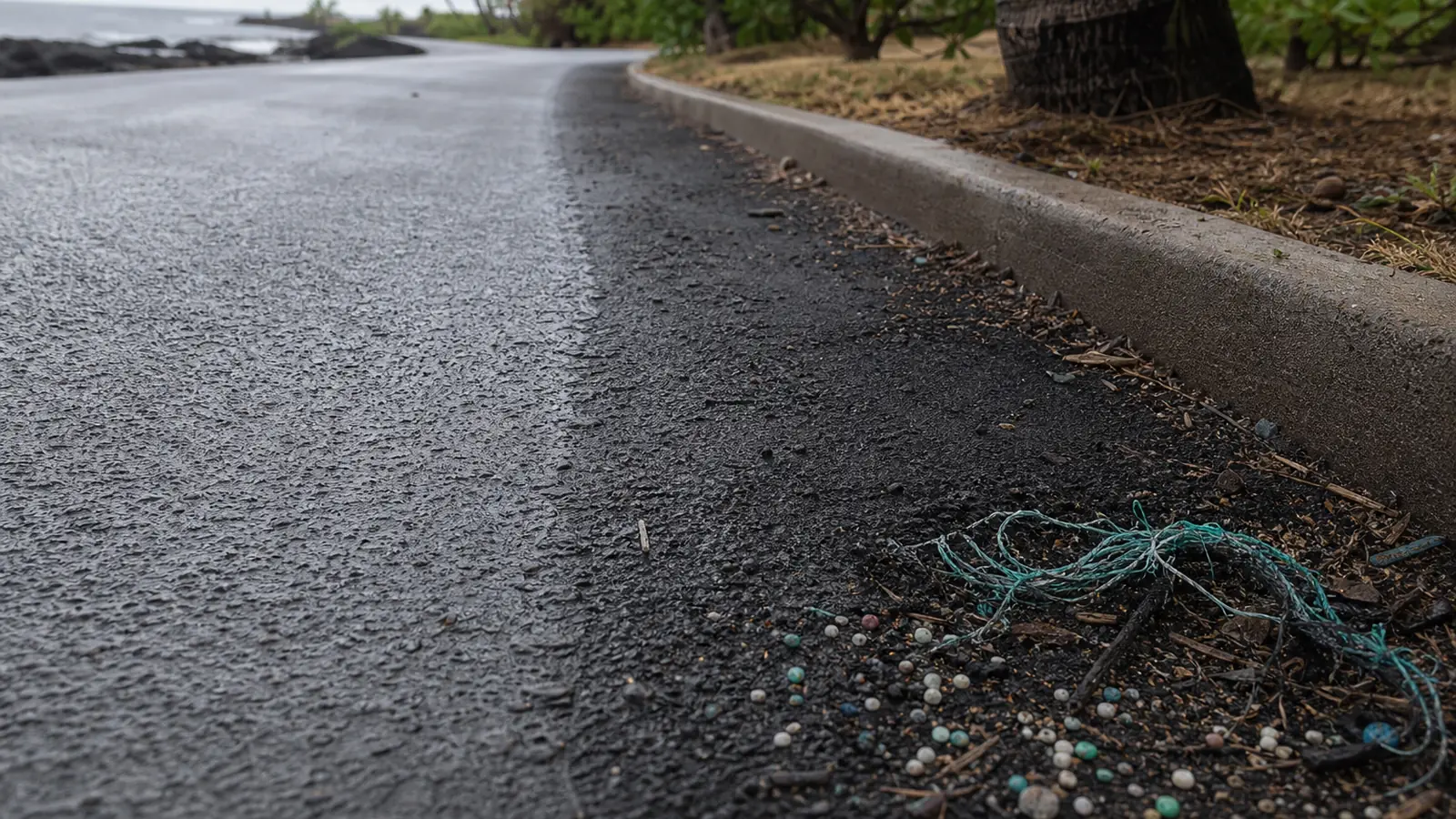
If you had told me a road built out of melted-down ocean fishing nets was about to be tested for how much plastic it sheds into road dust, runoff, and the air, I would have braced for bad news. Plastic in the pavement, sun beating on it, ten thousand tires grinding over it every day. Of course it sheds. That was my whole assumption walking in, and it turns out I had the villain exactly backwards.
A team led by environmental chemist Jennifer Lynch at Hawaiʻi Pacific University’s Center for Marine Debris Research took abandoned fishing nets pulled from the Pacific, along with household plastic from Honolulu’s recycling bins, and worked the recovered polyethylene into asphalt. Then they did the thing most “green material” stories skip: they took it out onto a real residential street on Oahu. Not the whole road, three side-by-side test strips, as the team described at the American Chemical Society’s spring meeting and in coverage published June 28: one standard mix as a control, one with recycled household polyethylene, one with polyethylene from the ghost nets. Then they let real traffic run over the sections for about eleven months and came back to scrape up the road dust.
I love this design, and I want to tell you why before we get to the numbers. Most of the time when someone calls a recycled material “safe,” they mean they tested it in a lab under conditions a real road never sees. Lynch’s group measured the thing that actually decides it: what comes off the surface once cars are on it. They sorted the dust into microplastics, larger fragments, and tire rubber, then cooked each particle and read its chemical fingerprint to tell exactly where it came from, a method called pyrolysis gas chromatography-mass spectrometry.
The recycled-plastic strips did not shed more polymer than the plain control. When particles did break loose, most weren’t loose plastic at all; they were composite chunks of rock, binder, and melted polymer fused together, the kind of heavier grit that drops to the ground instead of drifting off into a stream or your lungs. The polyethylene was locked into the asphalt matrix, and it largely stayed there.
Then there’s the line from Lynch that stopped me cold: “In our initial Py-GC-MS data, we saw tire wear swamps the signal of polyethylene by orders of magnitude, like gigantic peaks!”
Orders of magnitude. So I sat with the obvious question, the one a curious person actually asks: why would the plastic baked right into the road barely shed, while the tires, which are just rolling across the top, gush microplastic by comparison? When I chased it down, the answer was almost embarrassingly physical. The recycled polyethylene is bound inside a hard composite. The tire is the soft body in the equation, dragging and deforming against an abrasive surface a few times a second for the life of the tread. The road isn’t really the source. The contact patch is. We’ve spent years worrying about the pavement when the microplastic factory is the four black rings under every car, including mine, shaving themselves into dust mile after mile.
Once you see that, the scale of it is unsettling. Tire wear is one of the single largest sources of microplastic on the planet. Researchers estimate roughly 6 million tonnes of tire particles enter the environment worldwide every year, and tire and road wear may account for about 45 percent of all microplastics reaching land and water. The heavier particles settle into soil and rivers; the finest fraction goes airborne, small enough to breathe. And the chemistry that travels with them is its own problem: 6PPD-quinone exposure has been linked to damage in the liver, lungs, and kidneys. Straws and grocery bags became the face of the plastic crisis. The thing actually filling our waterways was idling at every red light.
It gets sharper than “particles.” Tires are dosed with a preservative called 6PPD that keeps the rubber from cracking. When it meets ozone in the air it transforms into 6PPD-quinone, and that compound is lethal to fish. A 2021 study in Science traced the long-unexplained mass die-offs of coho salmon to this chemical washing off roads in stormwater, killing returning adults within hours of exposure at concentrations around a microgram per liter. The case was strong enough that in 2023 the EPA granted a petition from the Yurok, Port Gamble S’Klallam, and Puyallup tribes to begin regulating 6PPD in tires. The human-exposure picture is still being worked out. The ecological one is already a body count.
So I want to be straight about what this Hawaii result is and what it isn’t, because the caveats are the conflict. One street. Eleven months. A handful of strips. And the money came from the Hawaii Department of Transportation, the same agency that would love to start paving with the stuff. That conflict stays in view, the kind this publication doesn’t wave through just because the conclusion is convenient. Lynch herself leans into the bigger argument, that “some people think plastic recycling is a hoax,” and that this shows it can work when a society decides to make it work. Maybe. Durability over years of sun and salt is the unanswered question, and a single street can’t answer it.
But look at where our scrutiny goes. We will study, sample, and gas-chromatograph a recycled-plastic road for a year before we trust it, and we should. Meanwhile the documented microplastic hazard, the one with a salmon-killing chemical and a global tonnage in the millions, rolls across that same road untouched and almost entirely unregulated. The recycled fishing net got the background check. The tire never did.
My view, personally. I’m not going to wait for a guideline to tell me which lever matters, because this study already told me: the material under the wheels is a smaller problem than the wheels. The project behind these strips has pulled 84 tons of derelict fishing gear out of the Pacific, and turning recovered ghost net into pavement instead of letting it strangle a reef looks like the easy call. So I’d green-light the recycled-plastic roads and move the worry I was about to spend on them onto the tires and the 6PPD inside them, and I’d back the tribes and regulators trying to get that chemical out of the rubber before the human-exposure data catches up to the salmon. The road was never the thing shedding into the water. I was sitting on it.
Sources
- ScienceDaily – “Hawaii is turning ocean plastic and fishing nets into roads” (June 28, 2026)
- American Chemical Society – “Paving Hawaiian roads with recycled plastics and abandoned fishing nets” (Lynch quotes)
- Phys.org – Hawaii tests asphalt made with recycled plastics and fishing nets for shedding
- Resource Recycling – Hawaii trials asphalt made with plastic debris and nets (HDOT funding)
- PBS NewsHour – One of the biggest microplastic sources isn’t straws or bags, it’s your tires
- NCBI/PMC – “Wear and Tear of Tyres: A Stealthy Source of Microplastics in the Environment”
- US EPA – 6PPD-quinone overview
- US EPA – EPA grants tribal petition to protect salmon from lethal tire chemical (2023)
- Science (Tian et al., 2021) – A ubiquitous tire rubber–derived chemical induces acute mortality in coho salmon