I rinse the yogurt tubs. I peel off the labels, sort the caps into their own little pile, and run the whole quiet ritual we were all taught, telling myself it adds up to something. It mostly doesn’t. Just 9 percent of the plastic the world has ever thrown away actually gets recycled, according to the OECD’s Global Plastics Outlook. Another 19 percent is incinerated, which is a polite word for setting it on fire and breathing what comes off. Almost everything else gets buried, and it doesn’t stay put.
| Measure | Value |
|---|---|
| of all plastic ever thrown away | 9% |
Because plastic doesn’t sit in a landfill being someone else’s problem. It breaks down into fragments small enough to cross into your blood, and last year researchers went looking for those fragments in the one organ we least want them. In a 2025 Nature Medicine paper, Matthew Campen and his team measured micro- and nanoplastics in autopsied human brains and found about 4,800 micrograms per gram, nearly half a percent of the tissue by weight. CNN translated that into a now-famous image: roughly a plastic spoon’s worth packed into an average adult brain. The brains held 7 to 30 times more plastic than kidneys or livers, and the amount climbed about 50 percent between 2016 and 2024. The dominant polymer they pulled out was polyethylene. Grocery bags. Bottle caps. The film on everything you buy.
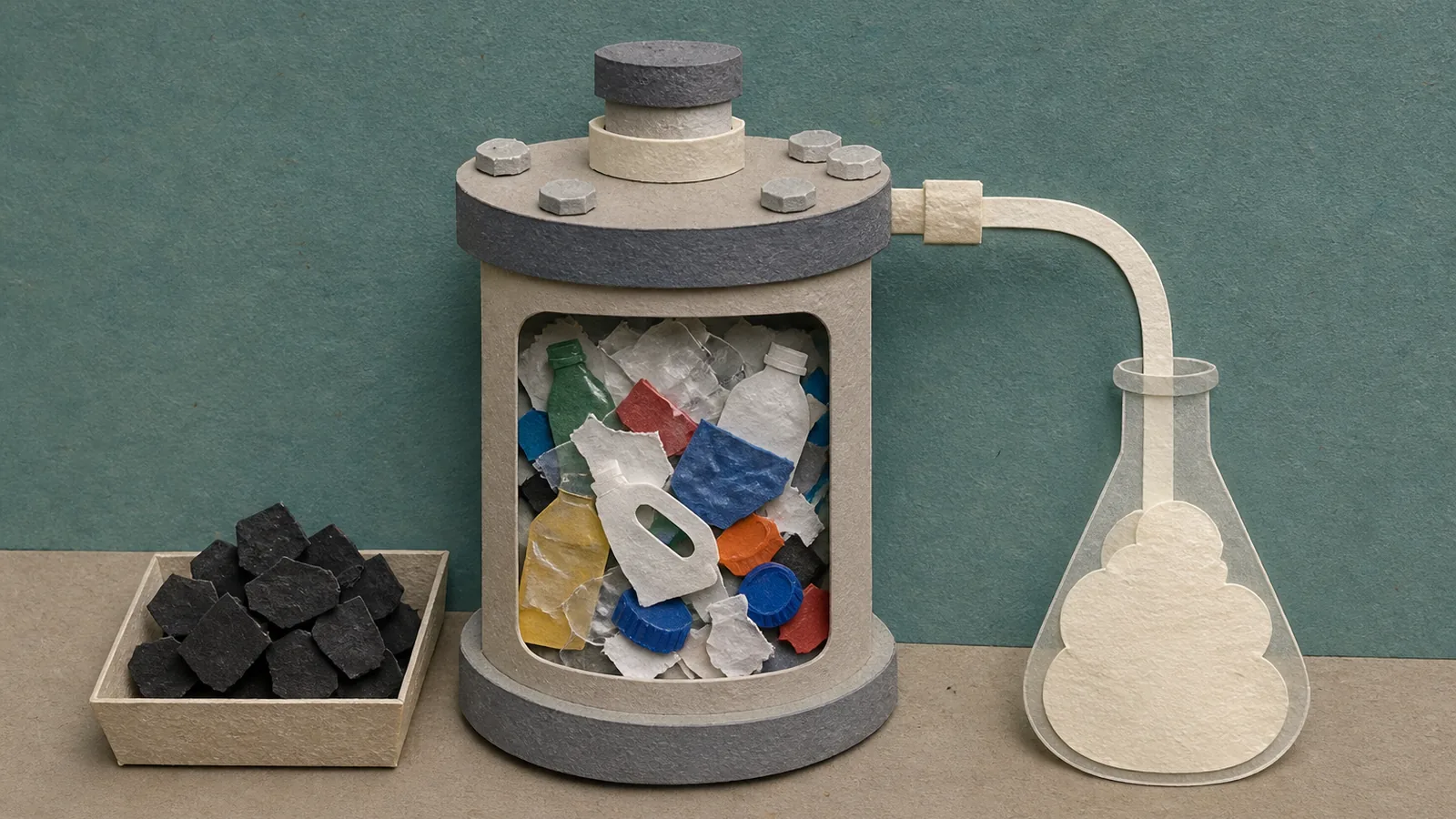
So when a study landed on July 31 describing a way to take that exact material, polyethylene and its cousins, and turn it into fuel while locking the carbon away, I read it twice. Not because I trust breakthrough press releases. Because the chemistry underneath goes at the problem from a direction the recycling industry never has: it treats mixed, filthy, unsorted plastic as the feedstock instead of the obstacle.
The work comes from a team at UCLA’s Samueli School of Engineering and Ewha Womans University in South Korea, published in the Proceedings of the National Academy of Sciences and led by Ah-Hyung “Alissa” Park and Woo-Jae Kim. They took three of the most common plastics on Earth, the PET, PE, and PP stamped on the bottom of almost everything, and converted them into hydrogen that comes out more than 90 percent pure. And the carbon that was locked in the plastic mostly stayed locked: more than 75 percent ended up in stable solid carbonate compounds and liquid residues, while less than 13 percent escaped as gas. Compare that to incineration, which sends the carbon straight up the stack.
And they did it without sorting the plastic first. Sorting is where recycling dies economically. Mixed plastic is nearly worthless because separating PET from PE from PP costs more than the recovered material is worth, which is a big part of why that 9 percent number is so grim. A process that swallows the mixed stream as-is is one that could actually pencil out.
So how does one cheap chemical do two jobs at once? The method is called alkaline thermal treatment, and the active ingredient is sodium hydroxide. Lye. The same caustic stuff that unclogs your drain. Heat plastic with it and the hydroxide goes after the long polymer chains and helps strip the hydrogen loose, which is the fuel you want. But that alone would leave you with a pile of carbon and a puff of CO2, same as gasification. So why doesn’t the carbon fly off? The sodium grabs it. As the carbon is freed, the sodium holds onto it as sodium carbonate, a stable white solid, instead of letting it escape into the air. One molecule, two functions: it cracks the plastic open and it catches the carbon on the way out. That sodium carbonate can then be converted into calcium carbonate, which is chalk, limestone, the stuff that sits inert in the ground for geological time.
The climate problem with the old options is simple. Traditional recycling chokes on mixed waste, and incineration releases the carbon it was supposed to hold. This chemistry sidesteps both, and it runs at temperatures 300 to 400 degrees Celsius below what conventional steam gasification demands. Lower heat means less energy going in, which is the lever that decides whether a clever lab result ever becomes a working plant.
Now the cold water, because enthusiasm is not evidence. This is a laboratory proof of concept, not a facility running in Ohio. Whether it can make hydrogen at commercial scale and at a price anyone will pay is still an open question, and “at a price anyone will pay” is exactly where these ideas usually die. The graveyard of plastic-to-fuel schemes is full of processes that worked beautifully on a benchtop and never survived contact with a spreadsheet. The study was funded by the National Research Foundation of Korea, a government science agency rather than a petrochemical firm shopping for a greenwash, though every funder shapes what gets studied.
Still. For 30 years the plastics industry sold us the blue bin as the answer while knowing most of what we dutifully rinsed would be burned or buried, and while the polyethylene from all of it worked its way into our bloodstreams and, we now know, our brain tissue. The honest fix was never going to come from making us feel more responsible at the sink. It was going to come from chemistry that can take the mess exactly as it is and pull it apart.
Would I stop rinsing the tubs? No. But I’ve stopped pretending the ritual settles the account. The test I’d put to any plastic-waste breakthrough from here on isn’t how much it recycles, it’s how much of the carbon it keeps in the ground instead of putting into the air. That is the number I read first now, and the one I’d want reported on every process that claims to be the answer.
Sources
- PNAS – Park, Kim, et al., alkaline thermal treatment of mixed plastics to high-purity hydrogen (2026), DOI 10.1073/pnas.2537552123
- ScienceDaily – “New process turns plastic waste into hydrogen fuel while trapping the carbon” (2026)
- Nature Medicine – Nihart, Campen et al., “Bioaccumulation of microplastics in decedent human brains” (2025)
- CNN – “Human brain samples contain an entire spoon’s worth of nanoplastics, study says” (2025)
- OECD – Global Plastics Outlook: only 9% of plastic waste is recycled (2022)