I always assumed the damage from drinking stayed on the table only as long as you kept drinking. Quit, wait, let the body do its slow repair, and the slate mostly clears. That is the quiet bargain a lot of us make about a rough decade: it was a hard stretch, the wine was load-bearing for a while, but it is behind me now. A mouse study out of the University of Massachusetts Amherst went straight at that assumption, and it found a piece of the brain that never got the memo about the fresh start.
The alarm still worked. The off-switch did not, so the alarm keeps ringing after the danger is gone.
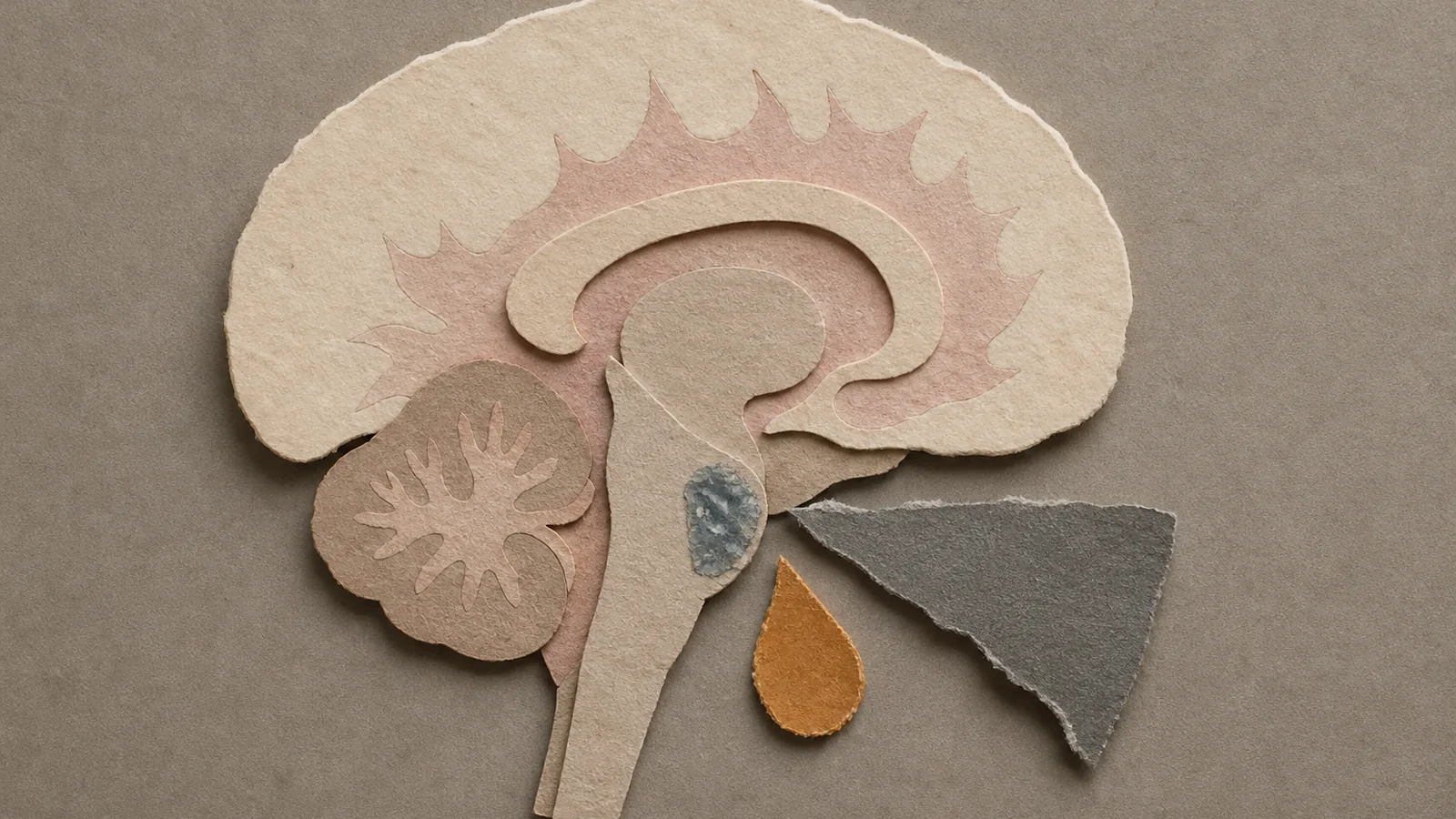
The finding sits in a structure most people have never heard of. The locus coeruleus is a tiny knot of neurons deep in the brainstem, and it is your brain’s main faucet for noradrenaline, the alarm chemical. When something stressful hits, it switches on and pours noradrenaline across the brain to sharpen you up, and in a healthy brain, once the threat passes, it shuts itself off. It has its own brake. In mice that went through alcohol and sustained stress together during the rodent version of early adulthood, that brake is what broke.
Elena Vazey’s lab built the experiment to model something specific: not heavy drinking alone, not chronic stress alone, but the two braided together the way they show up in a human twenties. The mice got alcohol paired with stress, then a long stretch of abstinence, and the researchers waited until the animals reached middle age to ask what was left. As published July 3 in Alcohol: Clinical and Experimental Research, the combination did far more damage than either exposure on its own, and it concentrated in the locus coeruleus, which had lost the molecular machinery it needs to turn itself off.
Sit with that for a second, because I had to. The alarm still worked. The off-switch did not, so the alarm keeps ringing after the danger is gone.
Wait, why would alcohol and stress take out the shut-down gear specifically and leave the rest running? That is the question I kept circling, and it is where the biology gets grim. A neuron that fires and fires without ever standing down is burning fuel it cannot replace. The team saw it in the tissue: marked oxidative stress in the locus coeruleus, which they flag as the kind of cellular damage normally seen in the brains of Alzheimer’s patients. Their proposed mechanism is almost mechanical. An alarm cell stuck in the on position slowly cooks itself, and the exhaust is oxidative damage the brain is famously bad at cleaning up.
Then came the abstinence, the stretch we like to imagine is when the healing happens. The formerly hard-drinking brains did not repair. By middle age they showed a very particular deficit: cognitive flexibility, the ability to change tack when the situation changes, was markedly reduced, while plain learning stayed roughly intact. These were not globally impaired animals. They could still learn. What they had lost was the capacity to adapt, which is exactly the function you would predict from an off-switch that no longer works.
There is a second, meaner loop hiding in here. Those same middle-aged brains were more likely to slide back into drinking when stress came around again. A stress-response system with no brake makes stress harder to ride out, and harder-to-ride-out stress makes the old chemical shortcut more tempting, which feeds the exact machinery that broke in the first place. Drinking to cope is not just a phrase clinicians use. In people it is a measurable motive, the daily pattern where a stressful day directly drives the reach for a drink, and this study is a mechanistic account of how that pattern could carve a groove you cannot easily climb out of.
Let me hold the line on what this carries. This is mice, and the headlines shouting “permanently rewire your brain” are outrunning it. The mouse locus coeruleus is a reasonable stand-in for ours, which is why Vazey’s lab used it, but a rodent brainstem is not a verdict on yours, and “permanent” here means “did not repair over the abstinence window they tested,” not a door closed forever. It is a preclinical mechanism, funded by the National Institute on Alcohol Abuse and Alcoholism. Strong signal, not a sentence.
The frame it does earn is the one Vazey pointed to, and it runs close to the opposite of shame. If the off-switch is physically corroded, then sliding back under stress is not a character flaw waiting to be out-muscled. As she put it, the brain simply works differently, and treatment has to meet that changed circuit instead of demanding more grit from the person living inside it. That is a case against moralizing a stuck stress-response as weakness, and a case for building treatment around the biology rather than around blame.
So here is what I take from a mouse, knowing full well my brainstem is not settled by theirs. The stretch of life I used to file under “a rough couple of years, everyone has them,” the one where the drink was doing emotional work, I am filing somewhere else now. The signal I am watching for is narrow: reaching for a glass because the day broke me, not because I want one. When I catch that reach, I am treating it as the thing to interrupt, not the fix. I would rather protect the off-switch while I can still feel it working.
Sources
- Alcohol, Clinical and Experimental Research – Revka et al., on chronic alcohol, stress, midlife cognition, and locus coeruleus integrity in mice (2026)
- UMass Amherst – “Research links early adult drinking to middle age cognitive decline”
- EurekAlert! – UMass Amherst release on the Vazey lab study
- Addictive Behaviors – daily-level analysis of drinking-to-cope motivation and interpersonal stress (2021)
- ScienceDaily – “Drinking to cope with stress may permanently rewire your brain”