The first thing I did when I saw the headline was check my own knee. That is embarrassing to admit, but it is exactly what a line like “stop arthritis before it starts” is engineered to do: it walks straight past your brain and lands in the joint that has been clicking at you for a decade. So before I let myself get excited, I went and read what the University of Alabama in Huntsville team actually did. And what they did is genuinely cool. It is also not what that headline says.
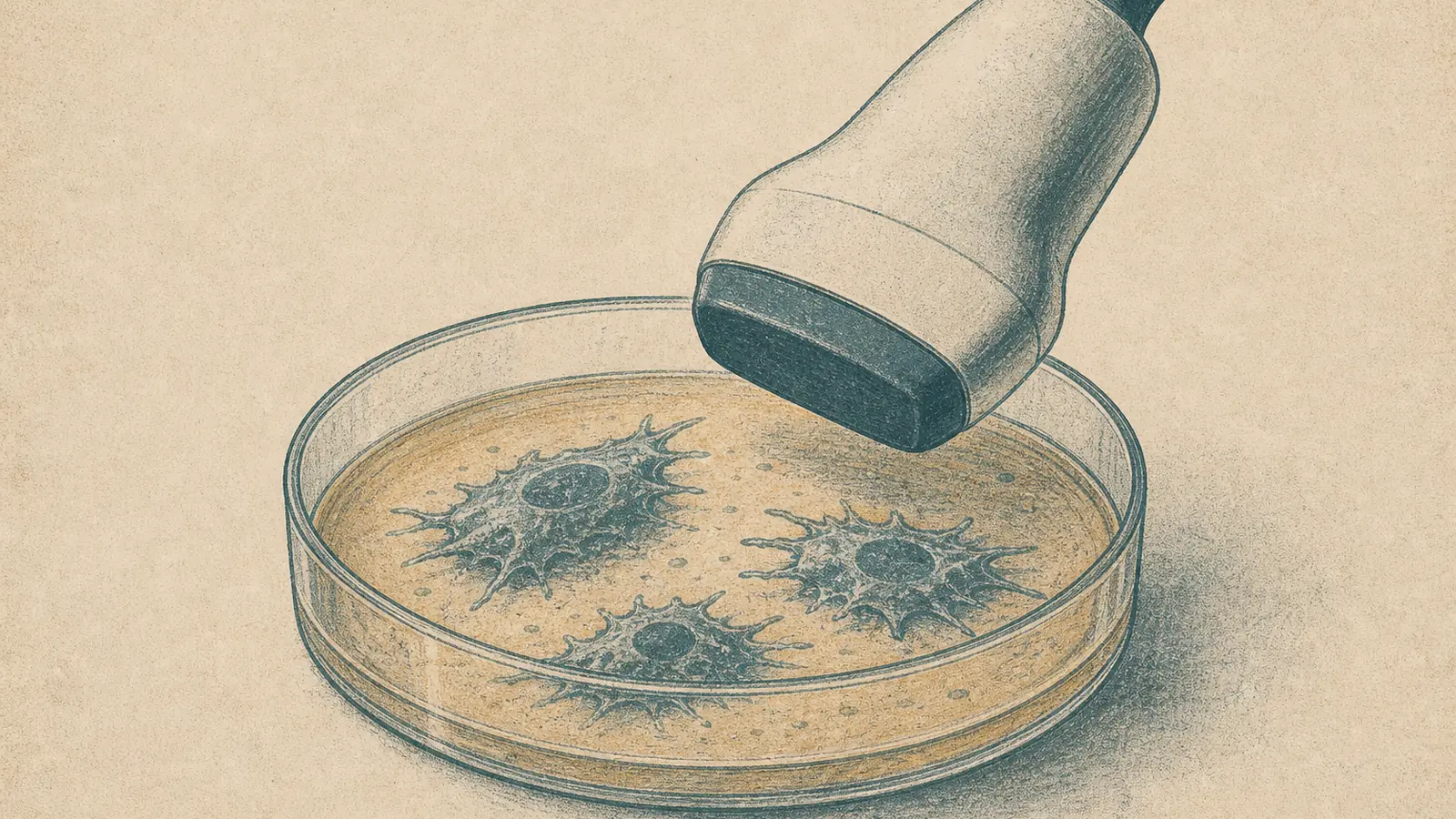
Here is the real experiment. It did not involve a person, or a mouse, or even a whole joint. It was a population of immune cells called macrophages, sitting in a dish, getting bathed in continuous low-intensity ultrasound. That is the entire stage. What the researchers reported in Scientific Reports is that the sound waves nudged those cells to quiet down their inflammatory program and turn up their repair program. Real finding, real journal, honestly reported by the scientists. The leap to “stops arthritis” got added somewhere between the lab bench and the press cycle.
But stay with me on the biology, because this is the part I could not stop turning over. Macrophages are two-faced by design, and I mean that as a compliment. When you injure a joint, your body sends in the aggressive version first, the M1 “defender” cells, to clear out the wreckage. Then it is supposed to switch them over to the M2 “healer” state that lays down new tissue and calms everything down. In post-traumatic osteoarthritis, that switch gets stuck. The M1 cells never stand down. They keep pouring inflammatory signal into a joint that finished its emergency long ago, and that slow, grinding, self-perpetuating inflammation is a big part of what chews the cartilage away.
So the question the UAH group chased is the one I would have asked: can you talk those stuck cells back into healer mode without a drug? And wait, why would a mechanical vibration, literally sound pressure, change what a cell decides to become? That was the moment the study stopped being a press release to me and turned into something worth reading. Cells feel force. They carry machinery that reads physical stress and pushes it inward toward the genes, and the researchers went looking right at that layer. They read the full transcriptomic profile, the whole sweep of which genes were switched on and off, then used a method called differential clustering to watch not just single genes but whole coordinated groups of genes shift their behavior together when the ultrasound came on. The inflammatory cluster came down. The M2-like repair cluster came up.
And they did not cheat the setup to get there. Instead of jabbing the cells with a generic irritant, they aged the injury more honestly, using fibronectin fragments, the actual molecular debris a joint sheds when its tissue breaks down. That is the signal a real damaged knee is screaming, so the macrophages in the dish were answering something close to a genuine injury rather than a lab convenience. I love that choice. It is the difference between a cell that is annoyed and a cell that thinks it is at a crime scene.
Now the honest part, because this publication does not do breathless. Every macrophage in this study lived in plastic. No animal, no cartilage, no immune system arguing with itself, no dose, no duration you could carry into a clinic. The paper’s own authors say as much: their stated next step is to validate this in animal models of early post-traumatic osteoarthritis, which is science-speak for “we have not done that yet.” And “the genes moved in the right direction” is exactly the kind of in-vitro win that so often evaporates once there is a whole living joint to answer to. The scientists know this. It is the science-communication layer, the ScienceDaily headline promising to stop a disease “before it starts,” that quietly cashed a check the data has not earned.
Which is a shame, because the actual idea deserves better than hype inflation. A non-invasive, non-pharmacological way to retrain inflammation, funded by an NIH R01 grant, is exactly the kind of low-drug, repair-first approach I want to see chased hard. Therapeutic ultrasound already sits in plenty of physical-therapy clinics; the intriguing claim here is that its payoff might be less “heat and comfort” and more “reprogram the immune cell.” If that survives an animal model, it is a story worth telling loudly. Today it is a promising one.
So what would I actually do with this? Nothing to my knee, yet. I am not booking an ultrasound session on the strength of a petri dish, and neither should you. But I have added Subramanian’s lab to the short list of groups whose animal data I will go read the moment it lands, because the mechanism holds up even where the headline did not. When the mouse study publishes, I will be first in line to read it. Until then, I am keeping my excitement and my expectations in two different rooms.
Sources
- Scientific Reports (Nature) – Khan, Trippany, Subramanian & Roy, “Continuous low-intensity ultrasound influences the transcriptomic profile in M1 macrophages by downregulating inflammation and promoting M2-like markers”
- University of Alabama in Huntsville – news release with researcher quotes and stated next steps
- ScienceDaily – “This ultrasound treatment may help stop arthritis before it starts”
- MedicalXpress – “Ultrasound-based approach may reduce harmful inflammation and support joint healing”