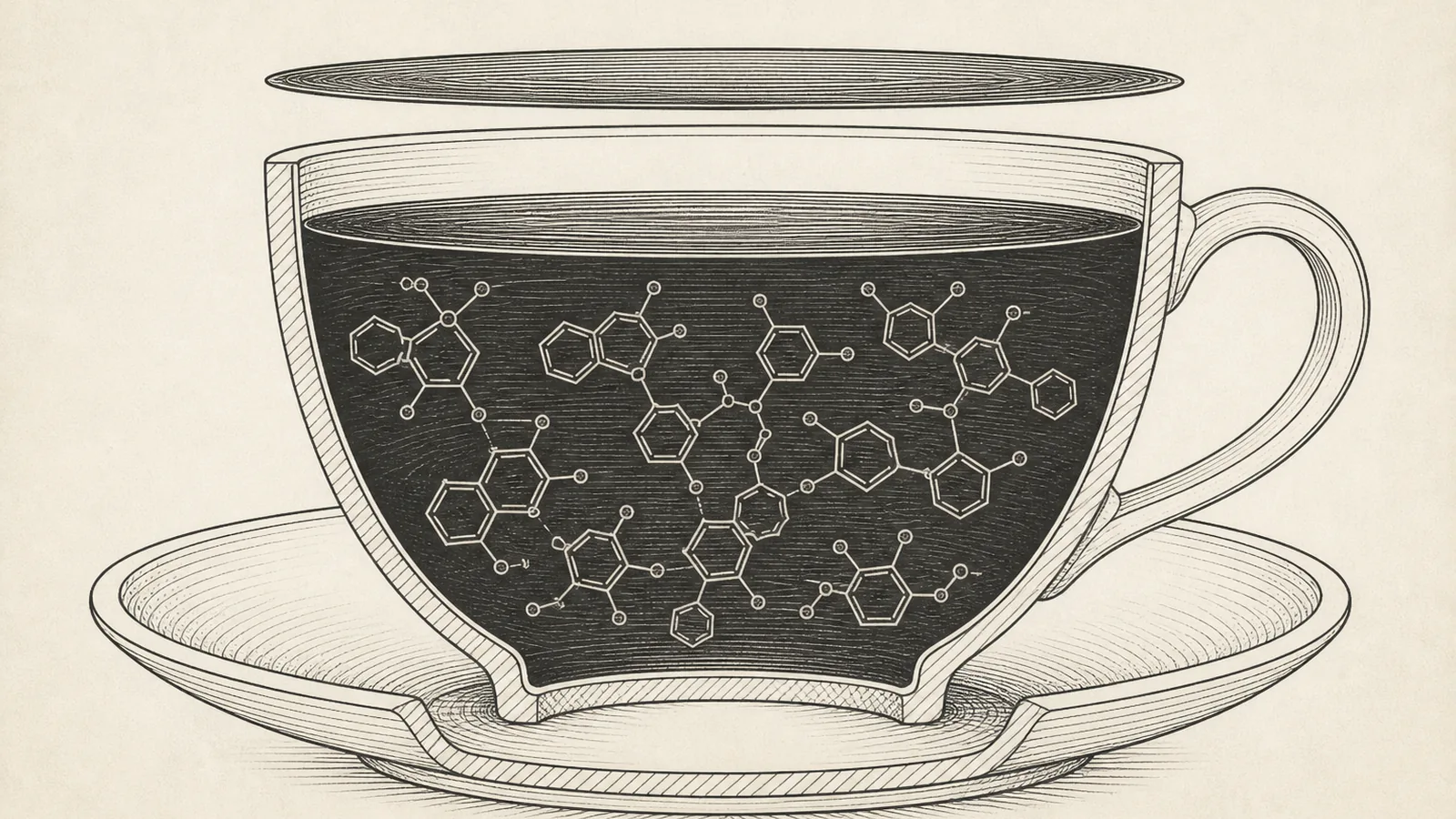
Stephen Safe has spent most of a career on the nuclear receptors nobody prints on a coffee mug. So when the veteran Texas A&M toxicologist and his team reported this spring that a handful of compounds in coffee latch onto one of those receptors and switch it on, the interesting part was which compounds did it. Not the caffeine. Caffeine binds the receptor and then, in Safe’s own words, “doesn’t do much in our models.” The molecules carrying the effect were the plant polyphenols, caffeic acid most tightly of all. In the journal it read like what it was, a careful piece of molecular pharmacology about a protein called NR4A1. By mid-July it had become “Coffee may help the body fight stress and aging through a hidden cellular switch,” and the wire cycle was off.
The paper appeared in the journal Nutrients in April, first author Amanuel Hailemariam, Safe as senior author. NR4A1, an orphan nuclear receptor also known as Nur77, flips on when tissue is stressed or damaged. “If you damage almost any tissue, NR4A1 responds to bring that damage down,” Safe told his university’s press office. “If you take that receptor away, the damage is worse.” That is roughly what the experiments showed. Several of the coffee polyphenols bound the receptor and activated it, and when the team stripped the receptor out of the cells, the protective effect went with it. That last step is the honest core of the study, the control that tells you the receptor is doing the work and not sitting there as a bystander.
A receptor lighting up in culture is a hypothesis about a person, not a finding about one.
The sentence the headlines skipped is a short one: every one of those experiments happened in cells in a dish. No people drank anything, and no animals either. The compounds doing the work were the same class of plant polyphenols the supplement aisle has been trying to sell you in capsule form for twenty years, which is where the wellness reading starts to run out ahead of the evidence.
It runs ahead because the backdrop genuinely favors coffee. The association the coverage keeps invoking is old and stubborn: coffee drinking has been repeatedly linked to lower disease risk and healthier aging, and the pattern has outlasted a lot of attempts to explain it away. If Safe is right that the caffeine is not the active ingredient, it reframes years of dietary advice that treated coffee as a caffeine-delivery system to be rationed, and it suggests decaf may not be the compromise everyone assumed. That reframing is worth taking seriously. It is also exactly the kind of hypothesis a supplement label loves.
None of which a cell study can prove. A receptor lighting up in culture is a hypothesis about a person, not a finding about one. The paper ran in an MDPI title built for volume and fast turnaround, which matters here for one narrow reason: it is another argument against filing a single in-vitro result under settled nutrition advice. The coverage that followed never said who funded the work, and neither did the announcement. And you can already see the shape of what comes next. “Hidden cellular switch” is precisely the phrase a supplement label wants, caffeic acid extract is cheap, and someone will bottle it, print NR4A1 on the box, and charge more than a bag of coffee costs.
The cancer claim drifting through the coverage deserves the same discipline. Safe’s group reported that coffee extracts and several of the compounds slowed the growth of cancer cells, the effect fading when they turned the receptor down, which is true and which describes cells in a flask. Nearly everything slows cancer cells in a flask at the right dose; the graveyard of oncology is stacked with molecules that did exactly that and nothing further. It is a reason to run the animal study, not a reason to tell anyone coffee treats cancer.
Safe, to his credit, kept saying so. “There are many receptors and many mechanisms involved,” he told the same press office, the kind of line that survives peer review and dies in a headline. He found a plausible molecular reason that the coffee your grandmother swore by might have been doing something after all. The reason arrived in a petri dish and left the building in a press release with the word aging in the title. He never put it there.
Sources
- ScienceDaily – “Coffee may help the body fight stress and aging through a hidden cellular switch” (July 19, 2026)
- Nutrients 2026, 18(6):877 – Hailemariam, Safe et al., coffee compounds and NR4A1 activation
- Texas A&M Stories – “Coffee doesn’t just wake you up: it may help protect your body from aging” (April 29, 2026)
- Sci.News – “Researchers Find Molecular Clue to Why Coffee May Be Good for You”