I walked into this study braced to be told to give something up. That’s how these stories usually go: you want a lower biological age, fine, hand over the steak, or the bread, or breakfast itself. So I did not expect the people who came out of this trial looking metabolically younger to have done the opposite of what the longevity internet preaches. They ate more carbohydrate. They kept the meat. And the group put on the high-fat, low-carb pattern that half of wellness Twitter swears by was the only one of the four that didn’t improve at all.
Researchers at the University of Sydney’s Charles Perkins Centre, led by Dr. Caitlin Andrews, recruited 104 Australians aged 65 to 75 and randomly assigned each to one of four diets for four weeks. This wasn’t a keep-a-food-diary-and-trust-us study. The meals were designed and controlled, with protein pinned at 14 percent of energy in every arm, so the only things that moved were where the protein came from and how the rest of the plate split between fat and carbohydrate. Two arms were omnivorous, two semi-vegetarian, pulling about 70 percent of their protein from plants. Within each pair, one version ran high-fat and low-carb, the other low-fat and high-carb. Before and after, the team measured a battery of blood and clinical markers and folded them into a single estimate of “biological age”, published in Aging Cell.
This is where I want to pump the brakes, because the headlines say “reversed aging” and that’s not quite what got measured. The “biological age” here isn’t one of those DNA-methylation clocks that read the chemical tags on your genome. It’s a composite of 20 biomarkers: cholesterol, insulin, C-reactive protein, blood pressure, the ordinary panel your doctor already runs. So when a group’s score dropped, it dropped because some mix of those markers eased. That’s good news for a 70-year-old. It’s also a very different claim than “we turned back the clock,” and the researchers keep saying so. “It’s too soon to say definitively that specific changes to diet will extend your life,” Andrews said. The number everyone actually wants, how many years younger, was never on the table. The result came out as a comparative score, not a birthday, and I’d rather tell you that than invent a figure nobody reported.
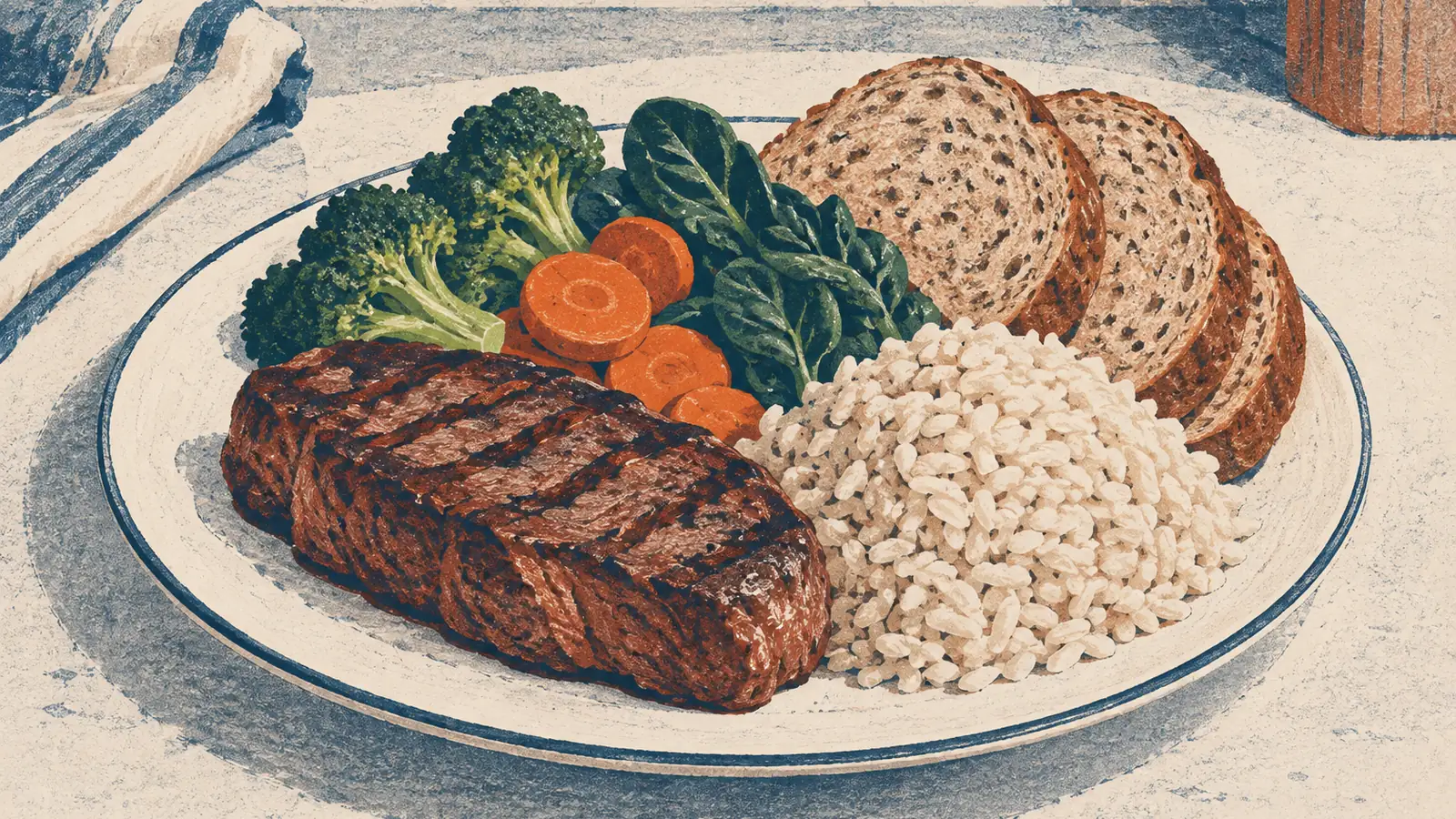
So why would the kept-the-meat, more-carbs plate win? Here’s my best read, and I’ll flag it as interpretation rather than something the trial nailed down. The winning omnivorous high-carb plate ran about 53 percent of its energy as carbohydrate and roughly 28 percent as fat. Pull dietary fat down that far and there’s simply less saturated fat pouring in for circulating cholesterol to work with, so the lipid markers ease. Give an older body carbohydrate it can actually burn instead of a steady fat load, and in this group the insulin and inflammation numbers settled rather than climbed. The liver and gut are doing the quiet accounting, and that 20-marker score is just tallying the receipts. The surprise, for me, was that the winner wasn’t the ascetic plate. It wasn’t the diet that cut a whole food group. It was the balanced, almost boring, carbohydrate-forward omnivore plate, while the fashionable high-fat version was the single arm that flatlined.
| Measure | Value |
|---|---|
| carbohydrate | 53% |
I don’t want to oversell a four-week study, so here’s its ceiling, honestly. Twenty-eight days is long enough to move blood markers and nowhere near long enough to prove anyone dodged a heart attack or lived longer. Associate Professor Alistair Senior, who supervised the work, said as much: “Longer-term dietary changes are needed to assess whether dietary changes alter the risk of age-related diseases.” A hundred and four people is a real trial, but a small one. Whether the same shift helps a 40-year-old, holds past a month, or actually bends disease risk is all still open.
And there’s a reason a study like this belongs somewhere skeptical of the usual machinery. Nobody can patent “eat a little less fat, a little more carbohydrate, and keep some plants on the plate.” There’s no molecule to license, no injectable, no monthly subscription. The trial was paid for by the University of Sydney, its Charles Perkins Centre, and a bequest from an emeritus professor, George Palmer, with no drug company anywhere in the funding line. Which is exactly why it’ll flare across the wellness press for a week and then vanish, while the anti-aging pill of the month gets a press tour and a valuation. The unglamorous fix that works on a grocery budget almost never gets the marketing budget.
So what would I do with this? I wouldn’t read “reversed biological age” and panic-buy a thing. But a lot of my readers have someone 65 to 75 at the kitchen table, and if that’s your house, the actionable version costs nothing: ease the saturated fat down, let more of the plate be real carbohydrate and plants, and no, you don’t have to give up meat to do it. I already eat carbohydrate-forward, and I’m not touching my bread on the strength of one month of data. But if I were sitting across from my own doctor at that age, I’d ask to run the same cheap panel this study ran, before and after a real month of eating this way, and I’d watch my own insulin and CRP instead of waiting for a guideline to catch up.
Sources
- Aging Cell – Andrews et al., diet and biological age randomized controlled feeding trial (2026), DOI 10.1111/acel.70507
- University of Sydney – “Dietary changes in older people can improve ‘biological age’” (2026-05-12)
- ScienceDaily – “Scientists reversed biological age in older adults in just 4 weeks” (2026-09-15)
- SciTechDaily – “Just 4 Weeks of Simple Diet Changes Reversed Signs of Aging in Older Adults” (2026)