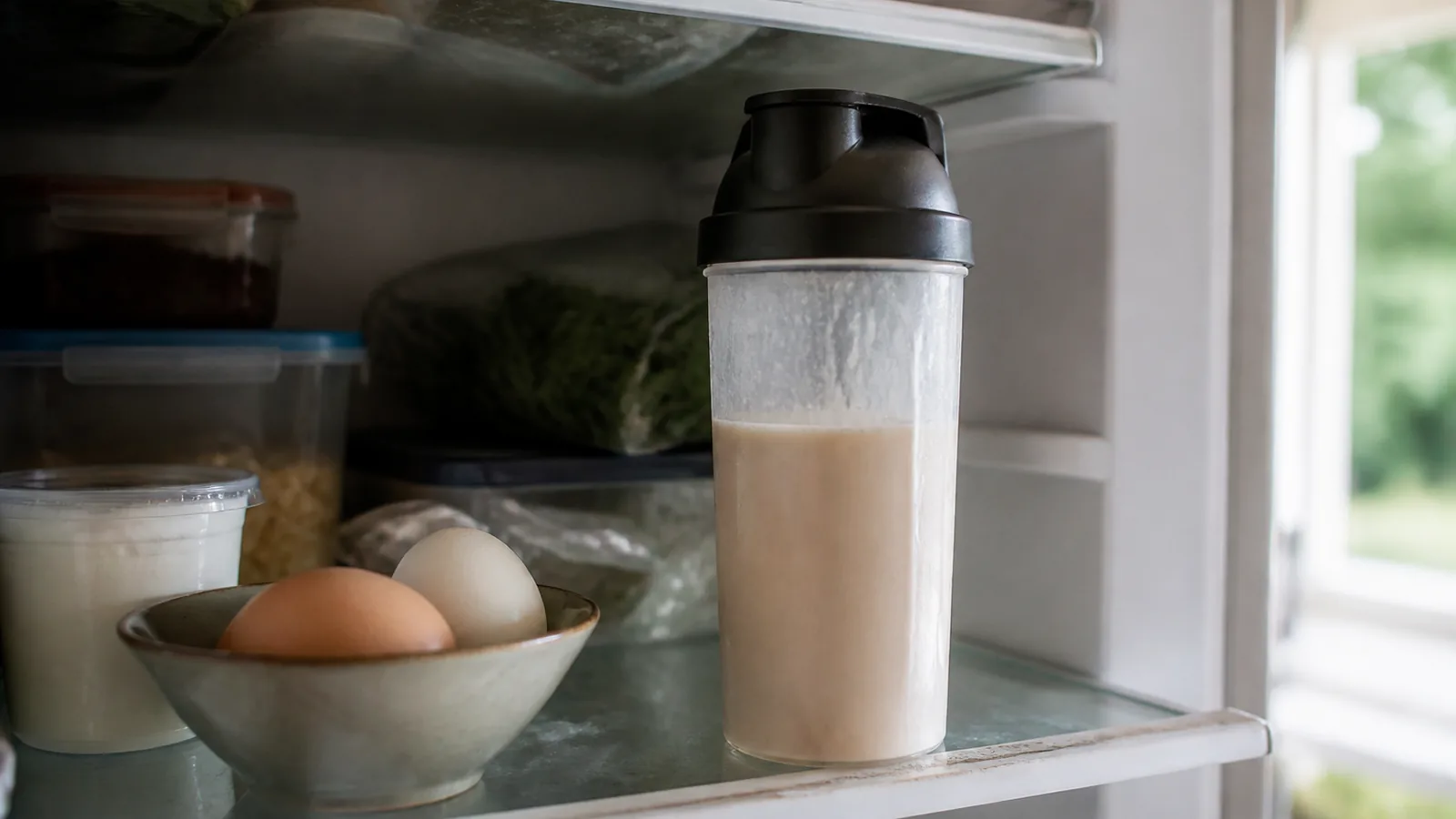
I have a protein shake in my fridge right now, and until this week I would have told you, with total confidence, that it was one of the least complicated good decisions in my kitchen. More protein, more muscle, better aging. Everyone with a gym membership agrees. Then I read that in the same year US authorities moved to nearly double the protein they recommend, a review of more than 350 studies quietly argued that for people who mostly sit, the extra may be speeding up the aging they are paying good money to outrun. When the official number and the biology point in opposite directions, I want to know which one is selling something.
On July 31, Bailey Knopf and Dudley Lamming of the University of Wisconsin–Madison published a sweeping analysis in Cell Press Blue titled “The hallmarks of protein and amino acid restriction in aging and longevity.” They pulled together more than 350 papers on what happens when animals, insects, and people eat less protein, not more. The pattern is consistent enough to be uncomfortable: lower protein intake tracks with better metabolism, calmer inflammation, less cellular damage, and the activation of the same nutrient-sensing pathways that keep surfacing in longevity research.
Now hold that next to the calendar. This is the same year US authorities moved to raise recommended protein to 1.2 to 1.6 grams per kilogram of body weight, nearly double the 0.8-gram baseline that anchored the guidelines for decades. We got told to eat more, and the whole market leaned in: the protein bars, the fortified pancake mix, the 30-gram bottled shakes stacked by the register. Meanwhile a lab funded by the National Institute on Aging laid out the mechanistic case that most sedentary people are eating well past the point where more protein does them any favors.
So let me chase the biology, because this is where it gets genuinely strange. The molecule doing a lot of the work is a hormone called FGF21, fibroblast growth factor 21. When protein intake drops below a certain level, the liver senses the shortfall and pours out more FGF21, and that hormone goes on to raise energy expenditure, sharpen blood-sugar control, and turn down inflammation. Wait, why would your body reward you for eating less of the nutrient it supposedly needs most? That is the question the review keeps circling. The answer is that your cells are not counting grams of protein, they are reading amino acids as a signal, and a few specific ones do most of the talking. Methionine, isoleucine, and valine sit at the center. Load up on them and you flip on the growth machinery, the mTOR pathway that tells a cell to build, divide, and store. Great when you are twenty and rebuilding a torn muscle. Less great when it runs hot for decades in a body that mostly sits at a desk. In the mouse work the review leans on, animals with elevated FGF21 simply lived longer, and the effect ran stronger in males.
It is a beautiful mechanism, and I want to be honest about what it is not. This is a narrative review, not a systematic one, and two British scientists said so out loud when the paper landed. Kevin McConway, an emeritus professor of applied statistics, noted that the authors “don’t explain how they chose the papers to review, and they don’t use statistical methods to combine the findings.” Paul Greenhaff, who studies muscle metabolism at Nottingham, was blunter: the question of whether protein restriction helps healthy aging and longevity “has not been addressed in humans.” Rodents and insects, he added, burn through metabolism at rates and body-composition trajectories that do not map cleanly onto a human life. So take this the way it is actually built: not proof that skipping protein makes you live longer, but a well-sourced warning that the protein boom is running ahead of the human data.
And here is the part I did not expect to land on. That same thin-human-data problem cuts against the maximalists just as hard. The push that nearly doubled your recommended intake this year is also standing on animal work and short-term studies, not on decades of human lifespan trials, and it is being marketed as settled. Lamming, for his part, refuses to pretend otherwise. The benefits of protein for muscle in active people, he says, are not in doubt. The trouble is that the amount sedentary people eat today “may have negative health consequences, at least at the population level.” His actual recommendation is not a bigger number. It is a personal one: dose protein to how much you actually move, not to the poster on the gym wall.
There is one group this review is emphatically not talking to, and I do not want a single tired 75-year-old skipping meals over a hormone in a mouse. Older adults lose muscle whether they like it or not, a slide called sarcopenia, and the geriatric-nutrition world has spent years arguing the 0.8-gram floor is too low for them. The PROT-AGE working group sets the target at 1.0 to 1.2 grams per kilogram for healthy seniors, and higher when they are ill, precisely to keep muscle on the frame. Pregnant women and hard-training athletes sit in the same eat-more column. Restriction is a metabolic lever for sedentary, well-fed, middle-aged bodies, not a universal virtue. The one place low protein already has hard clinical footing is kidney disease, where easing the protein load lightens the work on failing filters.
So who benefits from the version where more is always better? The people selling the powder, the bars, and the fortified everything, and the guidance bodies that moved the number up in the very year the mechanistic literature was moving the other way. I am not going to pretend one review settles decades of nutrition science. It does not. But when the recommendation and the biology disagree this sharply, the honest response is not to pick a slogan. It is to notice who profits from each one.
My conclusion follows. I lift twice a week, and I am keeping my protein where it is, because the muscle case for active people is the part of this that really is settled. What I am done doing is treating the number as a virtue to maximize. On the days my body is mostly sitting, I am not adding a scoop to justify it. The shake stays for training days, and on the desk days I would rather let the liver do its quiet, ancient math and leave the protein alone.
Sources
- Cell Press Blue – Knopf & Lamming, “The hallmarks of protein and amino acid restriction in aging and longevity” (2026)
- ScienceDaily – “Eating less protein could slow aging, major review finds” (2026)
- EurekAlert – University of Wisconsin release with Lamming quotes and funding (2026)
- Science Media Centre – expert reaction (Greenhaff, McConway) to the protein-restriction review
- Journal of the American Medical Directors Association – PROT-AGE position paper on protein intake in older people
- JAMA – “Eating Less Protein May Improve Outcomes for Patients With Kidney Disease” (2026)