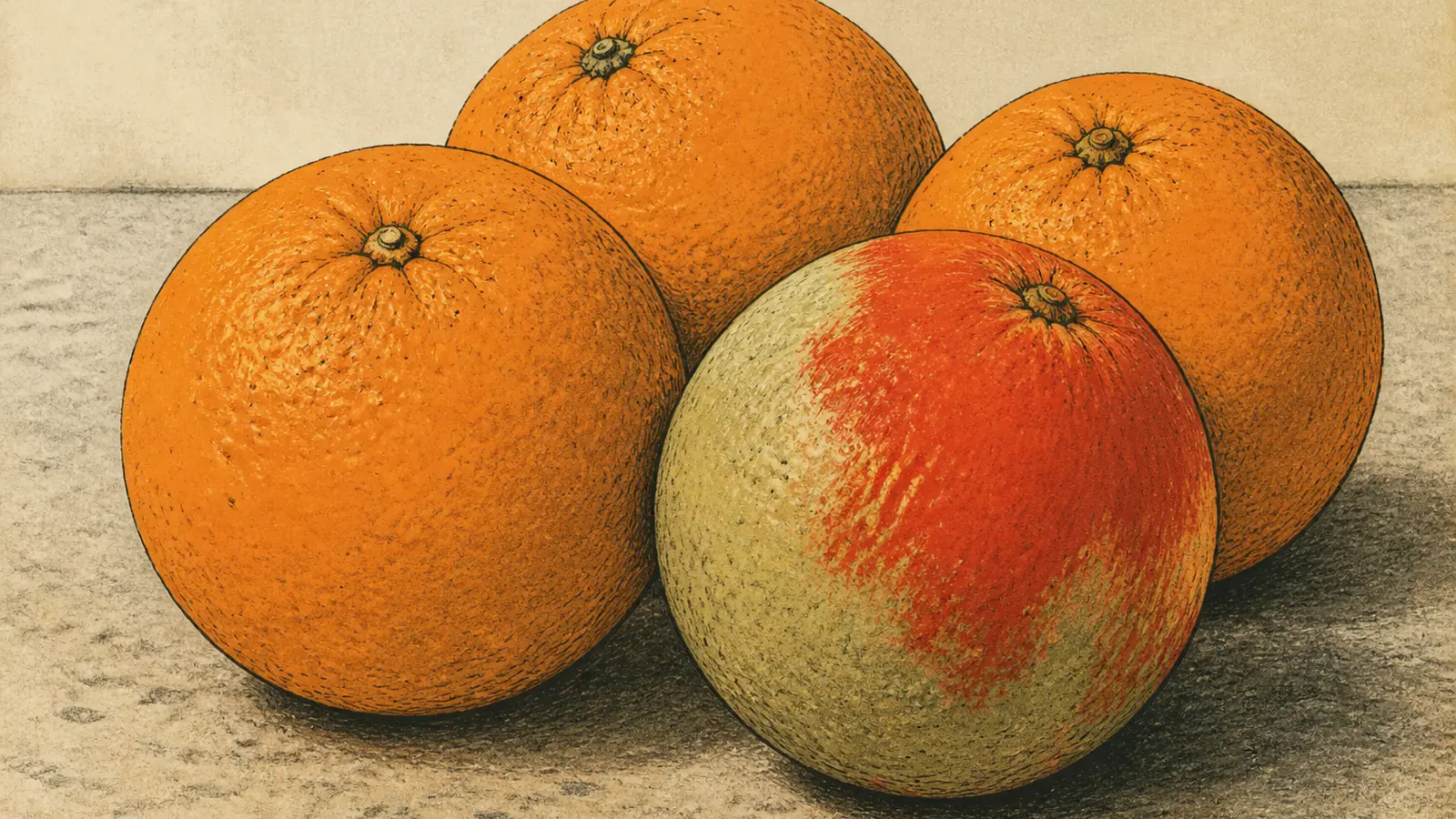
Every winter for the better part of seventy years, Florida shipped oranges that were the wrong color. Fruit that ripens in a warm climate often stays green or blotchy on the outside while the inside turns sweet and orange, and a green orange does not sell. So beginning in 1959, growers were allowed to fix the optics with a chemical: Citrus Red No. 2, a petroleum-derived azo dye painted onto the peel of mature oranges at up to two milligrams per kilogram of fruit. It made pale oranges look the way shoppers expected. It is also, by the International Agency for Research on Cancer’s reading, a Group 2B agent, possibly carcinogenic to humans, because feeding it to rats and mice produced hyperplasia and bladder tumors. The European Union never allowed it. The United States did, for sixty-seven years.
On July 22 the FDA finally moved, and it moved on Orange B in the same breath. The agency issued a final order revoking Orange B, a petroleum dye once cleared to color the casings of hot dogs and sausages, and separately proposed revoking Citrus Red No. 2. One is done; the other is a proposal with a comment window. Both come under the “Make America Healthy Again” banner, and getting synthetic petroleum colorants out of the food supply is a direction this publication has argued for. So say the good part plainly, then read the fine print.
The fine print is that neither dye is in anyone’s food. Orange B was last certified for use in 1978, during the Carter administration; the sausage industry walked away from it and never came back. Citrus Red No. 2, the FDA tentatively concluded, has likewise been dropped by growers. In the agency’s own accounting, both authorizations were “abandoned by industry.” This is housekeeping, and to their credit the officials did not dress it up as anything more. Acting FDA Commissioner Kyle Diamantas said the actions remove “outdated and unnecessary authorizations under President Trump’s regulatory reform agenda,” which is an honest description of clearing dead rules off the books. Nobody claimed a single American will eat less dye because of it.
The question is what the housekeeping stands in for. Back in April 2025, Secretary Robert F. Kennedy Jr. and Commissioner Marty Makary announced a plan to phase out the six petroleum dyes that are actually in the American diet, the ones coloring the cereal and the sports drinks and the candy: Red 40, Yellow 5, Yellow 6, Blue 1, Blue 2, and Green 3, with a target of end-2026. Those are the molecules a child actually swallows. But the mechanism underneath the plan was soft. It rested on voluntary industry cooperation, what Kennedy called “an understanding” with major manufacturers, with no regulatory or statutory pathway named and, at the time, no company publicly signed on. Makary’s own framing was “let’s start in a friendly way and see if we can do this without any statutory or regulatory changes.” A handshake is not a regulation. It can be un-shaken.
So line the two events up, because together they tell you how this works. The dyes the FDA can retire by fiat are the ones nobody uses; a final order on Orange B and a proposed order on Citrus Red No. 2 cost the food industry exactly nothing. The dyes genuinely in the food supply sit on a voluntary schedule with no enforcement teeth and no signatures. That sequencing is not an accident. Removing Orange B costs a manufacturer nothing, which is why it can be done with a stroke. Removing Red 40 costs reformulation money, which is why it has been left to a pledge.
None of that makes the goal wrong. It makes the test clear, and the test has a date on it. The public-comment window on Citrus Red No. 2 (docket FDA-2026-N-6304) closes August 24, and the Orange B order takes effect 45 days after it hits the Federal Register, and each will generate a press release about progress. Neither is the number to watch. The number that will tell you whether MAHA delivered on food dyes is whether, by the end of 2026, the six real dyes come out of the products your kids eat with a binding rule behind them and not a friendly understanding. If they do, the credit is earned and this publication will say so. If the calendar turns to 2027 and the next announcement is one more batch of authorizations nobody was using, the honest goal got traded for the easy one, and the manufacturers who never signed will have told you why.
Sources
- FDA – Takes Further Steps to Remove Outdated Authorizations for Color Additives in Food (July 22, 2026)
- Quality Assurance & Food Safety – FDA Revokes Orange B, Proposes Ending Citrus Red No. 2 Use
- WFTV – FDA revokes Orange B authorization used in sausage casings (last certified 1978)
- FDA – HHS, FDA to Phase Out Petroleum-Based Synthetic Dyes in the Nation’s Food Supply (April 2025)
- Snopes – RFK Jr.’s dye phase-out is voluntary, not an outright ban
- IARC (INCHEM) – Citrus Red No. 2 monograph: Group 2B, bladder tumors in rats and mice
- WHO/FAO JECFA – Citrus Red No. 2 toxicological record
- Wikipedia – Citrus Red 2 (history since 1959, 2 mg/kg peel limit, EU status)
- CNN – FDA plan to phase out petroleum-based food dyes (April 22, 2025)