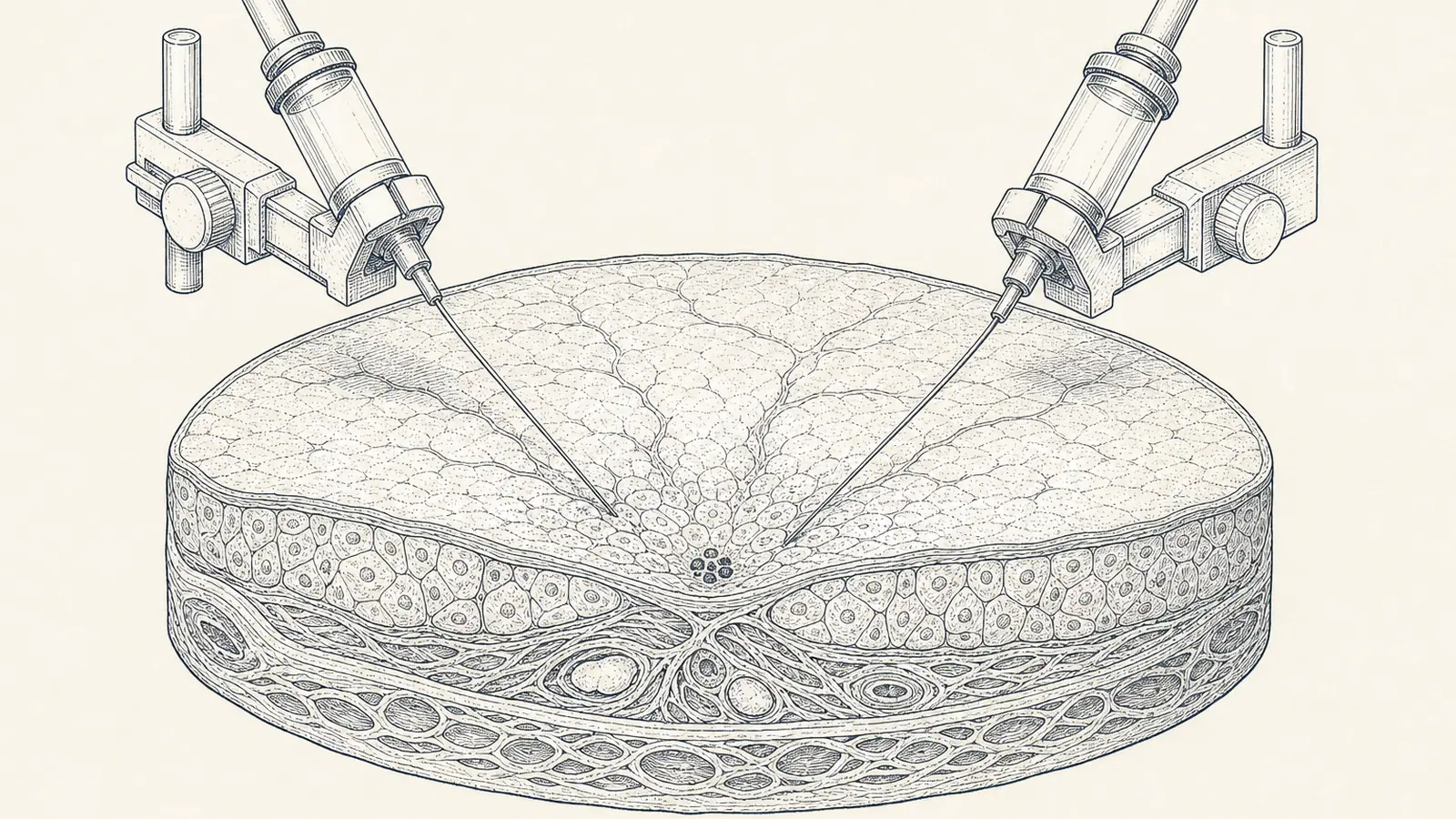
Robert Noble does his oncology on a whiteboard. A senior lecturer in the mathematics department at City St George’s, University of London, he spent the better part of a study on a single question: when, exactly, do you hit a shrinking tumor with a second drug? The answer his team published this month in GENETICS is that you wait for the cell population to reach its lowest ebb, the moment the first treatment has done all the killing it is going to do and the survivors are still too few and too scattered to regroup. Land the second strike then, the model says, and you can drive the whole population to extinction before drug resistance ever takes hold. There is one catch, and it is a large one. The tumors this works on are too small for any scanner to have found.
It is a genuinely elegant idea, and the press release wrapped around it, headlined “a new cancer strategy could stop tumors before resistance takes hold,” is doing more work than the paper underneath it can pay for.
The idea is worth understanding on its own terms. Cancer kills, in the end, because it evolves. You give a drug, the sensitive cells die, and the few that happen to survive inherit a world with no competition and a clear runway. Biologists call that escape evolutionary rescue, and it is the same process that turns a treatable infection into a resistant one. Noble and his co-authors propose to deny the tumor its runway: collapse the population with a first strike, then hit the survivors with a second, different drug at the nadir, while they are too few to adapt. “Evolutionary approaches have been very successful in other contexts, such as combating antibiotic resistance,” Noble said. The model’s own wrinkle is that a beat after the low point tends to beat a beat before it, because the resistant cells have a little longer to decay before the second drug lands.
Then come the numbers that complicate the headline. In the model, a 95 percent chance of driving the tumor extinct holds only when the starting population is 7 million cells or fewer. Push it past 100 million cells and the best case the math can reach falls below 40 percent, no matter how cleverly you time the switch. Small tumors can be finished with two drugs; larger ones, the authors expect, would need a third strike and probably more.
A tumor you can feel, or see on a scan, runs to a billion cells or so, about a centimeter across, which is roughly the smallest a scanner reliably finds. 7 million cells is more than a hundred times below that line. The regime where two-strike therapy works beautifully is, by the model’s own arithmetic, a tumor no one has diagnosed yet. By the time the disease is large enough to be caught the way real patients are caught, the same math has quietly capped the best case below two in five.
The researchers are honest about all of this, which is more than the press release manages. The GENETICS paper is a mathematical and computational study; it uses no patient data, treats no one, and declares no conflicts of interest and no industry funding. What it offers is a prediction, sharply specified and still waiting for a patient.
That wait matters, because a close cousin of this idea has already been tested in people. Adaptive therapy, developed at Moffitt Cancer Center by Robert Gatenby’s group, plays the opposite hand: instead of chasing eradication it keeps a reservoir of drug-sensitive cells alive to hold the resistant ones in check, cycling the drug on and off. In a pilot trial of metastatic castration-resistant prostate cancer published in eLife, 17 men on intermittent abiraterone reached a median time to progression of 33.5 months, against 14.3 months for men on continuous standard dosing. Overall survival ran 58.5 months against 31.3. Adaptive therapy has a survival curve. Two-strike therapy has a spreadsheet.
The two strategies are not the same bet. Containment, the Moffitt approach, aims to manage the disease for years. Eradication, Noble’s approach, aims to end it outright, the more thrilling promise and the far harder one, since it demands you kill the last resistant cell before it multiplies. What they share is the insight worth sitting with: the reigning standard of care, maximum tolerated dose until the disease progresses, keeps patients on drug continuously and selects hard for the very resistance that eventually kills them. It is hard not to notice that continuous dosing is also the arrangement that sells the most drug. The adaptive pilot used less of it and bought more than twice the time. That is not a result the maximum-dose paradigm was built to want.
Three small trials are now testing evolutionary schedules in soft-tissue, prostate, and breast cancer, with more in development. They are testing the family of ideas, the on-off timing and the sequencing, not Noble’s exact optimal-switch protocol, which for now exists only in simulation. When one of them reports, the number worth reading will not be a relative shrinkage or a striking headline. It will be the size of the tumors they managed to enroll, and whether the survivors, cut loose from their first drug, sat still long enough for the second one to land.
For now, the cleanest cures in this story keep happening where they have always been easiest to arrange: inside the model, on tumors too small for anyone to have found.
Sources
- GENETICS – Noble et al., “Preventing evolutionary rescue in cancer using two-strike therapy” (2026; DOI 10.1093/genetics/iyaf255)
- eLife – evolution-based adaptive abiraterone in metastatic castration-resistant prostate cancer, pilot trial results (2022)
- ScienceDaily – “New cancer strategy could stop tumors before resistance takes hold” (2026)