I have read the calorie line on the side of a box more times than I’d like to admit, and it never once occurred to me to ask who else was eating with me.
Seventeen adults made me ask. Researchers at Arizona State and AdventHealth in Orlando fed each of them two diets matched for calories and macronutrients, one built from whole foods and one highly processed, and then measured everything that came out the other end. On the whole-food diet, the one loaded with fiber for gut microbes to eat, people absorbed about 116 calories a day less than on the processed one. More food for the bugs, less energy for the person. That trial ran in Nature Communications in 2023, and this week the same group published a model in PLOS One that tries to account for where those calories went.
Same plate on paper, different body at the end
The trial was about as controlled as nutrition science gets. Eight women and nine men, average age about 31 and average BMI about 25, ate each diet for roughly three weeks in random order, with at least two weeks off in between, and spent the last 12 days of each stretch in a metabolic ward where every bite, breath and bathroom trip was measured. Both diets were tailored to each person’s energy needs. That’s also a small, young, healthy group with nobody living with obesity or diabetes in it, which is exactly the crowd a “fewer calories” headline gets pitched to, and because the diets looked nothing alike, nobody could be blinded.
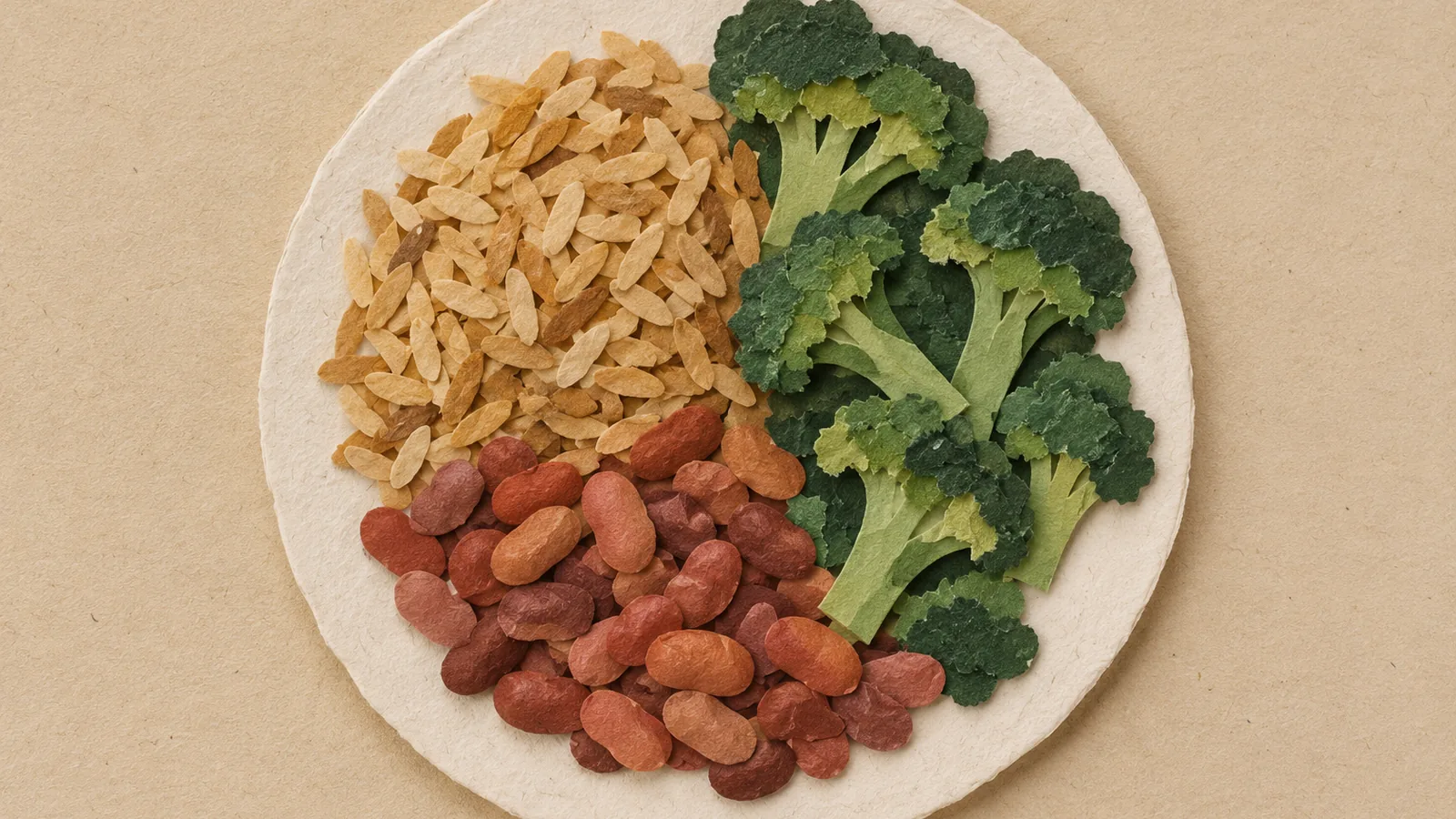
What differed was what the food actually was. The “microbiome enhancer diet” was whole foods, high in fiber and resistant starch, with bigger food particles and far less processing. The Western diet was processed and low in both.
On the Western diet, people’s bodies kept 95.4 percent of the calories they ate. On the whole-food diet they kept 89.5 percent, and the difference, about 116 calories a day on average, went out in their stool, which carried more than twice as much energy as it did on the processed menu. The NIH’s own write-up landed on the same number.
What stopped me was how differently people responded. On the Western diet everyone sat in a tight band, between 94.1 and 97.0 percent. On the whole-food diet the spread ran from 84.2 to 96.1 percent, so one person was losing roughly one calorie in six while another kept nearly as much as anyone did on the processed food. Same menu, same ward, very different bodies.
on the whole-food diet
- Lower bound
- 84.2
- Upper bound
- 96.1
Wait, why would feeding the bugs cost you calories?
This is where I expected the logic to fall apart. Colon microbes ferment fiber into short-chain fatty acids, which your colon wall soaks up and burns for fuel. So more fiber should mean more fermentation and more calories flowing back to you, not fewer.
The new model, called DAMM (digestion, absorption and microbial metabolism), follows food down the whole tract and keeps two sets of books: what you pull out in the stomach and small intestine, and what the microbes in your colon pull out of your leftovers. By its estimate, the fatty acids microbes hand back are worth roughly 140 calories a day on average, about 7.4 percent of the energy people absorbed. And yes, the microbes did pay out more on the whole-food diet: 51.9 units of fatty acids a day against 33.8 on the Western diet, in the model’s own energy units.
So why do people still come out behind? Because the microbes don’t just pay rent, they eat at the table and multiply. The 2023 team’s model put the microbial biomass leaving in stool at 19.6 units a day on the whole-food diet against 9.4 on the Western one, more than double, and microbes made up over a quarter of the energy in stool on both diets. In that accounting, the bugs keep a bigger slice of a bigger meal to build more of themselves, and the new growth leaves with the waste. Fiber is also just harder to break down, and the trial’s authors say outright they can’t separate how much of the gap came from the microbes and how much from the food itself. Still, once I stopped picturing my gut bacteria as a digestive aid on my payroll and started picturing a growing population with its own budget, the paradox stopped bothering me.
Food structure has an older, cleaner demonstration. In a 2012 USDA feeding study, 18 adults ate controlled diets with and without almonds, and a 28-gram serving delivered about 129 calories against the 168 to 170 that standard factors predict, a 32 percent overestimate, because intact cell walls keep some of the fat locked away from you. Only whole almonds were tested, and the authors suspected almond butter wouldn’t come in as low. That study was funded by the USDA and the Almond Board of California, an industry group with an obvious interest in a lower number, though the paper says the board had no role in the design or analysis.
The century-old arithmetic undercounts the processed plate
The calorie counts behind most nutrition labels still rest on the Atwater factors, fixed per-gram values for protein, fat and carbohydrate worked out more than a century ago. The PLOS One team ran Atwater arithmetic on the trial menus and checked it, and DAMM, against what people actually absorbed. DAMM explained 95.6 percent of the variation; Atwater explained 88.5 percent. On average, DAMM came within 2.5 units a day, while Atwater ran 22.3 units low, and its misses went in one direction: it underestimated what bodies absorbed, with a statistically significant bias only on the processed Western diet (Davis et al.).
| Group | Value (percent) |
|---|---|
| DAMM model | 95.6 |
| Atwater factors | 88.5 |
Put that beside the almonds. Atwater undercounted the energy people pulled from the processed menu in this trial and overcounted what they got from whole almonds in the USDA one. Nobody tested real package labels here, and 17 people is a thin base for a rule. But if both findings hold up, a factory calorie is worth more to your body than the standard math assumes and a calorie from intact food is worth less, and that should bother anyone who has heard a snack company insist that a calorie is a calorie.
The model has seams of its own. When the team seeded it with the methane-making microbes counted in stool, its methane predictions for the methane producers missed by at least a factor of ten. The fix was to multiply that starting microbe count by 2.58, a value picked by searching for the best fit on the same data, on the theory that most of these microbes live in a film on the gut wall rather than washing out. Maybe so, but a knob tuned on the data it’s graded against flatters the result, and the authors say plainly that DAMM hasn’t been tested in people with metabolic disease and isn’t a tool for prescribing diets.
Hunger stayed flat
The obvious worry with a diet that leaks calories is that appetite claws them back. Here it didn’t, at least not measurably: hunger, fullness and how much people ate at a free buffet showed no difference between the two diets (Corbin et al.). The researchers had hoped the whole-food diet would actually curb appetite, and it didn’t do that either, but a draw is the result you want when you’re absorbing less. The hormones leaned the helpful way, with pancreatic polypeptide, a satiety signal, about 1.4-fold higher, and the body’s own GLP-1, the gut hormone today’s weight-loss injections imitate, higher after lunch.
Over the ward stay people lost about 626 grams on the whole-food diet versus 134 grams on the Western diet. The authors call that clinically insignificant over a few weeks, and they’re right; this isn’t a weight-loss protocol. Whether the absorption gap holds, and appetite stays put, over months is untested. If it does, roughly a hundred calories a day that costs nothing and needs no prescription is a lever worth having.
“Digestion is not just a human process,” Rosa Krajmalnik-Brown, an ASU microbiologist and one of the model paper’s corresponding authors, said in the university’s release. The question I can’t shake is the one that 84-to-96 spread raises: what separates the people who lose a big cut from the people who keep nearly everything, and can you move yourself from one group to the other?
I’m not going to recalculate labels at the kitchen counter, but I’m reaching for whole almonds over the jar of almond butter, and I’ve stopped treating a calorie from a box and a calorie from a bean as the same number.
Sources
- Davis et al., PLOS One (2026): DAMM model of digestion, absorption and microbial metabolism
- Corbin et al., Nature Communications (2023): randomized crossover feeding trial
- Novotny, Gebauer and Baer, American Journal of Clinical Nutrition (2012): measured energy of almonds
- NIDDK: Complex interplay of diet and gut microbiome influences human health (2023)
- ScienceDaily / Arizona State University: Your gut bacteria could be changing how many calories you absorb (2026)