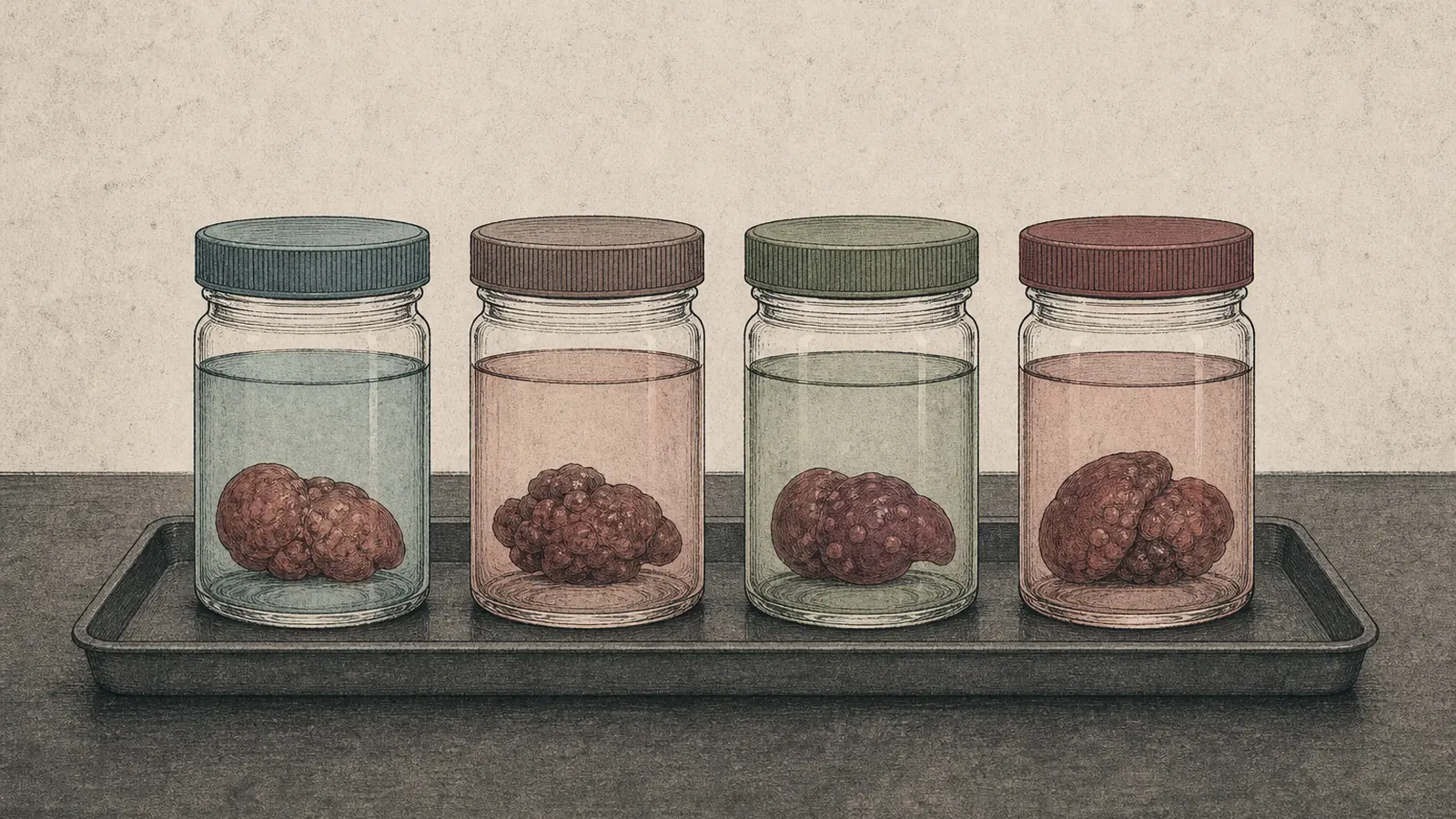
Every mouse got the same needle. One dose of diethylnitrosamine, a carcinogen found in tobacco smoke and processed foods, delivered at fifteen days of life to four strains of laboratory mice chosen to span the kind of genetic variation you would find across a human population. Same compound, same dose, same day, same controlled environment for the rest of their lives. If cancer were simply damage in and tumor out, the animals should have arrived at more or less the same place.
They did not. When Sarah Aitken, now at Yale, and Duncan Odom, now at the German Cancer Research Center, and their collaborators across Cambridge and Edinburgh sequenced the 581 liver tumors that grew out of that experiment, the story on the table was not one cancer repeated 581 times. It was four different cancers, sorted by nothing the mice had done and everything they had inherited.
The work, published July 27 in Nature, is the kind of controlled experiment you cannot run in people and rarely get this cleanly in animals. Human cancer studies are a fog of confounders: this person smoked, that one drank, a third lived downwind of a refinery, and untangling inherited risk from a lifetime of exposure is mostly guesswork. Strip all of that away, hold the carcinogen and the environment fixed, vary only the germline, and you get to ask the question directly. What does inherited background actually do to a tumor?
Quite a lot, as it turns out, and in a way the headlines flattened. Nearly every tumor, across all four strains, ended up activating the same growth-driving machinery, the MAPK pathway, the workhorse circuit that a large fraction of human cancers hijack. That is the convergence the press releases led with: same destination, whatever the starting point. The more telling finding is what happened on the way there. The specific driver mutation each tumor reached for, and what that mutation then did to the rest of the cell, depended on the animal’s inherited genome. In Aitken’s words, the same mutation could have the opposite effect in different individuals. In one background it pushed the tumor one direction; in another, the identical genetic change pushed it the other way.
Some backgrounds also showed a striking tendency toward whole-genome duplication, the wholesale doubling of every chromosome in the cell, an event long linked to more aggressive, harder-to-treat tumors. That, too, tracked with inheritance rather than exposure. The dose was a constant. The genome was the variable. The genome won.
It is worth being precise about what this is, because the gap between the claim and the experiment is where the spin lives. The Cambridge announcement reached for smoking and UV rays in its headline; the actual work was a controlled mouse-liver study with a single carcinogen and four inbred strains. The mechanism the mice revealed is solid and hard to argue with. The leap to human prevention is a hypothesis, and the authors are honest enough to label it as one.
To their credit, they label it pointedly. If inherited background shapes both who gets cancer and how the tumor evolves once it starts, then prevention and screening will have to reckon with genetics in a way they currently don’t. Aitken was blunt about the status quo: we target particular groups based on age or particular exposures, she said, whereas we don’t consider people’s genetics in the equation. That is the quiet indictment sitting underneath a study that is otherwise all elegant molecular biology. The entire apparatus of population screening, the age cutoffs and the risk-factor checklists that decide who gets the colonoscopy and who gets told to come back in ten years, is built on the two variables this experiment deliberately held constant, and blind to the one it allowed to vary.
There is a familiar pattern here for anyone who has watched precision medicine get sold. The field has spent two decades and a great deal of money promising treatment tailored to the individual tumor, cataloguing driver mutations as if a mutation meant the same thing in every patient who carried it. This experiment says it does not. The same lesion, read against a different inherited background, can behave like a different lesion, which is an awkward result for a diagnostic industry that sells the mutation as the answer and rarely asks whose genome it landed in. Aitken went further, noting that how people respond to cancer drugs is likely to differ depending on their inherited genetics, so diagnostics and treatments may need to be tailored accordingly. The mutation was supposed to be the thing that made oncology personal. It turns out the mutation is only half the sentence, and the industry has been selling the half it can bill for.
The authors are careful about the limits of their own reach. They cannot yet say which pieces of the inherited background are doing the work, because millions of genetic differences interact at once and the experiment points at the forest without naming the trees. That is the next decade of labor, and it is genuinely hard. What the 581 tumors establish is narrower and firmer: inheritance is not a passive backdrop to cancer but an active hand on the wheel, steering which mutations appear and what they do once they arrive.
Odom has spent years arguing that genetic background shapes not just whether cancer starts but how it unfolds. What he could show for the first time, he said, was the extent to which inherited genetics influences both the mutation processes and the pathways that lead to a tumor. In 581 mouse livers that all got the same dose on the same day, he finally has the receipts.
Sources
- Nature – “Genetic background sets the trajectory of experimental cancer evolution” (2026)
- University of Cambridge – Study reveals why DNA damage may cause cancer in some people but not others (2026)
- Yale News – Genetics influence how cancer arises and how it evolves (2026)
- ScienceDaily – Why the same DNA damage causes cancer in some people but not others (2026)