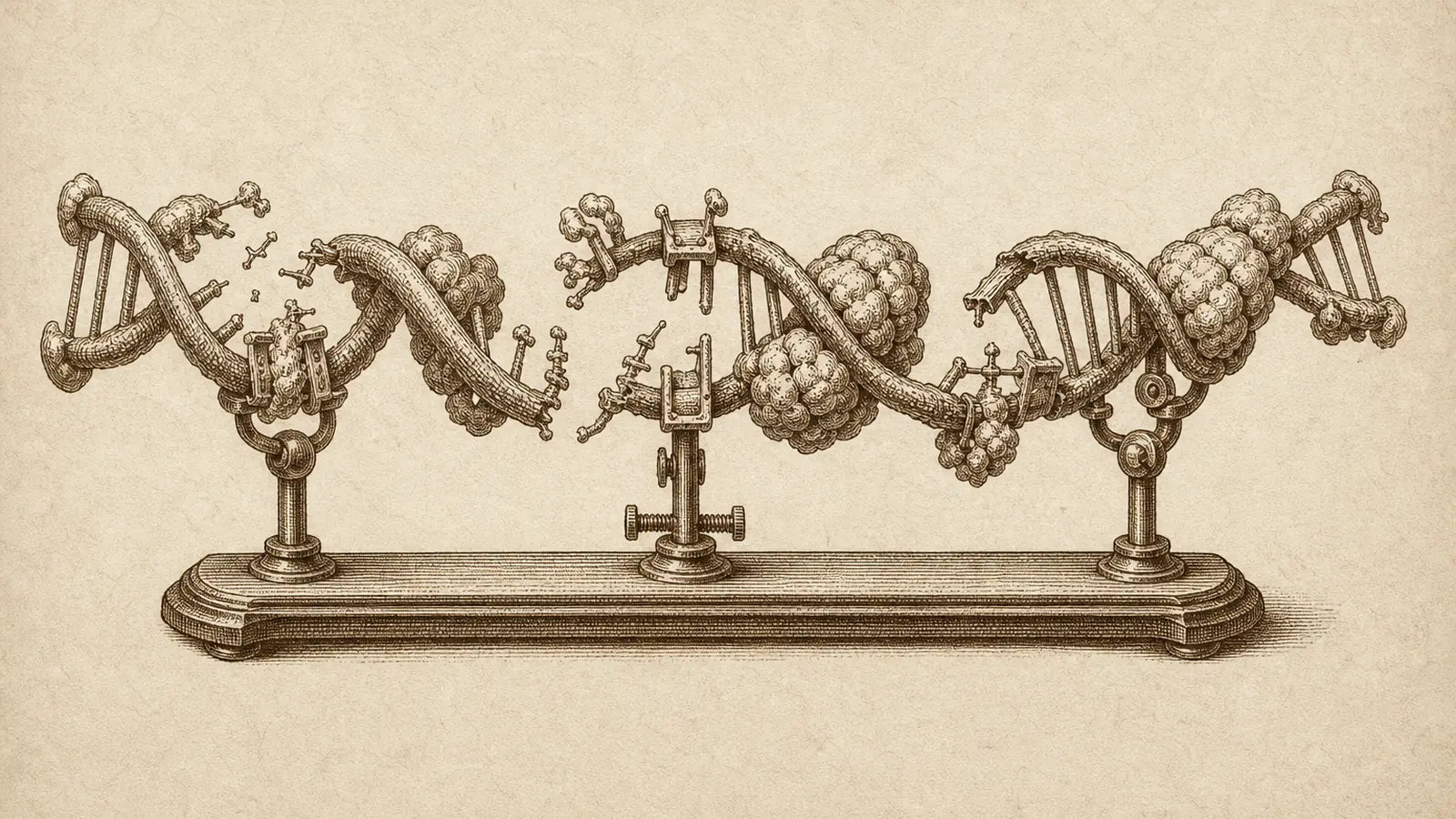
Osama Hidmi spent the better part of his doctorate watching cancer cells hurt themselves, and the punchline is that they can’t stop. The same machinery a tumor uses to grow is the machinery that keeps snapping its own DNA, and the botched patch-up jobs afterward are a plausible source of the mutations it reaches for next. Working under Prof. Rami Aqeilan at the Hebrew University of Jerusalem’s Lautenberg Center, Hidmi built a genome-wide map of the exact spots where tumor DNA breaks in two, then went looking for what those spots had in common. The answer was uncomfortable in the way good biology often is. The places cancer breaks are the same places it works hardest to grow.
That is the finding, published in Science Advances under a title only a molecular biologist could love, “Superenhancers shape the landscape and repair dynamics of transcription-associated DNA breaks in cancer.” Strip the jargon and it reads like a design flaw. To grow without limit, a cancer cell leans on super-enhancers, stretches of regulatory DNA that act like a stuck accelerator on the genes that drive proliferation. Those genes get read so fast and so often that the physical act of transcription puts the double helix under strain. The strain snaps both strands. The cell repairs the break, then reads the gene again, snaps it again, repairs it again. Every repair is a chance to make a small mistake, and the mistakes pile up exactly where the machinery is busiest.
To find these breaks, the team used sBLISS, a sensitive method for labeling and sequencing double-strand breaks across the whole genome, and cross-referenced the damage against the super-enhancer landscape. The breaks did not scatter randomly. They clustered inside the highly transcribed, super-enhancer-driven genes, and in breast-cancer cells goosed with estrogen, the hormone that revs those growth genes, the fragility tracked the activity. Cancer’s engine and cancer’s instability are wired to the same switch. That churn of self-inflicted mutation is the raw material a tumor uses to keep evolving, keep adapting, and shrug off the last drug that worked.
It is an elegant piece of cell biology, and it earns a specific kind of attention. This is preclinical work in cultured cancer cells that maps a mechanism: where the breaks happen, how they get repaired, and why the busiest genes are the most fragile. That is a contribution to the genomic-instability question that has sat near the center of cancer research for decades. It is not a treatment, a trial, or evidence about a single human patient. Which is where the press release goes to work. Hidmi’s own summary is careful: because cancer cells depend on these high-stress regions, he notes, “they may also be more vulnerable there.” By the time the finding reached American inboxes, that cautious “may” had been asked to carry a great deal of weight, dressed up as an open door to therapies that “target the very processes tumors rely on to survive.” The paper maps where cancer wounds itself. It does not hand anyone a drug.
There is a smaller tell in the timeline, the kind a veteran of the press-release trade learns to notice. The story that landed on ScienceDaily on August 2 with the sheen of breaking news is not new. The peer-reviewed paper appeared in Science Advances on January 23 and got its first wave of coverage then, under headlines about a “double-edged sword,” with outlets describing the same breaks and the same error-prone repair the summer rerun would describe again. What arrived this week is that rerun, the same paper pushed back out more than six months after the science was settled. The work did not change. The news cycle simply came back around for another pass.
None of that is a knock on the lab. Aqeilan’s group has been circling this idea for a while, arguing in a companion review that cancer’s “transcriptional addiction” is itself a driver of genome instability, and the Science Advances paper is the receipts for that argument. It was funded by an Israel Science Foundation grant, no. 1056/21, the kind of unglamorous public money that pays for mapping experiments nobody will license next quarter. The scientists said what they found and hedged what they hadn’t. The distance between their hedges and the “opens the door” framing is the distance between the work and its marketing, and it is worth keeping straight, because the reader footing the bill for the next “breakthrough” headline is usually the patient hoping one is close.
For now, the honest version is the one Hidmi wrote. Cancer keeps breaking the genome it can’t live without, the repairs keep going slightly wrong, and there is now a detailed atlas of where that happens. Somewhere down the line that atlas may tell a drugmaker where to aim. It has not yet, and the man who drew the map was careful enough to say so, even if the press release that reintroduced it was not.
Sources
- Science Advances – Hidmi, Shatleh, Oster Flayshman, Monin & Aqeilan, “Superenhancers shape the landscape and repair dynamics of transcription-associated DNA breaks in cancer” (Jan 23, 2026)
- Hebrew University of Jerusalem – “Cancer’s Super-Enhancers May Set the Map for DNA Breaks and Repair” (press release)
- News-Medical – “Super-enhancers: Cancer’s double-edged sword of growth and DNA damage” (Jan 22, 2026)
- Medical Xpress – “Super-enhancers in cancer cells trigger DNA breaks and error-prone repair cycles” (Jan 2026)
- ScienceDaily – “Cancer may be breaking its own DNA to keep growing” (Aug 2, 2026 rerun)
- PubMed – Aqeilan group review, “Breaking the script: transcriptional addiction as a driver of genome instability in cancer”
- SciTechDaily – “Cancer’s Deadly Paradox: How Tumors Break Their Own DNA To Keep Growing” (funding and study details)