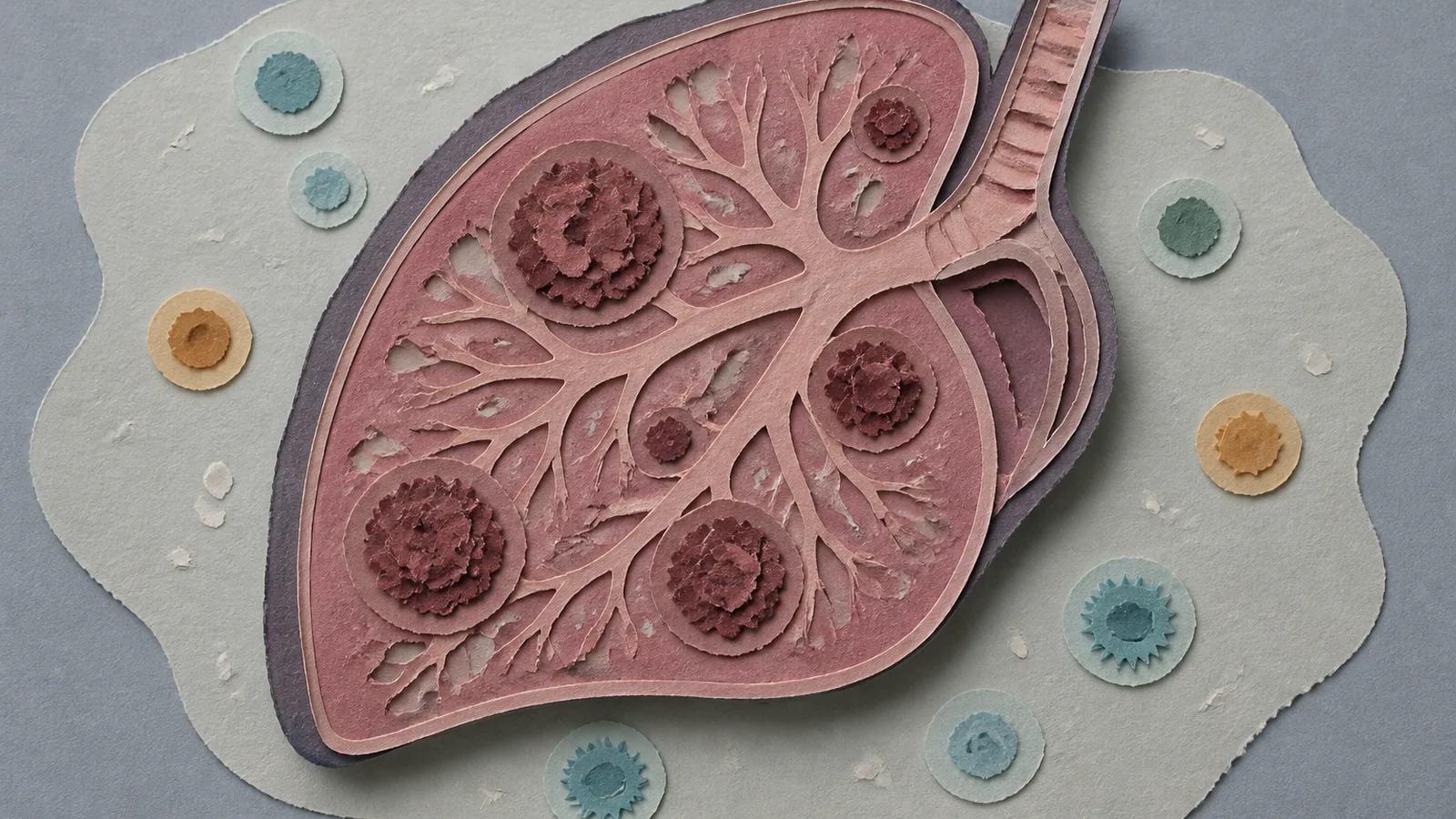
At National Jewish Health in Denver, the oldest respiratory hospital in the country, the study that made the rounds this month began the way most sarcoidosis research does, with a bronchoscope and a wash of saline. Sixteen people whose lungs were studded with granulomas, the tiny inflammatory clumps that define the disease, let a team thread a tube past the vocal cords and rinse a corner of the lung. Fourteen healthy volunteers did the same. What came back up was a cloudy fluid crowded with the immune cells fighting a war no one has fully mapped, and it went into a machine that reads one cell at a time.
Out of those thirty people, the team led by Camille Moore and Lisa Maier pulled roughly 150,000 usable cells and produced the most detailed immune census of the sarcoid lung published to date. It is a genuinely good piece of biology. It is also a map of a disease that, eleven months earlier, had humiliated the most serious attempt yet to drug it, and the two facts are more closely related than the coverage let on.
Start with what the census actually found, because the detail is the whole argument. The lung’s resident scavenger cells, the macrophages, sorted into five distinct states in sarcoidosis, one of them a pro-fibrotic recruited population of exactly the kind you would expect to be laying down scar tissue. The B cells, the antibody makers, had collapsed to a third of their normal share of the immune pool, 2.6 percent of the non-macrophage cells in patients against 7.5 percent in controls, a difference the authors flag at p=0.01. The CD4-positive T cells, by contrast, were lit up, with activation of the TNF, interferon-gamma, and IL-1 pathways, the classic inflammatory triumvirate. And the ordinary chatter between immune cells had gone quiet nearly everywhere, except where those inflamed CD4 cells were doing the talking.
Read plainly, that is a portrait of a disease with several engines running at once, in different cell types, pushing in different directions. It is not obviously the sort of thing you switch off by hitting one receptor. The map does not point at a target; it points at a thicket. Which brings us to the part the press release skips.
The stated hope, repeated in the write-ups, is that this map will support the development of targeted therapies. It is a reasonable hope. It is also the same one that just cost a company most of its market value. In September 2025, aTyr Pharma reported that its Phase 3 EFZO-FIT trial of efzofitimod, the targeted immunomodulator that had gotten furthest in pulmonary sarcoidosis, all the way to a Phase 3 readout, had missed its primary endpoint. The drug reduced patients’ daily steroid dose by an average of 2.79 milligrams against 3.52 for placebo, a gap that landed at P=0.3313, which is statistics for “we cannot tell this apart from nothing.” The immunology behind the drug looked elegant. The trial did not. aTyr’s stock fell about 83 percent in a single session, and efzofitimod joined a longer list of targeted approaches that read well on a mechanism slide and thin in a trial.
Now look at the footnotes, because that is where a veteran learns to look first. The study itself was funded honestly and publicly, with seven NIH R01 grants and the Anne Theodore Foundation’s Breakthrough Sarcoidosis Initiative. But the disclosure section tells you where the field’s leading researchers keep their other coats. Co-senior author Lisa Maier reports funding from Mallinckrodt Pharmaceuticals and Boehringer Ingelheim. A co-author reports consulting fees from aTyr Pharma, the very company whose drug just failed, along with Kinevant and Xentria, two more firms circling this same small disease. Mallinckrodt is worth pausing on, because it makes Acthar Gel, the repository corticotropin injection that is one of only two therapies the FDA has ever approved for sarcoidosis. The other is prednisone.
None of that makes the cell counts wrong. The B cells really did drop, and the sequencer does not care who funds the lab. But it does mean that the people mapping the disease and the companies selling into it are the same tight circle, and a reader told a study “may lead to new therapies” is owed the names of who stands to sell them.
The limits are their own beat in this story, and the authors, to their credit, list them. The healthy volunteers had a median age of 32. The patients were in their fifties, the progressive cases 88 percent male. Because the groups were so small, the team did not adjust for age, sex, smoking, or treatment, which means some of what separates a scarred lung from a healthy one in this data could just as easily be separating a former smoker in his fifties from a 32-year-old who never lit up. Thirty people, washed at one lung, read once. It is a hypothesis machine, not a verdict.
For the person actually living with sarcoidosis, the one short of breath on the stairs, nothing changes this week. The prescription is still prednisone, a steroid older than most of the equipment used to study it, with a side-effect ledger that lengthens the longer you take it. Methotrexate is gaining ground as a steroid-sparing second move. The targeted drugs remain, for now, mostly a record of what has not worked.
National Jewish Health has treated lung disease since the 1890s, and it has just built the finest immune map of this one anyone has made. In the same document, it notes that one of the mapmakers is paid by the company behind one of the only other drugs these patients can be offered when the steroid gives out. The people drawing the map and the people selling the next workaround are, as they have been for years, the same short list of names.
Sources
- Frontiers in Immunology – Moore, Maier et al., single-cell transcriptome signatures in sarcoidosis lung immune populations (2026)
- HCPLive – Efzofitimod fails to meet primary endpoint in Phase 3 pulmonary sarcoidosis trial
- BioPharma Dive – aTyr shares plunge on efzofitimod trial miss
- Sarcoidosis News – FDA-approved treatments for sarcoidosis (prednisone and Acthar Gel)
- Frontiers in Medicine – Sarcoidosis: updates on therapeutic drug trials and novel treatment approaches (2022)
- News-Medical – National Jewish Health study on immune cell changes in sarcoidosis lungs